



Training for Nepal Peak Climbing: A Comprehensive 2026 Preparation Guide
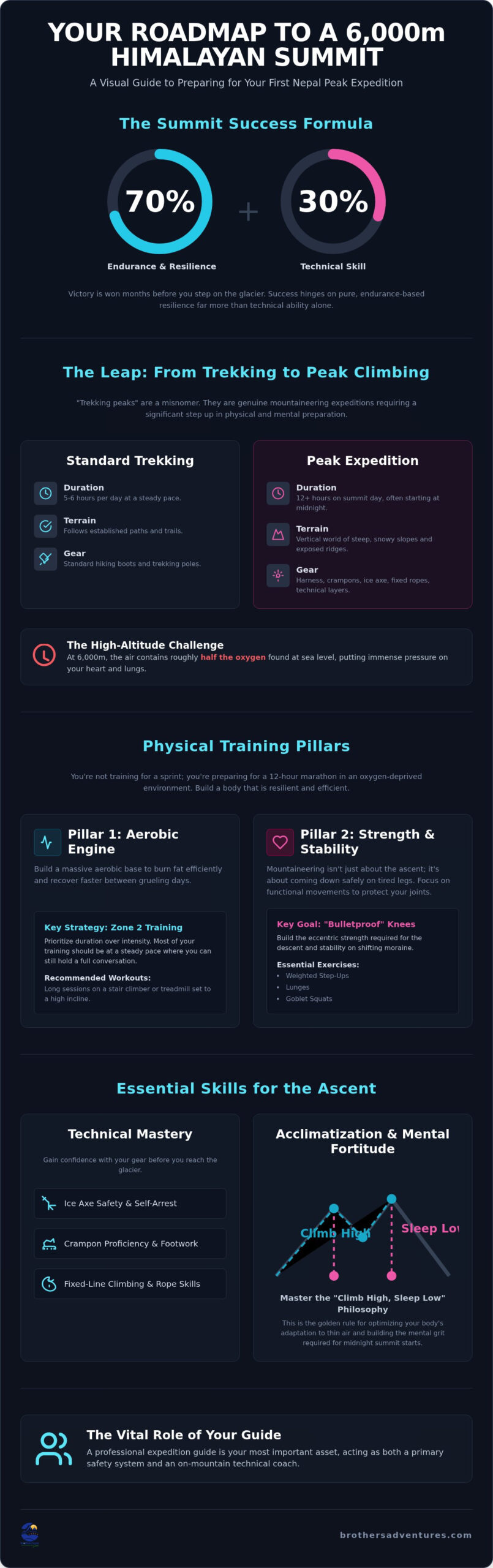
Summit success in the Himalayas is 30% technical skill and 70% pure, endurance-based resilience. While many climbers obsess over the latest gear, the real victory is won months before you even step onto the glacier. It’s completely normal to feel a surge of nerves when you imagine that final, frozen summit push or feel overwhelmed by the jargon surrounding trekking peaks versus full expeditions. You want to ensure your training for Nepal peak climbing is exactly right so you don’t just reach the top, but actually enjoy the breathtaking view when you get there.
This guide is your definitive preparation roadmap for 2026, designed to help you master the physical, technical, and mental grit required for your first 6,000m peak. We’ll break down a structured fitness plan that mirrors the slow, sustained grind of the mountains and clarify the specific technical skills you must practice, from ice axe arrest to fixed-line climbing. By the time you finish reading, you’ll have the clarity to choose the right support team and the confidence to step into the thin air of the Khumbu or Annapurna regions with a smile.
Key Takeaways
- Learn why “trekking peaks” are often a misnomer and how to prepare for the vertical shift from horizontal trails to steep, snowy slopes.
- Discover a specialized physical roadmap for training for Nepal peak climbing that builds the massive aerobic base and core stability needed for high-altitude endurance.
- Gain confidence with technical gear by understanding the fundamental skills of crampon proficiency and ice axe safety before you reach the glacier.
- Master the “climb high, sleep low” philosophy to optimize your acclimatization and develop the mental fortitude required for midnight summit starts.
- Understand the vital role a professional Nepal expedition climbing guide plays as your primary safety asset and on-mountain technical coach.
Understanding the Leap from Trekking to Nepal Peak Climbing
You’ve walked the winding trails of the Khumbu. You’ve gazed up at the jagged, ice-crowned summits from the safety of a tea house. Now, the call of the high peaks is getting louder. The leap from a standard trek to your first 6,000-meter summit is one of the most exhilarating milestones an adventurer can achieve. However, it’s vital to understand that the term “trekking peak” is a bit of a misnomer. These are not just high-altitude hikes; they are genuine mountaineering expeditions that demand specialized training for Nepal peak climbing.
The primary difference lies in the terrain and the physiological toll. While a trek follows established paths, a peak expedition takes you into a vertical world of steep, snowy slopes and exposed ridges. At altitudes above 6,000 meters, the air contains roughly half the oxygen found at sea level. This puts immense pressure on your heart and lungs. Integrating proven acclimatization strategies into your preparation is essential for ensuring your body can adapt to the thin air. If you’ve already completed an Everest Base Camp trek, you have built the perfect foundation of endurance and high-altitude experience to take this next step.
The Difference Between a Trek and a Peak Expedition
Duration of effort is the biggest shock for many first-time climbers. On a standard trek, you might walk for five or six hours at a steady pace. On a summit day, you’ll likely be moving for twelve hours or more, often starting your climb under the stars at midnight. You’ll face extreme cold and biting Himalayan winds that require professional-grade down layers and technical shells. Even on peaks considered non-technical, you’ll use equipment like harnesses, caribiners, and fixed ropes to ensure your safety on the ice. This isn’t just about walking anymore; it’s about moving with purpose and precision in a high-stakes environment.
Why 2026 is the Year to Level Up Your Adventure
Himalayan mountaineering is evolving, with a clear trend toward enhanced safety and professional management. With 1,181 permits issued in the spring 2026 season alone, the infrastructure for success has never been more robust. This shift toward structured expeditions means you receive better on-mountain coaching and more reliable logistics. Today’s Island Peak climbing packages provide the perfect balance of challenge and expert support, making the 6,000-meter mark more accessible than ever for fit trekkers. There’s a unique sense of wonder waiting for you at the summit, and there’s no better time than now to begin your training for Nepal peak climbing.
The Physical Training Pillars for Himalayan Summits
Success on a 6,000m peak is built on a foundation of relentless endurance. While technical skills are vital, your physical training for Nepal peak climbing determines how much you’ll actually enjoy the experience. You aren’t training for a sprint; you’re training for a slow, twelve-hour marathon in an oxygen-deprived environment. The goal is to build a body that is resilient, efficient, and capable of recovering quickly after grueling days on the trail.
Building Your Aerobic Engine
Most of your preparation should happen in “Zone 2,” a steady pace where you can still hold a full conversation. This builds a massive aerobic base, allowing your body to burn fat efficiently and recover faster between climbing days. Following expert conditioning advice, you should prioritize duration over intensity to prepare for the long approach marches. In the context of high-altitude climbing, your aerobic threshold is the maximum intensity at which your body can still meet its energy needs primarily through aerobic metabolism without a rapid buildup of lactic acid. To push this limit, incorporate long sessions on a stair climber or a treadmill set to a high incline, gradually increasing your time each week.
Strength and Stability Training
Mountaineering isn’t just about the ascent; it’s about coming down safely on tired legs. Focus on functional movements that protect your joints and provide stability on shifting moraine. Integrating these exercises into your training for Nepal peak climbing will pay dividends during the final descent.
- Weighted step-ups and lunges: These build “bulletproof” knees and the eccentric strength required for the descent.
- Goblet squats: Excellent for strengthening the glutes and quads for vertical gain.
- Core stability: Planks and rotational work help you stabilize a 10-15kg daypack over uneven, rocky terrain.
Don’t neglect recovery and mobility. Incorporate stretching or yoga twice a week to prevent common overuse injuries like IT band syndrome. If you want to test your current fitness in a real-world setting, joining an Everest Base Camp Trek is an excellent way to gauge your readiness for higher altitudes. Climbers traveling from Southeast Asia will also find it helpful to review a detailed breakdown of the Everest Base Camp trek cost from Singapore to plan their full 2026 budget before committing to a peak climbing expedition.
The 6-Month Specificity Roadmap
The “Specificity Rule” states that the best training for hiking with a pack is, quite simply, hiking with a pack. Start your six-month journey with a 5kg load and gradually work up to 15kg. By the final three months, your weekly volume should look something like this:
- 3 days: Zone 2 cardio (60-90 minutes) on hills or stairs.
- 2 days: Functional strength and core training.
- 1 day: Long weekend hike (5-8 hours) with a weighted pack and significant elevation gain.
- 1 day: Full rest and recovery.
This methodical approach ensures you arrive in Kathmandu with the physical “armor” needed to tackle the challenges of the high Himalaya with confidence.
Physical fitness gets you to the base of the mountain, but technical proficiency gets you to the top. Many climbers focus solely on the gym, yet the real challenge begins when you strap on 12-point steel spikes and grab an ice axe for the first time. Effective training for Nepal peak climbing must include hands-on time with your kit. You don’t want your first time using a Jumar to be at 3 AM on a frozen headwall when your fingers are cold and your breath is short.
Mastering the Mountaineering Toolkit
Crampons are your best friends on the glacier, but they can be your worst enemy if you trip over your own feet. Practice “flat-footing” on snowy slopes to maximize surface contact and avoid catching points on your trousers. It’s also vital to understand your ice axe. Most of the time, it’s a glorified walking stick providing stability on three points of contact. However, you must instinctively know how to use it for self-arrest if a slip occurs. This muscle memory only comes from repetition.
While you might not have a glacier in your backyard, you can practice movements at home. Wear your harness while doing step-ups or practice your layering system during cold-weather hikes. Managing sweat is a critical skill; if you get wet from perspiration at -15°C, you’ll freeze when you stop to rest. For more structured guidance, look into physical conditioning for mountaineering which emphasizes the integration of gear into your routine to build specific strength.
Fixed Lines and Safety Systems
On peaks like Lobuche East or Island Peak, you’ll encounter fixed lines. These are ropes anchored into the mountain by your guides to provide a safety corridor through steep or exposed sections. You’ll use a Jumar (an ascender) to move up and a descender to come back down safely. Getting “clipped in” provides a massive psychological boost. Trusting your harness and the rope allows you to focus on your breathing and footwork rather than the dizzying exposure below your boots.
- The Ascender (Jumar): This mechanical device slides up the rope but locks when pulled down. It’s your lifeline on steep headwalls.
- The Descender: Typically a Figure-8 or ATC, this allows for a controlled rappel down steep slopes after the summit.
- Knot Tying: Learn the Figure-8 follow-through and the Clove Hitch. These are the bread and butter of mountain safety.
Malfunctioning gear or a painful blister can end an expedition faster than a storm. Break in your mountaineering boots months in advance. Wear them on your weighted training hikes to ensure there are no hot spots. We always include a dedicated training day at Base Camp in our Nepal Expeditions & Peak Climbing packages. This ensures every guest is comfortable with their gear before the summit push begins. Don’t let your gear be a distraction; make it an extension of your body.
Acclimatization Strategy and Mental Fortitude
You can have the strongest legs in the world, but if your body cannot process oxygen at 6,000 meters, the summit will remain out of reach. While you cannot “train” your lungs to breathe thin air in a traditional gym, your training for Nepal peak climbing must include a strategy for physiological adaptation. This is where the “Climb High, Sleep Low” philosophy becomes your greatest ally. By pushing your body to higher altitudes during the day and descending to sleep, you trigger the production of more red blood cells. This process slowly turns your body into a high-altitude machine capable of handling the extreme environment of the Himalayas.
The Science of Acclimatization
Adaptation is a patient game. Over a typical 14-day itinerary, your body undergoes significant physiological shifts. It’s vital to distinguish between normal fatigue, like a mild headache or heavy breathing, and Acute Mountain Sickness (AMS). Persistent vomiting, a staggering gait, or severe confusion are clear signs to stop and descend. Rest days are not “days off”; they are active recovery periods where your body does the hard work of adjusting to the pressure. Even a shorter Nepal adventure tour prioritizes these transitions to ensure you stay healthy and energized for the journey ahead. For a deeper understanding of how to transform your physiology into a high-altitude machine, our Everest Base Camp trek acclimatization guide provides a comprehensive 2026 safety blueprint covering everything from Diamox protocols to recognizing early AMS symptoms.
Developing a Summit Mindset
Summit night is a test of character. You’ll likely wake up at midnight, shivering in a dark tent, faced with the sensory deprivation of a headlamp-lit world. This is where mental conditioning pays off. Don’t look at the summit; look at the next ten steps. Break the climb into micro-goals that feel manageable. Visualize yourself clipping into the fixed lines or taking that final step onto the summit ridge. This mental rehearsal prepares you for the inevitable discomfort, helping you push through the “wall” when your brain screams for more oxygen.
Managing “Summit Fever” is perhaps the most difficult mental skill. The summit is only the halfway point. You must maintain enough mental clarity to recognize when it’s time to turn back, ensuring you have the strength for a safe descent. Train your stomach early by eating small, frequent snacks during your long training hikes. At 6,000 meters, your appetite will vanish, but your body needs fuel to keep the internal furnace burning. If you’re ready to test your mental grit, book your spot on our next Nepal Expeditions & Peak Climbing journey.
The Vital Role of a Nepal Expedition Climbing Guide
Don’t underestimate the power of a seasoned partner when you’re standing at the edge of a glacier. A professional Nepal expedition climbing guide is far more than a pathfinder; they are the bridge between your physical preparation and a successful summit. While your training for Nepal peak climbing focuses on your own endurance and strength, your guide manages the complex variables of the mountain itself. They handle the high-stakes logistics of establishing high camps, managing oxygen supplies when needed, and fixing safety ropes across technical headwalls.
Their expertise allows you to focus entirely on your performance. A guide’s ability to read the subtle shifts in Himalayan weather patterns is often the difference between a successful summit window and a dangerous retreat. By choosing a specialist tour operator with deep local roots, you’re investing in a safety net built on decades of on-mountain experience. These experts don’t just lead the way; they manage the entire ecosystem of your expedition so you can climb with total confidence.
Guide as Mentor: Beyond Carrying Loads
A great guide acts as a technical coach throughout your journey. During the approach trek, they’ll watch your movement patterns and offer real-time refinements to your crampon technique or ice axe positioning. This on-mountain coaching is a vital extension of your training for Nepal peak climbing. Beyond technique, they are your primary health advocates. Professional guides use pulse oximeters daily to monitor your blood oxygen saturation and heart rate, ensuring your acclimatization is progressing safely. This relationship of trust creates a supportive environment where you can push your limits while knowing your safety is being monitored by an expert eye.
Brothers Adventures: 30+ Years of Climbing Excellence
Experience is the most valuable currency in the Himalayas. Brothers Adventures has been operating specialized peak climbing expeditions since 1992, bringing over three decades of logistical mastery to every trip. As a family-owned business, we avoid the cold, corporate approach. We treat every climber as an invited guest, providing a high-touch service that starts long before you reach Kathmandu. Our specialized Island Peak and Mera Peak packages are designed with high-altitude safety protocols that exceed standard requirements.
We understand that the journey to 6,000 meters is both a physical and emotional challenge. Our local experts provide the steady, encouraging guidance you need when the air gets thin and the slopes get steep. From managing the 8kg mandatory waste return rule to ensuring your electronic tracking chip is active, we handle the details so you can soak in the wonder of the high peaks. When you’re ready to level up your adventure in 2026, join a team that has been a bridge to the summits for over 30 years.
Begin Your Journey to the 6,000-Meter Mark
Standing on a Himalayan summit is a transformative experience that stays with you forever. As you’ve learned, the transition from trekking to peak climbing is a vertical evolution that requires both physical armor and a sharp mental edge. By focusing on building a massive aerobic base, mastering your technical gear, and respecting the science of acclimatization, you’re setting the stage for a safe and triumphant expedition. Your training for Nepal peak climbing is the foundation, but the right partnership is what carries you to the top.
At Brothers Adventures, we’ve been a family-owned bridge to these high peaks since 1992. Our certified Nepal expedition climbing guides provide on-mountain coaching to refine your skills, and we offer customized training advice for every guest before they even arrive in Kathmandu. We prioritize your safety and the quality of your experience above all else, ensuring you feel like a welcomed guest in our mountain home.
Explore our 2026 Nepal Peak Climbing Expeditions and take the first step toward your Himalayan dream. The jagged ridges and golden sunrises of the high peaks are waiting for you; let’s reach them together.
Frequently Asked Questions
Do I need previous mountaineering experience to climb a trekking peak in Nepal?
No, you don’t need prior technical mountaineering experience for most Group B trekking peaks, but a solid background in high-altitude trekking is essential. Many climbers successfully summit after completing an Everest Base Camp trek. Our guides provide on-mountain training for basic technical skills like using a Jumar and clipping into fixed lines. This ensures you feel confident and safe before the final summit push.
How long should I train before attempting a 6,000m peak?
You should ideally begin your training for Nepal peak climbing at least six months before your expedition date. This timeline allows you to build a massive aerobic base and strengthen your core and legs gradually. Starting early helps prevent overuse injuries and ensures your body is resilient enough for twelve-hour summit days. Consistency is the most important factor in your preparation journey.
What is the best month for peak climbing in Nepal in 2026?
The best months for peak climbing in 2026 remain the stable pre-monsoon spring season and the post-monsoon autumn season. April and May offer warmer temperatures and beautiful rhododendron blooms; October and November provide the clearest skies and most stable weather for summit attempts. Both windows are excellent, though spring is traditionally the busiest time for major expeditions in the Everest region.
Is it possible to train for altitude if I live at sea level?
Yes, you can absolutely prepare for the Himalayas while living at sea level by focusing on cardiovascular capacity and functional strength. Since you can’t replicate the thin air, you must make your heart and lungs as efficient as possible through Zone 2 training and weighted stair climbing. This builds the engine your body needs to handle the physiological stress of 6,000 meters once you begin your trek.
What is the success rate for beginner peaks like Island Peak?
Success rates for peaks like Island Peak are generally high for climbers who are physically fit and well-acclimatized, though they are never guaranteed. Factors like mountain weather and individual health play a massive role in reaching the top. Choosing an experienced team with high-altitude safety protocols significantly improves your chances. Focus on your preparation and trust your guide’s expertise to manage the variables on the mountain.
What happens if I get altitude sickness during the climb?
If you show signs of Acute Mountain Sickness (AMS), the primary protocol is immediate descent to a lower altitude. Our guides monitor your health daily with pulse oximeters to catch early symptoms before they become serious. Safety is always the absolute priority. We follow strict high-altitude protocols to manage health issues, ensuring you receive the necessary care and support if your body struggles to adapt.
How much weight will I need to carry in my daypack during the expedition?
You’ll typically carry a daypack weighing between 10 and 15 kilograms during the approach and climb. This pack should contain your water, snacks, extra layers, and personal safety gear. Training with this specific weight on local trails is a vital part of your training for Nepal peak climbing. It helps your body adjust to the constant load and ensures your shoulders and core are ready for the challenge.
Can I rent technical climbing gear in Nepal or should I buy it?
You can easily rent technical gear like plastic boots, crampons, and harnesses in Kathmandu or in regional hubs like Namche Bazaar. While renting is a cost-effective option for beginners, many climbers prefer to buy their own boots to ensure a perfect, blister-free fit. Check with your expedition leader for a full gear list and recommendations on which items are best to bring from home versus renting locally.


Comments are closed