


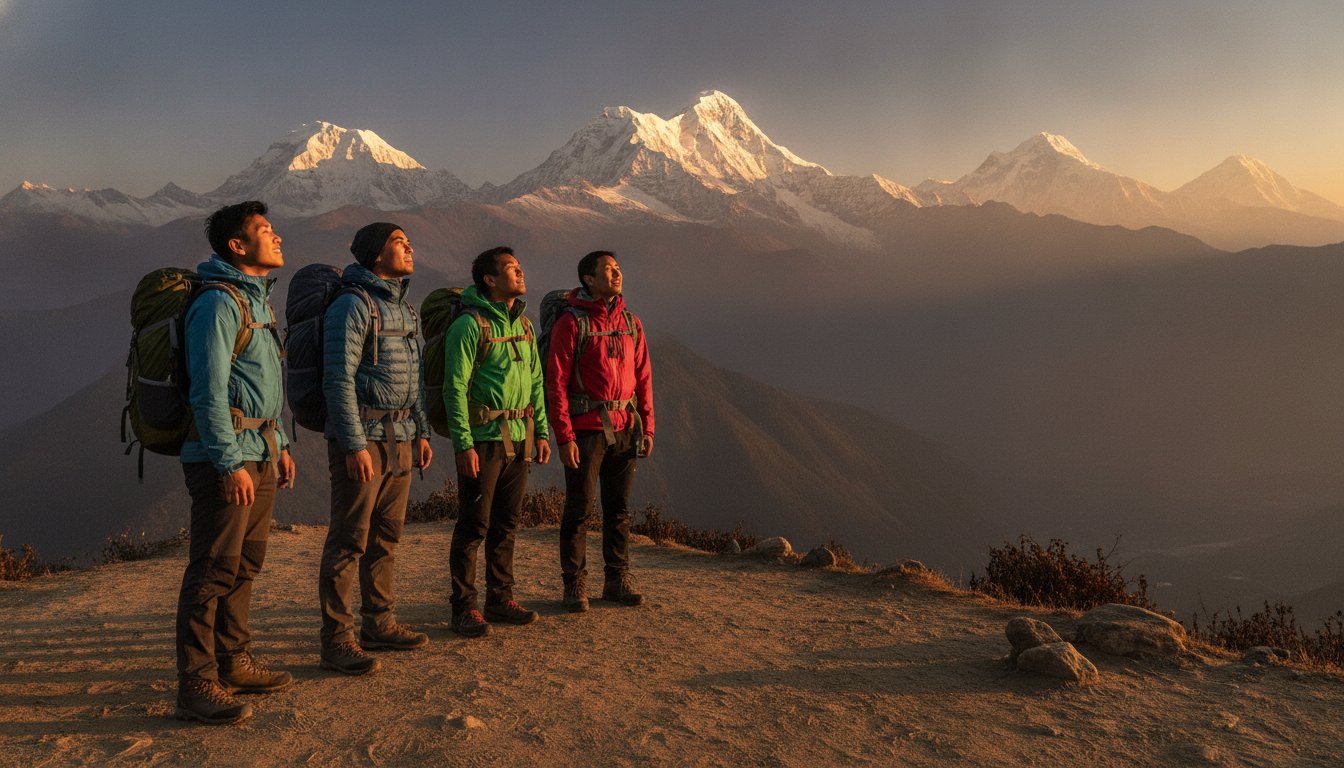
Nepal Trekking for Beginners: Ultimate 2026 Guide
What if your first glimpse of a 6,000-meter peak didn’t require decades of elite training or a superhuman lung capacity? It’s a common myth that the Himalayas are reserved only for the world’s most extreme athletes. You might feel a knot of worry about altitude sickness or wonder if you’ll pack the wrong gear, but those fears shouldn’t keep you from the trail. We understand that the logistics can feel overwhelming, especially with the 2026 regulations requiring all foreign trekkers to hire a licensed guide for safety.
This guide to Nepal trekking for beginners is your roadmap to a successful Himalayan adventure. We’ll show you how to navigate the new e-TIMS permit system and choose routes that offer maximum beauty without extreme technical difficulty. You’ll discover our favorite beginner-friendly itineraries, like the 8-Day Scenic Nepal Mini Trek, alongside a practical fitness plan and essential safety tips. By the time you finish reading, you’ll have the expert knowledge and confidence to book your first trip and finally stand among the clouds.
Key Takeaways
- Master the essentials of Nepal trekking for beginners by learning to distinguish between technical difficulty and the endurance needed for high-altitude trails.
- Identify the most scenic, entry-level routes for 2026 that offer breathtaking Himalayan panoramas without requiring elite mountaineering skills.
- Follow a realistic 12-week preparation strategy focused on building stamina and “time on feet” to handle 4-6 hours of daily trekking comfortably.
- Navigate the latest 2026 logistics with ease, from mandatory licensed guides and e-TIMS permits to the science of packing a perfect layering system.
- Discover how 30+ years of local expertise can transform a daunting mountain expedition into a safe, welcoming, and deeply personal adventure.
What Does “Nepal Trekking for Beginners” Actually Mean?
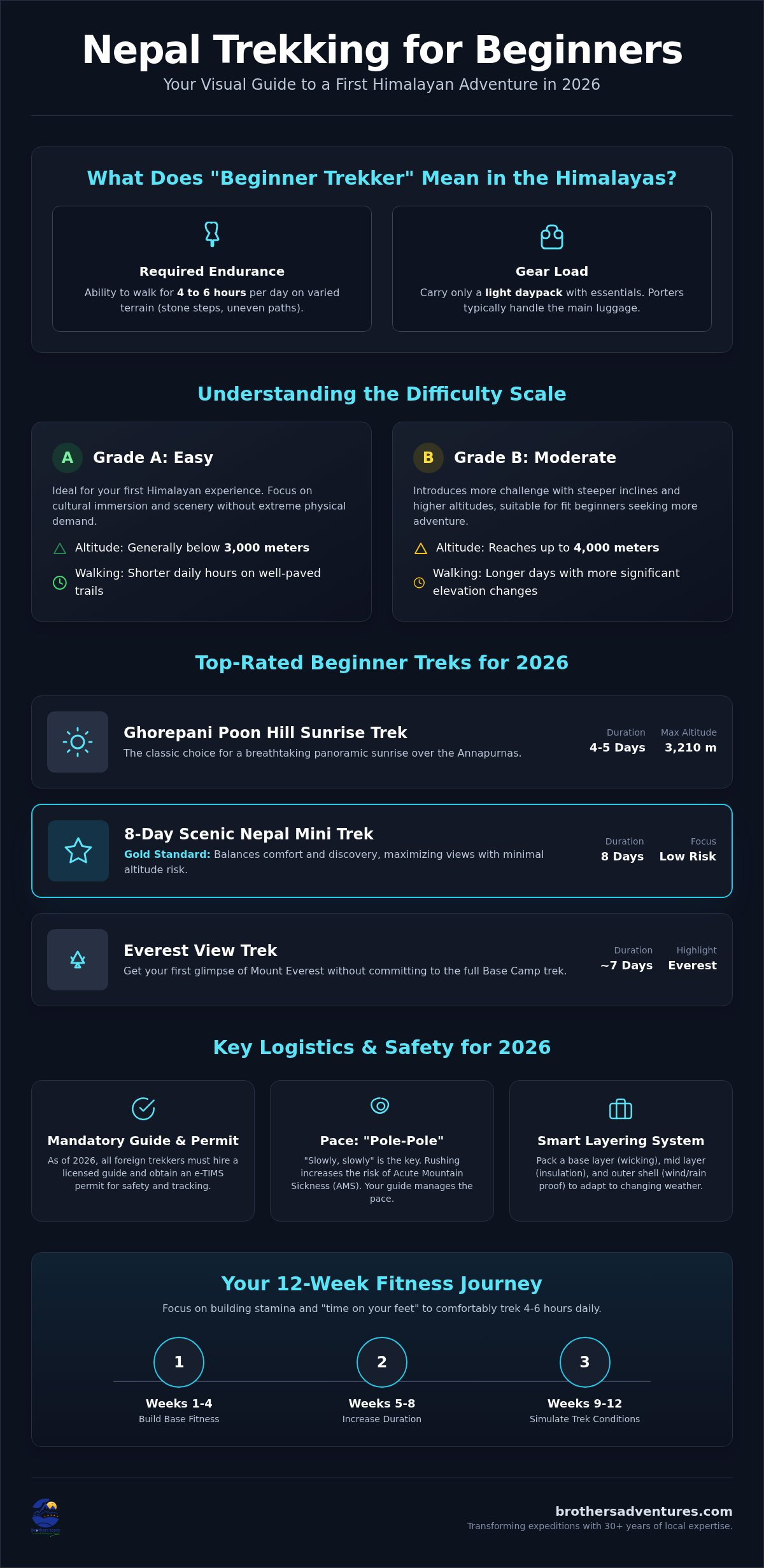
In the context of the Himalayas, “beginner” doesn’t mean you’ve never stepped onto a trail before. It describes a traveler who can comfortably walk for 4 to 6 hours a day while carrying a light daypack. While you don’t need to be a marathon runner, Nepal trekking for beginners requires a specific kind of endurance that differs from your local weekend hill walk. The vast Great Himalaya Trail system offers a massive variety of routes, but for your first time, we focus on paths that prioritize cultural immersion and steady elevation gains rather than technical climbing.
Many people confuse “easy” with “beginner.” In Nepal, even an easy trail involves stone steps, uneven terrain, and constant changes in elevation. The real challenge isn’t the steepness; it’s how your body reacts to the thinning air. Success here is measured by your ability to manage your energy and listen to your guide, not by how fast you reach the next village. You’ll stay in traditional tea houses, which are cozy mountain lodges offering warm meals and a bed. Expect simple comforts rather than luxury, where the real “five-star” experience is the view of the sunrise over the peaks.
The Himalayan Difficulty Scale for Novices
We categorize routes to help you choose the right fit for your fitness level. Understanding these grades is the first step in planning a journey that feels like a discovery rather than a chore.
- Grade A (Easy): These treks stay at lower altitudes, usually below 3,000 meters. The trails are well-paved and the daily walking hours are shorter.
- Grade B (Moderate): You’ll encounter steeper inclines and reach altitudes up to 4,000 meters.
For your first journey, we recommend Grade A or low-altitude Grade B treks. These routes allow you to experience the scale of the mountains without pushing your body into extreme territory too quickly. They provide the perfect introduction to the rhythm of mountain life.
The Importance of Pacing and Acclimatisation
If there’s one phrase you’ll hear constantly on the trail, it’s “pole-pole,” which means “slowly, slowly.” Rushing is the quickest way to end a trek early. Acclimatisation is the body’s natural adjustment to lower oxygen levels. Our guided itineraries, such as the 8-Day Scenic Nepal Mini Trek, are designed with this physiology in mind. We build in specific rest days and gradual elevation increases to prevent Acute Mountain Sickness (AMS). Trusting a professional guide ensures that your pace is monitored and your health is the top priority, giving you the freedom to look up and enjoy the scenery instead of just staring at your boots.
The Best Beginner-Friendly Trekking Routes for 2026
Choosing your first trail shouldn’t feel like a gamble. For those exploring Nepal trekking for beginners, the secret lies in finding routes that offer “big mountain” views without requiring weeks of grueling ascent. While the Annapurna region is famous for its lush rhododendron forests and ancient stone steps, the Kathmandu Valley rim provides a gentler introduction with incredible accessibility. Before you fly, it’s wise to review the CDC health information for Nepal to ensure your health prep and vaccinations are on track for the altitude.
The 2026 trekking season emphasizes safety and local connection. This means your journey is about more than just the peaks; it’s about the heritage of the villages you pass through. We’ve selected routes that balance manageable physical strain with maximum visual reward, ensuring you feel inspired rather than exhausted.
The Ghorepani Poon Hill Sunrise Trek
This classic route is a favorite for a reason. Over 4 to 5 days of walking, you’ll climb through vibrant villages to reach the Poon Hill viewpoint at 3,210 meters. The reward is a 360-degree panorama of the Annapurna and Dhaulagiri ranges glowing in the morning light. It’s a moderate challenge involving many stone stairs, but the frequent tea house stops make it very achievable for anyone with basic fitness levels.
The 8-Day Scenic Nepal Mini Trek
If you want the perfect balance of discovery and comfort, this is it. The 8-Day Scenic Nepal Mini Trek is our gold standard for novices. It minimizes altitude risks while maximizing the sensory experience of the Himalayas. You’ll witness the scale of the peaks and the warmth of local heritage without the physical drain of a high-altitude expedition. It’s a journey designed to make you fall in love with trekking, not just survive it.
Everest View Trek (The “Short” Everest Option)
You don’t need 12 days to see the world’s highest peak. This shorter alternative takes you to the spiritual hub of Tengboche, offering clear views of Everest, Lhotse, and Ama Dablam. It’s ideal for beginners who have limited time but big dreams. If you’re feeling more ambitious after reading this, check out our guide on the Everest Base Camp Trek from Singapore to see if you’re ready for the full journey. Our team at Brothers Adventures is always here to help you pick the trail that matches your dreams.
Preparing Your Body: Fitness and Mental Readiness
You don’t need to be an elite athlete to stand in the shadow of the world’s highest peaks, but you do need a solid plan. Nepal trekking for beginners is as much about physical endurance as it is about mental resilience. We recommend a 12-week preparation window to get your body trail-ready. Instead of focusing on your 5km running time, prioritize “Time on Feet.” The Himalayas won’t ask you to sprint; they’ll ask you to walk for several hours a day on uneven ground. Building that specific stamina is what makes the difference between a grueling climb and an enjoyable journey.
Mental preparation is just as vital as your cardio. Prepare yourself for the simplicity of mountain life. While our guided tours offer the best available comforts, tea house amenities are basic. You’ll likely encounter squat toilets, shared dining areas, and rooms that get quite chilly once the sun goes down. Embrace this as part of the adventure. It’s a chance to disconnect from the digital world and reconnect with the raw beauty of the landscape.
A Simple 3-Month Training Plan
Start your training early to build confidence. This structured approach ensures you’re ready for the daily rhythm of the trail without overexerting yourself too soon.
- Month 1: Focus on building a base. Aim for three days a week of brisk walking or light swimming. Consistency is more important than intensity during these first four weeks.
- Month 2: Introduce incline walking and stair-climbing. Start wearing your trekking boots and carry a small daypack with about 5kg of weight. This strengthens your quads for the long descents.
- Month 3: Simulate the trek with longer weekend hikes. Try to walk for 4 to 5 hours on consecutive days to see how your body recovers. This is the time to refine your pacing.
Understanding High-Altitude Safety
Safety is the cornerstone of every successful expedition. Even on beginner-friendly routes, you must stay aware of how your body reacts to the altitude. Common symptoms of Acute Mountain Sickness (AMS) include persistent headaches, loss of appetite, and dizziness. If you feel any of these, communicate them to your guide immediately. They are trained to monitor your health and decide if a rest day or descent is necessary.
Follow the “Golden Rule” of altitude: walk high, sleep low. This means you might climb to a higher viewpoint during the day but return to a lower elevation to sleep, giving your body the best chance to recover. For a deeper dive into managing your health on the trail, see our guide on High-Altitude Safety and Expedition Preparation. Your safety is our family’s legacy, and we take it seriously on every single mile of the trail.
Essential Gear and Logistics for First-Time Trekkers
Packing for your first Himalayan journey is a thrilling milestone. It’s the moment your dream starts to feel real. For those diving into Nepal trekking for beginners, your gear serves as your mobile home. It’s the bridge between a comfortable discovery and a cold, damp ordeal. Instead of buying the most expensive technical equipment, focus on a smart layering system. This involves a moisture-wicking base layer, an insulating mid-layer like fleece or down, and a waterproof outer shell to block the wind and rain. This setup lets you adjust your temperature as you move from sunny valley floors to chilly ridgelines.
Logistics can often feel like a maze of red tape. Between TIMS cards and National Park permits, the paperwork is extensive and strictly enforced. Booking through a specialist tour operator simplifies your journey immensely. We take care of the bureaucratic heavy lifting so you can focus on the majesty of the peaks. Our team ensures every permit is secured long before you step off the plane in Kathmandu, allowing you to breathe easy and enjoy the ride.
The “Big Three” Gear Items
Choosing the right equipment is the most practical part of preparing for Nepal trekking for beginners. While you’ll have a porter to help with heavy bags, your daypack and boots are your personal responsibility.
- Boots: Choose mid-cut boots that offer firm ankle support. Ensure they have a waterproof lining and, most importantly, break them in thoroughly during your training. A broken-in pair of mid-range boots is always better than a brand-new pair of elite ones.
- Backpack: A 30-40L daypack is the perfect size for your water, camera, and layers. Look for one with a padded waist strap to shift the weight from your shoulders to your hips.
- Sleeping Bag: Even though you’ll stay in tea houses, a personal sleeping bag is a must for hygiene and extra warmth. A bag with a -10°C rating is essential for a cozy night’s sleep when the mountain air turns frosty.
Permits and Paperwork Made Easy
The Annapurna Conservation Area Project (ACAP) permit is a requirement for most beginner-friendly routes in that region. In 2026, most permits require digital pre-registration via an authorised agency. You can’t simply show up and buy these on your own anymore. Our dual-office support in Singapore and Kathmandu means we handle the digital e-TIMS registration and all local municipality fees on your behalf. This seamless coordination is why so many novices trust us to guide their first steps. Ready to start your adventure? Let Brothers Adventures handle the details while you focus on the views.
Why Brothers Adventures is the Best Choice for Beginners
Embarking on your first Himalayan journey is a monumental decision. It requires more than just a map; it requires a partner who understands the unique anxieties of Nepal trekking for beginners. Since 1992, our family-owned business has acted as a bridge between the comfort of home and the raw wonder of the high mountains. We don’t just sell tours; we invite you into a legacy of exploration that spans over three decades. This deep heritage ensures that every novice who treks with us receives the personalized care and seasoned authority that only 30+ years of experience can provide.
What sets us apart is our dual-office structure. With dedicated teams in both Singapore and Kathmandu, we offer a level of logistical security that few others can match. You can plan your trip with our experts in Singapore and arrive in Nepal knowing our Kathmandu operations center is monitoring your progress 24/7. This continuity of care eliminates the stress of local logistics, leaving you free to focus on the breathtaking vistas. Our expert guides specialize in pacing for novices, ensuring you never feel rushed or overwhelmed as you find your mountain legs.
The Brothers Heritage: From 1992 to Today
Our story began in 1992 with a simple mission: to share the beauty of our homeland with the world. Today, that mission remains unchanged. Because we’re family-run, we treat every trekker like an invited guest rather than a customer. This personal touch extends to our commitment to ethical trekking. We prioritize local community support, ensuring that your journey contributes positively to the mountain villages you visit. Many first-time trekkers who once worried about their fitness or the cold have returned home with stories of triumph, all thanks to the steady, encouraging presence of our team.
Your Safety Net in the Himalayas
Safety isn’t just a checkbox for us; it’s our top priority. Our Kathmandu operations center provides a constant safety net, handling everything from permit updates to emergency coordination. When you book a guided experience with us, your package includes all permits, transport, and hand-picked accommodations. We’ve refined our itineraries to grow with your confidence, offering flexibility that accommodates your specific needs. Ready to start your journey? Explore our Scenic Nepal Mini Treks today and discover why thousands of beginners have trusted us to lead the way.
Your Himalayan Journey Starts Here
The mountains are calling, and now you have the roadmap to answer. Nepal trekking for beginners isn’t about rushing to the highest summit; it’s about the steady rhythm of the trail and the magic of the golden hour over the peaks. You’ve learned how to prepare your body, what gear to trust, and which routes offer the best rewards for your first expedition. Success in the Himalayas is simply a matter of the right pacing and the right partner.
Since 1992, we’ve helped thousands of novices turn their mountain dreams into reality. Our expert guides carry high-altitude medical training to ensure your safety every step of the way, while our comprehensive packages handle every permit and logistical detail. We’re here to act as your bridge to the wild, ensuring your first trip is as seamless as it is spectacular. We’ll be with you from the first planning session in Singapore to the final celebratory meal in Kathmandu.
Start Your Himalayan Adventure with Brothers Adventures
Don’t let another year pass wishing you were standing among the clouds. The crisp air and ancient heritage of Nepal are ready to welcome you home. We’ll see you on the trail.
Frequently Asked Questions
Do I need previous trekking experience to visit Nepal?
No, you don’t need prior mountain experience to enjoy Nepal trekking for beginners. What matters most is a consistent walking routine and a positive attitude. Many of our guests successfully complete routes like the 8-Day Scenic Nepal Mini Trek by following a 12-week preparation plan. We design these novice-friendly itineraries to build your confidence gradually without requiring technical climbing skills or specialized gear knowledge.
What is the best month for a beginner to trek in Nepal?
The most stable weather for novices occurs during the spring, from March to May, and autumn, from September to November. During these windows, the skies are usually crystal clear, offering the iconic “big mountain” views you’ve seen in photos. Temperatures remain moderate, which makes the physical effort of walking much more comfortable. Spring brings vibrant rhododendron blooms, while autumn provides the crispest air for photography.
How much does a beginner trek in Nepal typically cost?
You cannot trek alone in Nepal’s national parks or conservation areas as of the 2026 regulations. All foreign travelers are now required to hire a licensed guide to ensure safety and support the local economy. For those starting Nepal trekking for beginners, having a guide is a massive advantage. They handle all the complex logistics, navigate the trails, and act as a knowledgeable companion throughout your adventure.
Is altitude sickness common on beginner routes?
While Acute Mountain Sickness (AMS) is less common on beginner-friendly Grade A routes, it can still occur if you ascend too quickly. Our itineraries prioritize gradual acclimatization to keep you safe. Our expert guides are trained in high-altitude medical safety and monitor your health daily. By following the “pole-pole” philosophy and staying hydrated, most beginners find they adapt to the thinner air without any major issues.
What kind of food is served in the tea houses?
Tea houses serve a surprisingly diverse range of hearty, energy-rich meals. The staple is Dal Bhat, a nutritious combination of lentil soup, rice, and vegetable curry that provides the perfect fuel for trekking. You’ll also find international favorites like pasta, pancakes, eggs, and momos. We recommend sticking to vegetarian options at higher altitudes to ensure your digestion remains smooth and your energy levels stay high throughout the day.
How many hours a day will I be walking on a beginner trek?
You’ll typically walk between 4 and 6 hours each day on a beginner-friendly itinerary. This pace allows for plenty of breaks to take photos, visit local monasteries, and enjoy a relaxed lunch in a scenic village. We focus on steady movement rather than speed. This schedule ensures you arrive at your next tea house with enough energy to enjoy the evening atmosphere and get a restful night’s sleep.
Do I need to carry my own heavy luggage?
You don’t have to carry your own heavy luggage on our guided treks. We provide professional porters who carry your main kit bag, allowing you to walk freely and enjoy the landscape. You only need to carry a small daypack with your daily essentials like water, a camera, and an extra layer of clothing. This significantly reduces physical strain, making the journey much more accessible for first-time trekkers.



Comments are closed