


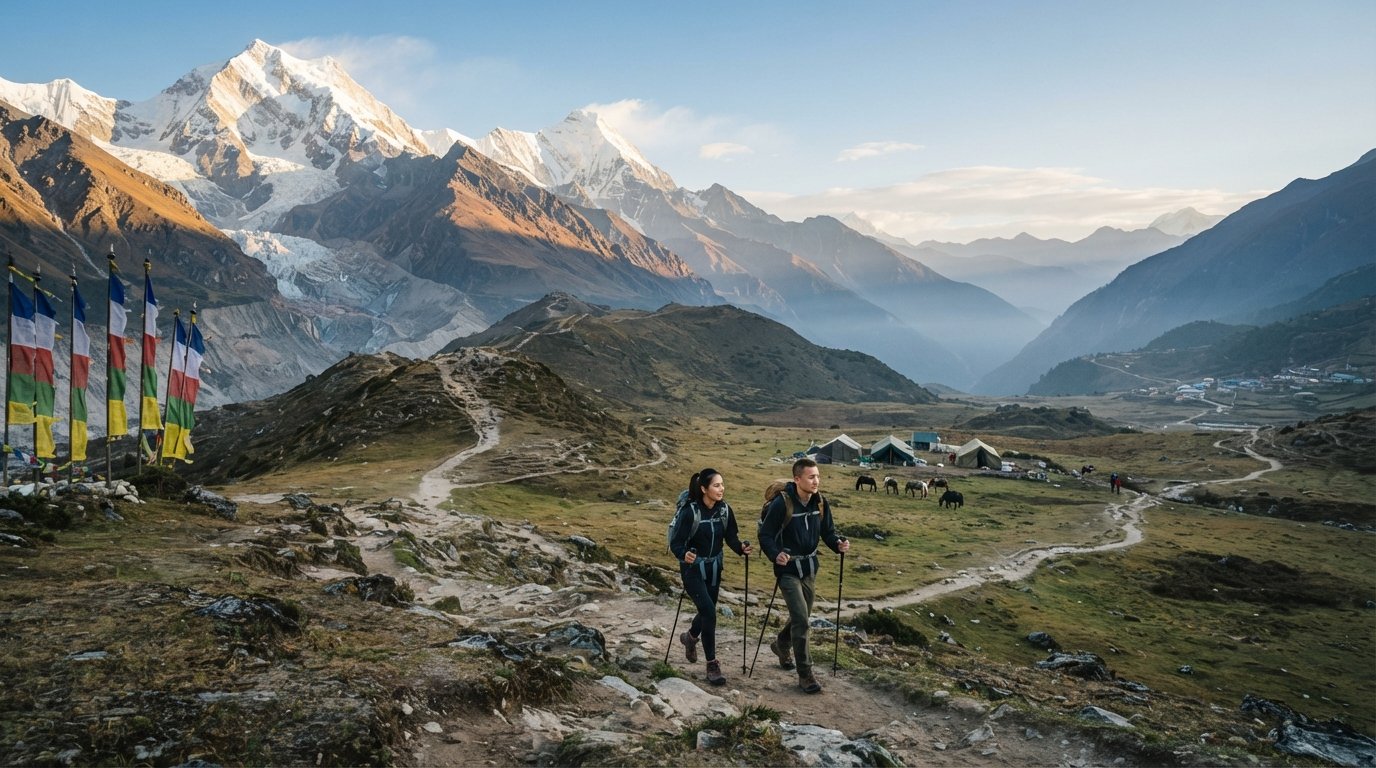
Jomolhari trek Bhutan package: Compare the trekking routes
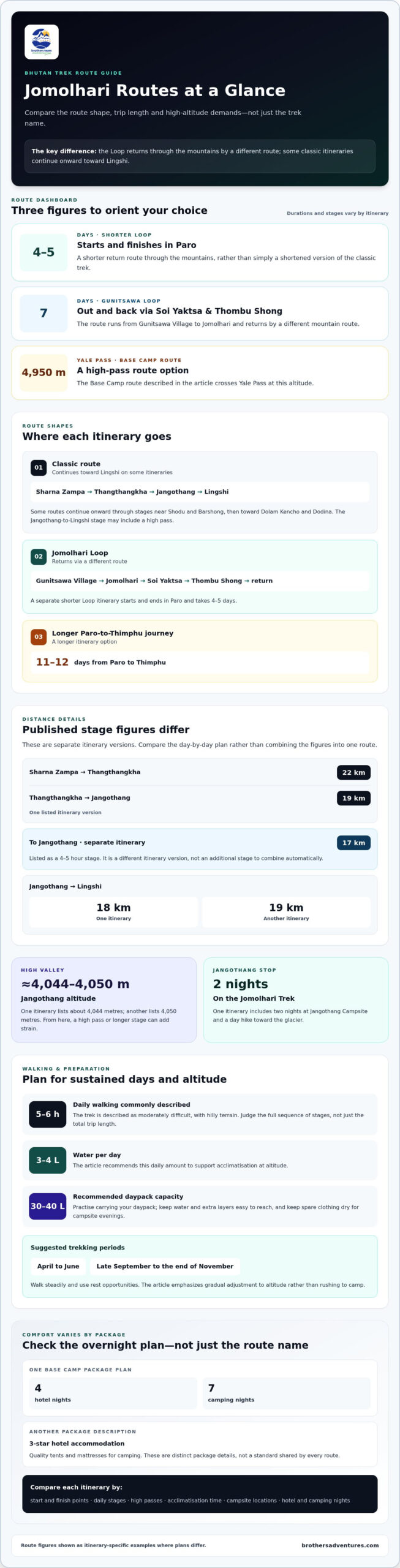
The Jomolhari Loop isn’t simply a shorter version of the classic trek: it returns to the start by a different route. A Jomolhari trek Bhutan package may follow the main trail through Jangothang and onward to Lingshi, a 7-day Loop from Gunitsawa Village via Soi Yaktsa and Thombu Shong, or a Base Camp route that crosses Yale Pass at 4,950 m. The shorter Loop takes 4-5 days and starts and ends in Paro, while a longer route from Paro to Thimphu takes 11-12 days.
When comparing these journeys, mountain views are only part of the picture. Route length and high-altitude stages matter too. The right fit depends on how much time you have and how demanding a walking itinerary you want.
Read on to compare the routes’ daily stages, distances, altitude, accommodation and meals, along with the practical differences that shape each experience. You’ll come away with a clearer sense of which Jomolhari journey suits your plans, and what to look for in a package before you set off from Singapore.
Key Takeaways
- Compare the classic trek, Loop and Base Camp routes by how they travel through the mountains, not just by their names.
- Use the day-by-day stages and walking demands to judge which itinerary best fits your time and fitness.
- Look beyond the highest pass: starting altitude, gradual acclimatisation and long climbs all shape the challenge.
- Understand how camping, hotel nights and meal arrangements affect comfort along the route.
- Choose a package by matching its itinerary and practical arrangements to the kind of Bhutan adventure you want.
What are the differences among Jomolhari trek, Jomolhari Loop trek and Jomolhari Base Camp trek?
The main difference is the route: some itineraries return through the mountains, while others continue toward Lingshi. Before choosing, compare each option’s duration, daily stages, high passes and campsite plan.
Route and Itinerary Variations
The classic Jomolhari itinerary links Sharna Zampa, Thangthangkha, Jangothang and Lingshi. One route lists 22 km from Sharna Zampa to Thangthangkha, then 19 km to Jangothang. A separate itinerary lists 17 km to Jangothang, taking 4 to 5 hours. Treat these as different itinerary versions, not stages to combine automatically.
From Jangothang, one itinerary continues 18 km to Lingshi, while another lists 19 km. The onward route from Jangothang to Lingshi may include a high pass. The Jomolhari Loop is a 7-day route from Gunitsawa Village to Jomolhari and back via Soi Yaktsa and Thombu Shong. A shorter Loop takes 4-5 days and starts and ends in Paro.
Which Bhutan tour operators offer Jomolhari trek packages? Bhutan trekking operators offer guided Jomolhari itineraries, but routes, durations and daily stages vary. Compare the day-by-day plan, including its start and finish points, rather than relying on the trek name alone.
How does the Jomolhari trek compare with the Snowman Trek and Druk Path Trek? Jomolhari itineraries travel through the Jomolhari region toward Jangothang, with some continuing to Lingshi. The Snowman Trek and Druk Path Trek follow distinct routes, so compare their itineraries and stages rather than assuming they use Jomolhari’s trail.
Campsites and Accommodation by Route
Jangothang is a key overnight stop on the classic route, and the Jomolhari Trek includes two nights at Jangothang Campsite. One itinerary includes a day hike toward the glacier, giving trekkers time in the high valley. When comparing plans, check whether the schedule pauses here or moves on after arrival.
Accommodation details depend on the specific itinerary. One Jomolhari Base Camp Trek plan includes four hotel nights and seven camping nights. Another package description includes 3-star hotel accommodation and quality tents and mattresses for camping. These are separate package details, not a single standard shared by every route.
For a clear comparison, note each overnight location alongside that day’s walking stage. Check how many nights are at Jangothang, whether the route returns to Paro, and where camping replaces hotel stays. A loop returning through Soi Yaktsa and Thombu Shong differs from a route continuing to Lingshi, including in where campsites fall along the journey.
Trek difficulty and fitness requirements
The Jomolhari Trek is moderately difficult, with hilly terrain and daily walking commonly described as 5-6 hours. To prepare, consider both the sustained walking and how your itinerary handles altitude, rest, and overnight stops.
What gear and clothing should I pack for the Jomolhari trek? Bring a 30-40-litre daypack, practical layers for changing conditions, and clothing suitable for walking and camping. Plan to drink 3-4 litres of water daily to support acclimatisation at altitude.
Preparation and Gear
Prepare for the route’s walking demands, not just the trip’s total length. Regular walks on uneven or hilly ground help you practise keeping a steady pace over varied terrain. Build up gradually, and practise carrying the daypack you plan to use.
Pack the essentials where you can reach them easily: water, extra layers, and items needed during the day. A 30-40-litre daypack is recommended for the Jomolhari Trek. Keep spare clothing dry for campsite evenings, and organise your kit so you can find warm layers quickly when conditions change.
Plan for camping as well as walking. Trail days and overnight stops bring different demands, especially when managing your layers and daypack. Review the daily stages, including the section toward Barshong, and prepare for the longest or steepest days.
Seasonal Conditions and Acclimatisation
April to June and late September to the end of November are listed as the best periods for trekking in Jomolhari. These windows can guide your planning, but altitude still shapes the physical challenge. Forest paths, exposed sections and high-altitude camps each call for a different pace.
Plan for altitude as a gradual adjustment, not a test of speed. Drink 3-4 litres of water daily, walk steadily, and use the itinerary’s rest opportunities rather than rushing to camp. A schedule with time to settle into the route gives your body space to adjust as the trail climbs.
The Jomolhari Trek reaches Jangothang at about 4,044 metres in one itinerary, while another lists it at 4,050 metres. From there, a high pass or longer stage can add strain even for a fit walker. Assess the full sequence of days, not only the first climb from Paro.
Some itineraries continue toward Lingshi and later stages near Barshong, while a longer route may travel from Paro to Thimphu. Compare the actual walking plan, altitude profile, and camping pattern before choosing. For another Bhutan route to compare, explore Bhutan trekking itineraries.
Daily trekking distances and durations
Jomolhari itineraries vary in total length and daily walking, so compare individual stages rather than relying on one headline distance. Some describe the trek as nine days; another lists a 12-day trip, with route length reported as 120 km or approximately 125 km.
How many days does the Jomolhari trek take, and what is the itinerary? Published plans range from a nine-day trek to a 12-day trip. Common stages link Sharna Zampa, Thangthangkha, Jangothang, Lingshi, Shodu, Barshong and Dolam Kencho, before the trail finishes at Dodina.
Daily figures also differ between itineraries, even for similarly named stages. One plan lists 22 km from Sharna Zampa to Thangthangkha, taking 7-8 hours. Another lists the walk from Shana as 15 km and 5 hours. Check the named start and end points, because a distance attached to one itinerary may not match another route’s stage.
The approach to Jangothang illustrates that difference. One itinerary gives 19 km from Thangthangkha to Jangothang, while another lists a 17 km route taking 4 to 5 hours. A separate plan describes 19 km from Sio Thangthangkha to Jangothang. These figures belong to different itinerary descriptions, so don’t combine them into a single daily schedule.
Beyond base camp, a Jangothang-to-Lingshi stage is listed as 18 km in one plan and 19 km in another. The longer figure appears with a 6-7-hour duration. The route from Lingshi to Shodu is listed elsewhere as 22 km and 8-9 hours, with 940 m of ascent. These long, rising stages demand more time than distance alone suggests.
Later stages can be shorter but still involve several hours on foot. The Shodu-to-Barshong stage can vary between itinerary descriptions. Barshong to Dolam Kencho is listed as 14 km and 4-5 hours in one version, and 15 km in another. The final stage runs from Dolam Kencho to Dodina.
Compare daily distance, walking time, ascent and campsite location together. Group size can also affect walking rhythm and coordination at stops, so consider how the itinerary accommodates the group. Flights into Paro are a separate travel detail and do not indicate how demanding a trekking day will be. Focus on the full sequence of stages and high-pass days, not just the total kilometres.
Altitude, acclimatization and high passes
Jomolhari itineraries climb from Paro’s approach to high camps and mountain passes. Compare each route’s stated maximum altitude, pass names and time spent adjusting to the elevation.
The trek is described as moderately difficult, with 5-6 hours of daily walking. The main Jomolhari Trek reaches a listed maximum of 4,890 metres; a Base Camp route crosses Yale Pass at 4,950 metres.
Altitude and Acclimatisation
Jangothang, the base camp area, appears at different elevations across itineraries: 4,040 m, 4,044 metres, and 4,050 metres. Treat these as route-specific figures when reviewing a schedule. One Bhutan itinerary includes an acclimatisation hike to Tiger’s Nest Monastery at 3,180 metres before trekking.
Plan each day around the elevation gained, overnight altitude, and following stage. The guidance recommends drinking 3-4 litres of water daily to help with acclimatisation. A Jangothang rest day can include a glacier hike, but it still adds activity at altitude. Keep the pace steady and use planned pauses.
Altitude affects the character of the journey as the trail leaves forests and opens into high meadows. Around Lingshi, an itinerary lists the village at 4,010 metres. Weather can change the feel of exposed sections, so carry layers where they’re accessible and follow the day’s planned route.
High Passes and Elevations
Pass names and elevations vary between route descriptions. One Jomolhari Trek itinerary places Nyele La at 4,890 metres, while another lists Nyele La at 4,700 metres. Yale La is listed at 4,990 metres in one itinerary; the Jomolhari Base Camp Trek lists Yale Pass at 4,950 metres. Match each figure to its named route.
Bhonte La is listed at 4,850 metres in one description and 4,890 metres in another. One itinerary places it between Jangothang and Lingshi. These differences make the route’s exact pass sequence more useful than a single maximum-altitude figure when comparing packages.
Look at the climb as well as the summit elevation. One itinerary lists 940 m of ascent from Lingshi to Shodu, followed by a long day across high terrain. Ask the itinerary to show where each pass falls, the overnight stop before it, and the descent afterward. That sequence helps you judge the effort and enjoy the spectacular mountain views, wild nature, and Lingshi valley meadows without treating every route as identical.
Accommodation and meals during the trek
Accommodation changes as the trail leaves Paro for alpine camps around Jangothang and Jomolhari Base Camp. Compare hotel and camping nights, meals and transport in the itinerary rather than assuming every package follows the same arrangement.
One Jomolhari Base Camp Trek description includes four hotel nights and seven nights camping. A separate package description lists 11 nights across 3-4-star hotels and spacious tents. These figures describe different arrangements, so use the itinerary’s overnight schedule to understand what applies to that journey.
Some trekking plans combine hotel stays before or after the trail with campsites during the mountain stages. The route and season shape the overnight stops. One itinerary, for example, includes two nights at Jangothang campsite, giving trekkers more time near the base camp before moving on.
Camping standards also vary by package description. One Bhutan trek package specifies 3-star hotel accommodation, plus quality tents and mattresses for camping. That detail helps set expectations for rest after a day’s ascent, but it doesn’t mean every route uses the same lodging or campsite setup. Read the overnight list alongside the daily stages to see where the change from hotel to tent occurs.
Read the meal arrangements as carefully as the route. A package description may include daily meals, but arrangements can differ between trekking days and hotel stays. Check how meals are handled throughout the itinerary, from departure from Paro to the Jangothang nights and return journey. The phrase “daily meals” does not specify a menu or dining style; consult the package details.
Transport can link the accommodation plan with the trailhead. One package description includes airport transfers, a private guided tour, Bhutan visas and daily meals. These are stated components of that package, not universal features of every Jomolhari itinerary. Compare how planned transfers fit with your arrival, departure and trekking schedule.
Before choosing, map each night to its location and type: hotel, tent, or another stated arrangement. Then match meals and transfers to those stages. This makes the difference between a comfortable hotel night and a high-altitude campsite clear before travel begins. Compare the trek accommodation and meal arrangements against the itinerary you’re considering, and choose the setup that fits your preferred balance of comfort and time outdoors.
Brothers International Tours & Trading Pte Ltd: 8Days Nepal Adventure Tour
Brothers International Tours & Trading Pte Ltd offers the 8Days Nepal Adventure Tour for travellers considering a Himalayan journey beyond Bhutan. It’s a Nepal option, not a Jomolhari itinerary, so choose it when Nepal’s landscapes and adventure appeal more than trekking Bhutan’s Jomolhari routes.
For a shorter Nepal trekking experience, the 8Days Scenic Nepal Mini Trek offers another distinct alternative. Compare each trip’s destination and itinerary with the time and style of travel you want. If your plans remain centred on Jomolhari, use the route, altitude and camping details in this guide to make your decision.
Contact Brothers International Tours & Trading Pte Ltd or visit brothersadventures.com to explore its Nepal tours.
Choose the Journey That Calls You Next
Turn your route comparison into a travel plan that fits the experience you want. When choosing a Jomolhari trek Bhutan package, start with the kind of journey you’re ready for. If you’re considering other Himalayan options too, Brothers International Tours & Trading Pte Ltd offers guided adventure and leisure packages across the region.
Brothers International Tours & Trading Pte Ltd offers the 8Days Nepal Adventure Tour and the 8Days Scenic Nepal Mini Trek for travellers drawn to Nepal. The 5Day Nepal Luxury Tour offers a different style of Nepal journey. Each is a separate option, so choose according to the destination and travel experience you have in mind.
For help exploring these trips, contact Brothers International Tours & Trading Pte Ltd. Keep your plans curious, thoughtful, and ready for the next mountain adventure.
Frequently Asked Questions
What’s included?
Package inclusions depend on the itinerary, so compare the written list rather than assuming every Jomolhari trip is alike. One Bhutan package description includes a private guided tour, Bhutan visas, airport transfers and daily meals. Accommodation can combine hotel stays with camping. Match each inclusion to the relevant travel day, especially transfers before the trek and meals on camping nights.
How difficult is this trek?
The Jomolhari Trek is moderately difficult, with sustained walking over hilly terrain and demanding high-altitude sections. Fitness for ordinary walks alone may not prepare you for consecutive trekking days. Before departure, practise longer walks on uneven ground while carrying your daypack. Also consider how you manage steep climbs, changing weather and camping: preparation for one challenge does not automatically cover the others.
Is it possible to do the Jomolhari trek independently, without booking it through an agency?
The Jomolhari itinerary described here is guided, not self-guided, so don’t assume you can arrive and walk the route independently. Trek arrangements involve more than navigation: route permissions, accommodation, transport and meals all need coordination. A guided package brings these elements together in a planned journey. If independence matters to you, distinguish between travelling independently in Bhutan and trekking this route without organised support.
Is this trek suitable for first-time international travelers?
The trek can suit a first international trip if you’re comfortable with a structured itinerary, remote campsites and long days on foot. Organise your passport and visa documents, arrival transfers and trekking essentials before departure. Consider your experience with overnight camping and high-altitude walking, not just international flights. A guided itinerary may be easier to follow if you prefer a more structured trip.
What is included in a Jomolhari trek Bhutan package?
Inclusions vary by package, but one Bhutan trek package description covers a private guided tour, visas, airport transfers and daily meals. It also specifies hotel accommodation and camping equipment, including tents and mattresses. Treat these as package-specific details, not a universal checklist. Before choosing, note which nights are in hotels, which are at campsites, and how transfers connect with arrival and departure.
What permits, visa, and Sustainable Development Fee are required for trekking in Bhutan?
Plan for Bhutan’s tourist visa and Sustainable Development Fee (SDF) as part of your visitor arrangements. Trekking also involves route-related permit processing, which may be included in a package. Keep entry documents and trekking arrangements distinct: one covers travel into Bhutan, the other relates to the route. Make sure your itinerary accounts for paperwork and travel dates together.
What is the best season to trek to Jomolhari?
April to June and late September to the end of November are listed as the best periods for the Jomolhari Trek. Choose your travel window alongside the itinerary, since the sequence of camps and high-pass days affects what you’ll experience. For planning from Singapore, compare your available leave with the full trip schedule, including travel days before and after trekking. Pack for changing mountain conditions in any season.
What fitness level and acclimatisation are needed for the Jomolhari trek?
Prepare for regular walking over several days, including hills, climbs, and high-altitude stages. Practise with progressively longer walks and a loaded daypack, then build in recovery time before departure. During the trek, use the itinerary’s planned pauses, keep a steady pace, and drink the recommended 3-4 litres of water daily. These habits support acclimatisation, but they don’t replace taking altitude seriously or following the guided schedule.


Comments are closed