


Nepal Peak Climbing Packing List: The Ultimate 2026 Himalayan Gear Guide
What if the difference between a triumphant summit photo and a shivering retreat isn’t your physical stamina, but the specific hardware inside your duffel bag? You’ve likely spent months training for the thin air, yet the fear of being under-equipped against biting Himalayan winds remains a heavy burden. It’s a common struggle to distinguish between standard trekking essentials and the technical tools required for a true vertical ascent, making a comprehensive Nepal peak climbing packing list your most important preparation tool.
We understand that anxiety because we’ve lived it. Since 1992, our family has guided climbers through these majestic landscapes, and we know exactly what it takes to stay safe and warm. This expert-vetted guide for the 2026 season replaces gear confusion with total preparation, ensuring you meet the latest insurance mandates and airline weight limits without sacrificing safety. Our goal is to make you feel like a prepared guest rather than a confused tourist.
In this guide, we’ll master the art of high-altitude layering, clarify which technical tools are non-negotiable, and reveal what’s better to buy versus what you should rent in Kathmandu. You’re about to gain the clarity needed to transform your expedition from a stressful logistics puzzle into the adventure of a lifetime.
Key Takeaways
- Learn why standard trekking gear falls short on the glacier and how a specialized Nepal peak climbing packing list ensures your safety in extreme alpine environments.
- Master the four-layer thermoregulation system designed to prevent sweat-induced chills and maintain warmth during the final freezing summit push.
- Identify which technical hardware is non-negotiable for peaks like Island Peak, including the specific crampon standards required for Himalayan terrain.
- Apply the “Contact Point” rule to strategically decide which gear to purchase for long-term comfort and which items to source locally.
- Discover how professional gear inspections and managed porter logistics in Kathmandu protect your equipment and your energy for the climb ahead.
Scaling Beyond the Trek: Why Peak Climbing Requires a Specialized Packing Strategy
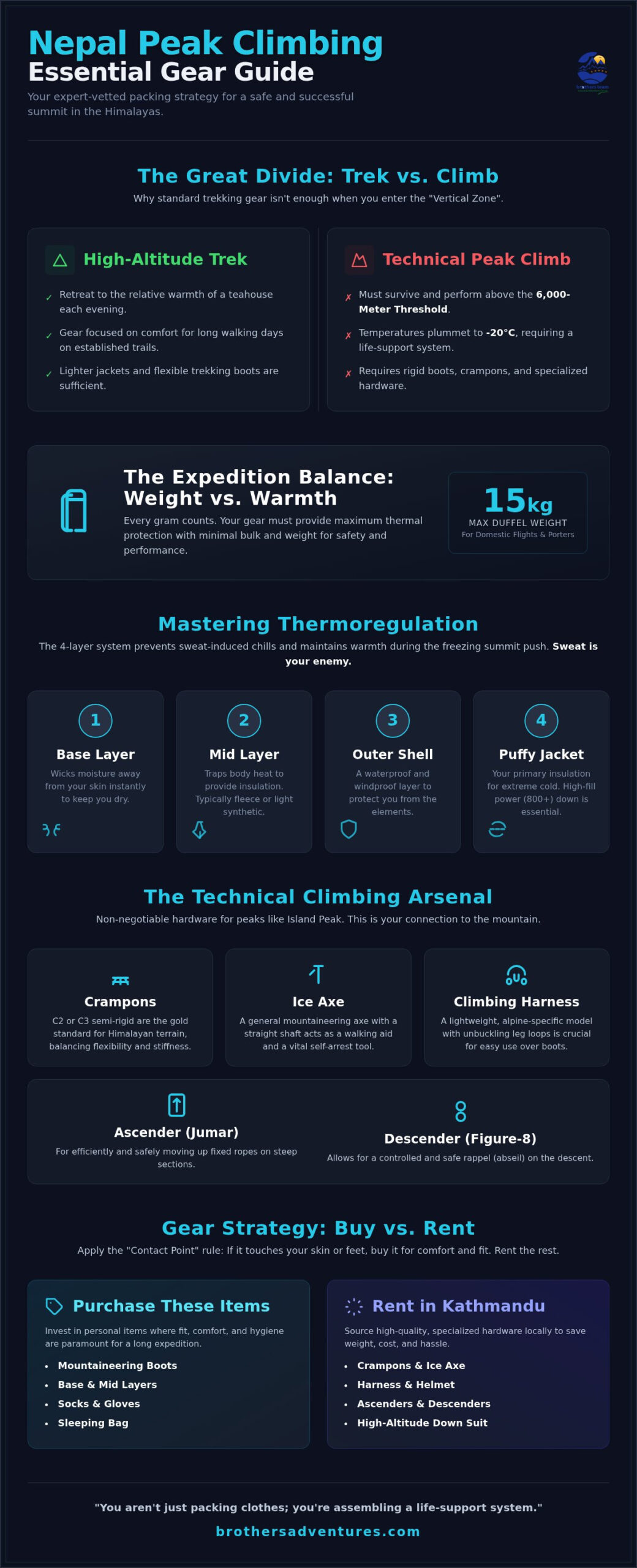
Transitioning from a high-altitude trek to a technical summit is more than just a step up in elevation; it’s a total environmental shift. While a trek allows you to retreat to the relative warmth of a teahouse every evening, peak climbing demands you survive and perform in the “Vertical Zone” of ice and rock. This is where your Nepal peak climbing packing list becomes your lifeline. We call this “Summit Synergy.” It’s the vital concept that your boots, crampons, and harness must function as a single, integrated system. If one piece fails or doesn’t fit the other perfectly, your summit bid ends before it even begins. You aren’t just packing clothes; you’re assembling a life-support system.
The 6,000-Meter Threshold
Crossing the 6,000-meter mark changes the rules of gear performance. At this height, oxygen levels drop significantly, and temperatures can plummet well below -20°C in an instant. Standard gear used for an Everest Base Camp trek from Singapore simply won’t cut it when you’re fixed to a rope on a steep headwall. Trekking boots lack the rigid soles needed for crampon security, and lightweight jackets often fail to block the piercing glacial winds. Moisture management is also a matter of survival. Sweat is your enemy in the sub-zero environment. If your base layers don’t wick moisture away instantly, that dampness will freeze against your skin during rest breaks. This is why we prioritize The Ten Essentials, adapted specifically for the extreme conditions of the Himalayas.
Weight vs. Warmth: The Expedition Balance
Efficiency is the name of the game on a high-altitude expedition. For most domestic flights to mountain airstrips like Lukla, you’re looking at a strict 15kg weight limit for your checked duffel. This isn’t just a rule from the airlines; it’s a safety standard for our porters and yaks who transport your gear to High Camp. Packing light is a strategic advantage. Every extra gram you carry is energy stolen from your summit push. We focus on high-fill-power down, usually 800-fill or higher, because it provides incredible warmth with minimal bulk. Your Nepal peak climbing packing list should prioritize multi-functional items that offer maximum thermal protection without weighing you down. We’ve spent over 30 years refining this balance, ensuring our guests are light enough to move quickly but warm enough to enjoy the view from the top.
The Technical Climbing Arsenal: Essential Hardware for a Successful Ascent
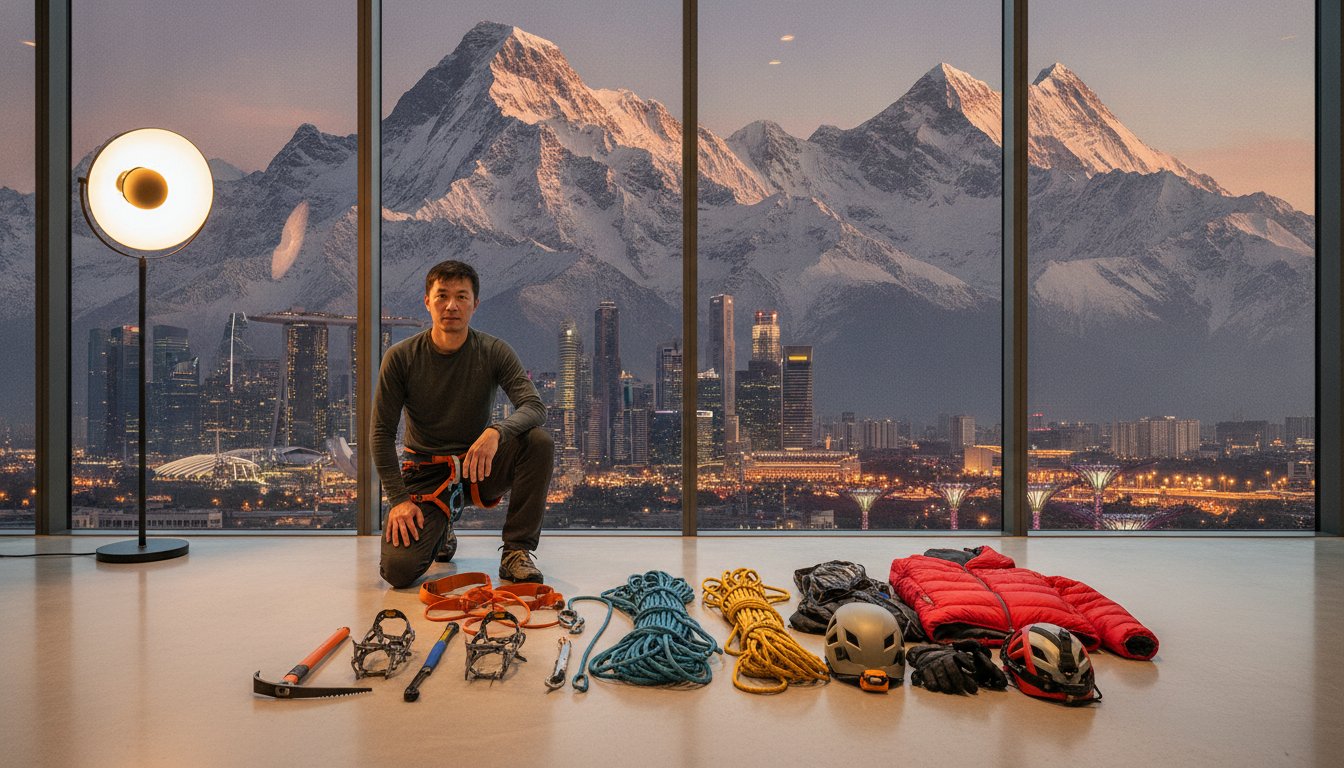
Hardware is the bridge between a challenging hike and a true vertical adventure. When you prepare for an Island Peak climbing package, you’re stepping into a world where your gear provides the mechanical advantage needed to conquer steep headwalls and icy ridges. Your Nepal peak climbing packing list must prioritize items that are rated for extreme cold and high-stress loads. These tools aren’t just accessories; they’re the physical extensions of your skill on the mountain.
- Crampons: C2 or C3 semi-rigid crampons are the gold standard for the Himalayas. They offer the perfect balance between a flexible walking gait on the approach and the stiffness required for front-pointing on icy summit slopes.
- Ice Axe: For most trekking peaks, a general mountaineering axe with a straight shaft is preferred. It acts as a stable walking stick on moderate inclines and a vital self-arrest tool if you lose your footing.
- Climbing Harness: Choose a lightweight, alpine-specific model. These often feature leg loops that unbuckle completely, allowing you to put the harness on without lifting your feet or removing heavy mountaineering boots.
- Ascenders and Descenders: You’ll need a Jumar (ascender) for efficiently moving up fixed lines and a Figure-8 or similar device for controlled rappelling down. These turn an impossible incline into a manageable path toward the sky.
Protection and Safety Gear
Safety starts with a properly fitted climbing helmet. It needs to be adjustable enough to sit comfortably over a thick wool balaclava and a high-lumen headlamp. You’ll also need a variety of carabiners; we recommend at least two locking screw-gate and two non-locking types for different rigging scenarios. Using safety leashes for your ice axe and tools prevents a small mistake from becoming a mission-ending disaster on a steep face.
Ropes and Slings
While Brothers Adventures provides the heavy-duty main ropes for the expedition, you’re responsible for your personal safety loops. This includes accessory cords and prusik loops used for self-rescue maneuvers and crevasse safety. A cow’s tail is a short, personal safety tether that stays clipped to the fixed line while you move between anchors. For a more detailed look at how these items fit into a larger expedition strategy, you can consult a comprehensive peak climbing gear list. If you’re feeling adventurous, our team at Brothers Adventures is always ready to help you select the perfect hardware for your upcoming summit bid.
Mastering the 4-Layer System: Thermoregulation from Base Camp to Summit
Coming from the tropical humidity of Singapore to the dry, freezing air of the Himalayas is a massive shock to the system. You cannot simply pile on random sweaters and hope for the best. Success on a 6,000-meter peak requires a scientific approach to clothing. The 4-layer system is the foundation of every professional Nepal peak climbing packing list. This strategy allows you to add or remove layers as your activity level and the environment change, keeping your core temperature stable from the dusty trails of the Khumbu to the icy winds of the summit ridge. It is about staying dry just as much as staying warm.
The Science of Base Layers
Your base layer is your second skin, and its primary job is moisture management. Merino wool is a favorite for multi-day expeditions because it stays warm even when damp and naturally resists odors. Synthetics dry faster but tend to hold onto bacteria, making them smell quickly. Whatever you choose, never pack cotton. Cotton is a “death fabric” in the mountains; it absorbs sweat, loses all insulating properties, and can lead to rapid hypothermia. Since washing opportunities disappear once you leave lower villages, we suggest bringing two sets of high-quality merino base layers. This physical preparation is vital, but don’t forget to review CDC guidance on high-altitude travel to understand how your body handles the physiological stress of the ascent.
Insulation and Wind Protection
The mid-layer provides the warmth you need during the day. Use a high-loft fleece or an “active insulation” jacket that breathes well while you are moving. When the wind picks up or the snow starts to fall, your outer shell becomes your primary shield. A hardshell with a Gore-Tex membrane is non-negotiable. It must be completely waterproof and windproof while allowing internal moisture to escape. For the final summit push, you will transition to your “Belay Jacket” or heavy down parka. This is your ultimate insurance policy against temperatures that regularly hit -20°C. Loft refers to the thickness and fluffiness of the down insulation, which directly determines how much heat the jacket can trap against your body. A high-loft parka ensures that even during long waits at a fixed-line anchor, your core remains protected from the biting Himalayan cold.
Managing these layers effectively is a skill you will refine throughout the trek. Start your morning slightly cool, knowing your body will generate heat as you climb. If you start sweating, peel a layer off immediately. This proactive approach prevents moisture buildup, ensuring you stay comfortable and safe as you move toward the sky. Using a Nepal peak climbing packing list built around this 4-layer system turns the extreme environment into a manageable challenge, allowing you to focus on the incredible views instead of your shivering hands.
Gear Selection Strategy: Renting vs. Buying for Your First Himalayan Peak
Deciding what to own and what to borrow is often the most stressful part of finalizing your Nepal peak climbing packing list. For your first major expedition, don’t feel pressured to buy every piece of high-tech gear. We recommend following the “Contact Point” Rule. Buy items that directly touch your body or require a precision fit, such as boots, gloves, and base layers. Rent bulky, specialized items that you might not use again for years, like -40°C down suits or heavy technical hardware. This strategy keeps your initial investment manageable while ensuring you have the best possible protection where it matters most.
Be cautious when browsing the vibrant markets of Kathmandu. While Thamel is a treasure trove of equipment, the “knock-off” market is extensive. For non-critical items like trekking poles or sun hats, these affordable options are usually fine. However, never compromise on technical safety gear. Second-hand harnesses, ropes, and carabiners carry invisible risks from UV damage or previous falls. At Brothers Adventures, we act as your expert bridge, helping you navigate these choices so you don’t end up with equipment that fails in the Vertical Zone. We prioritize your safety above all else, drawing on decades of experience to distinguish between genuine quality and clever imitations.
Footwear: The Most Critical Investment
Your feet are your engine, and they deserve the best. For peaks reaching toward 6,000 meters and beyond, we strongly suggest investing in your own double boots, such as the La Sportiva G2SM. These boots feature a removable inner liner for warmth and an outer shell for protection against ice and snow. It is vital that you buy these early and break them in thoroughly before arriving in Nepal. A single blister at Base Camp can end your journey before it truly starts. Pair your boots with a two-part sock strategy: use a thin, moisture-wicking liner to prevent friction and a heavy wool expedition sock to trap heat effectively.
Renting in Kathmandu
Renting is a smart way to manage your budget and stay within the 15kg domestic flight weight limit for mountain airstrips. Items like ice axes, crampons, and heavy summit parkas are excellent candidates for rental from specialized local outfitters. While Brothers Adventures does not provide standalone gear rental, our team accompanies you during the pre-climb briefing to assist with gear inspection. We perform a rigorous check to ensure every carabiner gate locks smoothly and every crampon strap is secure. This personal, high-touch approach ensures your Nepal peak climbing packing list is completed with reliable, professional-grade equipment that you can trust on the steep faces of the Himalayas.
Ready to start your Himalayan journey with a team that knows every knot and carabiner? Explore our Nepal Expeditions & Peak Climbing options today.
Final Preparation and the Brothers Adventures Expedition Advantage
The final days before your flight from Singapore are a whirlwind of excitement and last-minute checks. This is where your Nepal peak climbing packing list transitions from a spreadsheet to a physical reality. At Brothers Adventures, we don’t leave your safety to chance. Once you land in Kathmandu, our team conducts a mandatory, high-touch gear inspection. We examine every screw-gate carabiner, test the tension of your crampon straps, and verify the loft of your down parka. Our Sherpa guides, who’ve spent decades on these slopes, provide the final word on whether your kit is ready for the summit. They offer the kind of nuanced advice only a local expert can, like which specific batteries handle the cold best.
Transitioning from a tropical climate requires a strategic approach to packing. You’ll want to wear your heaviest items, like your mountaineering boots, on the flight to save weight and ensure they arrive with you. Our dual offices in Singapore and Kathmandu allow us to coordinate these logistics perfectly, acting as your knowledgeable companion from the moment you start planning until you stand on the summit. We prioritize the quality of your experience, ensuring every piece of gear is optimized for the 2026 season’s requirements.
Organizing Your Duffel Bag
Efficiency in the mountains depends on how you organize your gear. We recommend segmenting your equipment into waterproof dry bags within your main duffel. This protects your warm layers from unexpected rain or snow during porter transport. Your duffel bag, managed by our professional porter team, travels ahead to the next camp, while your daypack contains everything you need for the trail. On summit day, your daypack becomes a focused survival kit. Consider these essentials:
- Batteries: Keep spare lithium batteries in an inside pocket close to your body to maintain their charge in sub-zero temperatures.
- Snacks: Pack high-energy treats that won’t freeze solid, such as energy gels or specialized altitude chews.
- Extra Gloves: Always carry a spare pair of heavy liners in your daypack in case your primary pair gets damp.
The Brothers Adventures Difference
Since 1992, our family-run business has acted as a bridge between adventurous travelers and the majestic peaks of the Himalayas. We leverage over three decades of heritage to manage every detail of your expedition, from porter load distribution to the final gear check at High Camp. We treat every climber like an invited guest, providing a level of personal service that larger corporations can’t match. For those looking to understand our logistics further, explore The Ultimate 8-Day Nepal Adventure Tour Checklist for a look at how we prepare for every journey.
The mountains are calling, and with the right gear and a seasoned team by your side, the summit is within reach. Trust in our history of service and let’s make your 2026 Himalayan dream a reality together.
Step Into the Vertical World
You’ve mastered the science of high-altitude layering and identified the technical hardware needed to push far beyond the standard trekking trails. From breaking in your double boots to understanding the “Contact Point” rule for gear selection, your preparation is now grounded in professional expertise rather than confusion. Finalizing your Nepal peak climbing packing list is the last major hurdle before the adventure of a lifetime begins. At Brothers Adventures, we bring over three decades of family-owned expertise to every expedition we lead. With dual-country support in Singapore and Kathmandu, we ensure your logistics are seamless and your safety protocols for peaks like Island Peak and Mera Peak are world-class. We don’t just guide you; we welcome you as a guest into our climbing family. Let’s turn those ambitious summit dreams into a triumphant reality. Join a Brothers Adventures Peak Climbing Expedition today and stand where the air is thin and the views are truly endless. Your Himalayan journey starts with the right team by your side.
Frequently Asked Questions
Can I use my standard EBC trekking boots for peak climbing?
Standard trekking boots are insufficient for technical summits because they lack the rigid shank required to hold crampons securely. For a successful ascent, you need specialized double mountaineering boots that provide extreme insulation and a stiff sole. Attempting to use flexible trekking boots on a glacier is a safety risk that can lead to crampon failure or frostbite. Investing in the right footwear is a non-negotiable part of your Nepal peak climbing packing list.
How much extra weight should I budget for technical climbing gear?
You should budget approximately 5 to 7 kilograms of additional weight for your technical hardware and climbing boots. This includes your harness, helmet, crampons, ice axe, and carabiners. Keep in mind that domestic flights to mountain airstrips like Lukla have a strict 15kg total weight limit for checked duffels. Strategically choosing lightweight, modern hardware helps you stay within these limits while ensuring you have every essential tool for the vertical sections of your climb.
Is it better to buy climbing gear in Singapore or Kathmandu?
We recommend purchasing your “contact point” gear like boots and gloves in Singapore so you can test the fit and break them in properly. For specialized technical items like down suits or ice axes, Kathmandu offers excellent rental options and a wide selection of professional brands. Our dual-country support team can help you decide what to bring from home and what to source locally during our pre-expedition gear briefing in Kathmandu.
What happens if my rented gear fails during the expedition?
Our expert Sherpa guides carry a small cache of critical spare hardware to handle minor equipment issues on the mountain. To prevent failures, we conduct a rigorous inspection of all rented equipment in Kathmandu before we ever leave for the trail. We check every gate, strap, and buckle to ensure they meet our strict safety standards. You can climb with confidence knowing your kit has been vetted by professionals with decades of experience.
Do I need a different sleeping bag for peak climbing vs. trekking?
Yes, you definitely need a more robust sleeping bag for peak climbing than you would for a standard trek. While a -10°C bag is usually fine for teahouses, high-altitude camps on peaks like Island Peak require a bag rated to at least -20°C or even -30°C. High camps are significantly colder and lack the protection of a building, making a high-quality, high-loft down sleeping bag essential for your recovery and warmth.
What is the best way to keep electronics charged in extreme cold?
The most effective way to preserve battery life is to keep your devices and spare batteries inside your clothing, close to your body heat. Cold temperatures cause batteries to drain rapidly, so storing them in an internal chest pocket is vital. We suggest using lithium batteries for your headlamp as they perform much better in sub-zero conditions than alkaline ones. Always sleep with your phone and camera batteries inside your sleeping bag at night.
How do I prevent my water bottle from freezing on summit day?
Use a dedicated insulated bottle parka and store your water bottle upside down inside your pack. Since ice forms from the top down, keeping the bottle inverted ensures the opening stays clear of ice. We strongly advise against using hydration bladders on summit day because the thin delivery tubes freeze almost instantly in the morning cold. Wide-mouth Nalgene bottles are the industry standard for their durability and ease of use with thick gloves.
Are there specific items I should pack for female-specific mountaineering needs?
Female climbers should consider adding a few specialized items to their Nepal peak climbing packing list for comfort and hygiene. A “female urination device” is a game-changer for using the restroom while wearing a harness or during freezing nights. It’s also wise to pack extra sanitary supplies, as high altitude can sometimes disrupt regular cycles. Dry shampoo and biodegradable body wipes are essential for maintaining hygiene when traditional bathing isn’t an option at high camps.



Comments are closed