


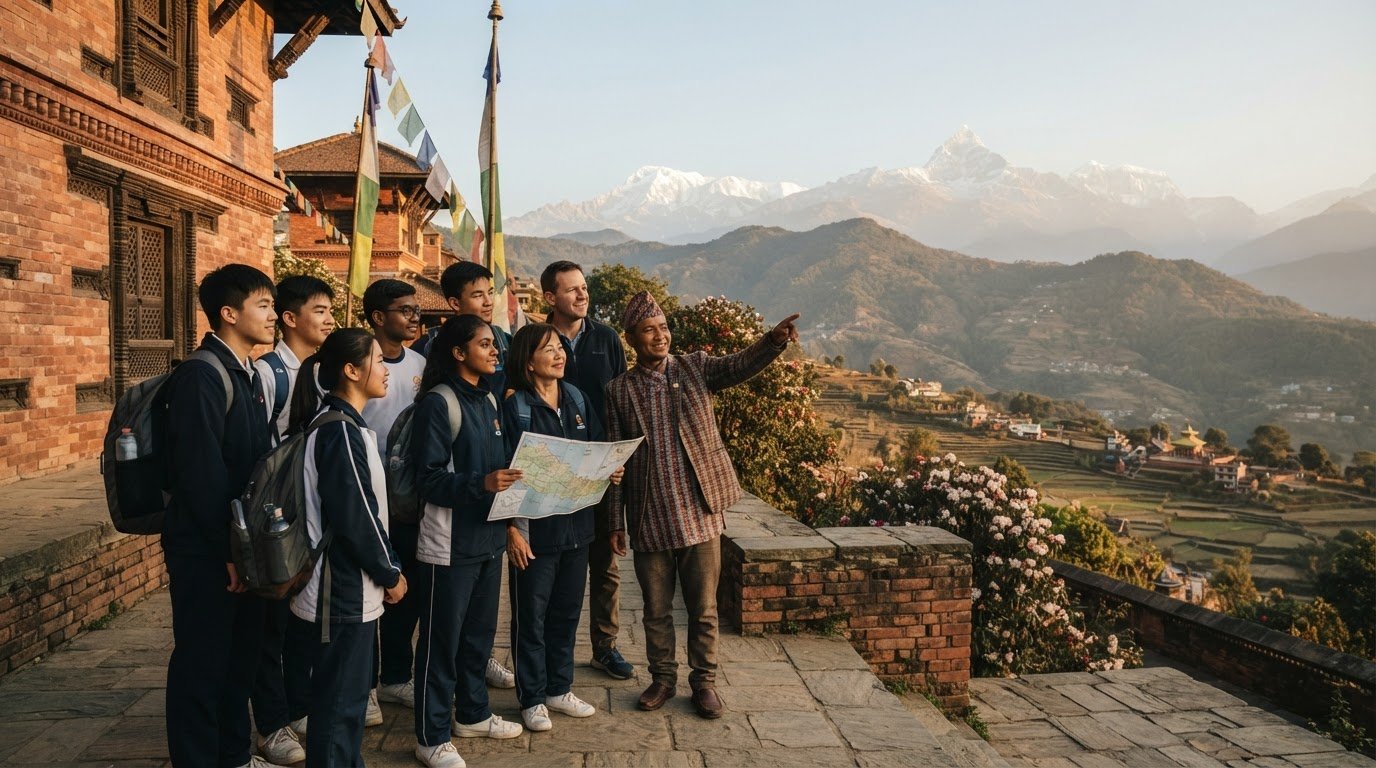
Student Group Travel in Nepal: 2026 Planning Guide
What makes the right student group travel Nepal itinerary? It’s not necessarily the one with the most stops. It’s the one that fits your students’ learning goals, abilities and needs, while giving leaders a manageable plan for supervision and travel.
Start with the group, not a preset route. A thoughtful programme can bring classroom themes to life through cultural encounters, shared challenges and time to reflect. To make it work, plan for the practical details too: transport, accommodation, guiding, entry requirements and any trekking rules relevant to the itinerary.
This 2026 planning guide explains how to shape a Nepal trip around your group’s interests and capabilities, prepare for safety and supervision, and organise key logistics before departure. You’ll also see how Brothers International Tours & Trading Pte Ltd’s School & College Trip offering can bring learning and adventure together through guided package planning that coordinates essential arrangements. Start with clear goals, then build a journey with purpose and room for discovery.
Key Takeaways
- Start planning student group travel Nepal by defining learning priorities, student abilities, trip length and the level of activity your group wants.
- Match cultural, heritage, nature and trekking experiences to your goals, and leave time for travel, rest and reflection.
- Assess suitability by considering the itinerary, supervision, preparation and current conditions. Don’t assume every activity suits every group.
- Use a clear planning sequence to define your brief, compare trip formats, organise practical requirements and prepare students.
- Brothers International Tours & Trading Pte Ltd’s School & College Trip brings guided travel and learning together as part of a family-owned travel agency established in 1992.
Student group travel in Nepal: define the trip before choosing an itinerary
Begin with the group, not a map full of tempting stops. Before comparing cultural visits, nature experiences or trekking routes, agree on four starting points: what students should learn, who is travelling, how much time the group has and what level of activity is appropriate. These answers give organisers a practical way to assess each itinerary option.
Student group travel Nepal is a guided journey designed around a student cohort’s learning goals, capabilities and shared experience, rather than a general holiday adapted for a school group. A class trip needs purposeful activities, adult supervision and arrangements that work for people travelling together. First define the educational aims, then consider how trip length, transport and accommodation will affect the experiences you can include.
For background on Nepal’s tourism organisation, the Nepal Tourism Board overview provides useful context. Your group’s brief should start with the students and the outcomes you want them to take home.
What should a school or college trip achieve?
Choose a small number of outcomes before discussing destinations. Your group might prioritise cultural exchange and history, confidence and teamwork, or nature and environmental learning. These goals can overlap, but identifying the main ones helps adults decide whether an activity adds value or simply fills time.
Make the outcomes easy to explain to students and accompanying adults. If teamwork is a priority, for example, look for shared tasks and time for group reflection, not just a demanding activity. Agreeing on the purpose early sets expectations and gives the school a clear basis for decisions.
Who is the trip being designed for?
Build a realistic picture of the cohort. Consider students’ ages, mobility, interests, previous travel experience and range of fitness levels. Some may be keen hikers, while others may be more comfortable with shorter walks or less strenuous days. That range is a reason to discuss activity levels carefully and plan a suitable balance, rather than choosing the boldest or easiest option for everyone.
Include accompanying adults in the planning picture. Their supervision responsibilities, the school’s approval process and the group’s needs all affect how the journey can work in practice. Suitability depends on the activity and the particular cohort, not a universal age cut-off. A clear group profile also helps a trip organiser tailor a guided plan, coordinating local transport, accommodation, guides and permit processing around the intended experience.
Write a short planning brief before requesting itinerary ideas. Note the priority outcomes, group profile, available trip length, preferred activity level and essential logistical requirements. Keep the route open at this stage. The aim is to give everyone a shared starting point, not to lock in every stop. With that foundation, you can turn the group’s purpose into a balanced Nepal itinerary.
Build a Nepal student itinerary around learning goals and group ability
Once the group’s priorities are clear, build a programme with a deliberate rhythm. A strong itinerary isn’t a checklist of famous places. It gives students time to engage with each experience, travel between activities without feeling rushed, rest after demanding days and reflect on what they’ve seen. For student group travel Nepal, the pace is part of the design, not an afterthought.
Match activities to outcomes, not just a destination checklist
Choose activities for what they can help students notice, explore or practise. A cultural encounter can prompt observation and discussion. Respectful participation can make learning more active than simply watching. Heritage experiences can bring history into focus, while nature outings can connect landscapes and local environments with guided learning and environmental awareness.
Trekking is one possible format, not a requirement for a meaningful trip. A group keen on physical challenge might include a suitable walk, while a cohort focused on cultural learning could build a rich programme around heritage, conversation and observation. A mixed itinerary can accommodate different interests, provided each activity supports the learning goals and suits the students taking part.
Use the official Nepal Tourism Board website to explore destination and activity information as you develop ideas. For more ways to connect experiences with educational aims, see this guide to educational tours in Nepal for students.
Balance challenge, travel time, and student energy
Map the demands of the whole day, not just the headline activity. Time spent travelling between locations can leave students with less energy for learning and group activities. Allow breathing room around longer journeys, build in breaks and avoid filling every day from morning to evening. Unscheduled time gives students a chance to reset and accompanying adults space to manage the day calmly.
Itinerary pacing is part of group suitability: a well-chosen activity only works when students have enough time and energy to take part meaningfully. Consider how altitude, terrain and activity intensity may affect comfort and effort, especially when combining travel with physical outings. Review current health and safety guidance for the activities under consideration, and shape the programme around the cohort rather than assuming everyone will respond in the same way.
- Cultural and heritage focus: supports observation, historical context and exchange. Allow time for discussion and respectful engagement.
- Nature-based focus: creates opportunities for environmental learning. Consider terrain, travel time and the group’s mobility.
- Trekking or mixed format: can add shared challenge and variety. Balance exertion with recovery and less demanding experiences.
Brothers International Tours & Trading Pte Ltd’s guided School & College Trip planning brings learning goals, activity choices and journey logistics together in a tailored programme.
Is Nepal suitable for student groups? Plan supervision, health, and logistics
Yes, Nepal can suit a student group, but no single itinerary works for every cohort. Suitability depends on the activities, students’ abilities, adult supervision, preparation and conditions at the time of travel. A cultural programme with modest activity demands needs different planning from a trek involving sustained walking, changing terrain or higher altitude. Set ambitious learning goals, but choose activities the group can manage comfortably.
For student group travel Nepal, careful planning means making responsibilities clear before departure and having a practical way to adapt if plans change. The aim isn’t to remove every uncertainty. It’s to help leaders respond calmly, keep students informed and make sound decisions about the programme.
Plan supervision and group communication
Decide who leads the group, who communicates itinerary updates and how adults will account for students during transfers, activity changes and free time. Make roles clear to students as well as accompanying adults. Agree on meeting points and what students should do if they become separated from the group. Keep instructions simple enough to remember in unfamiliar surroundings.
Before travelling, share a communication plan with accessible emergency contacts and a way to pass on changes. Review expectations with students, including how to stay with the group and whom to approach for help. Set procedures that suit the cohort and the activity rather than relying on a generic supervision ratio.
Build health and contingency planning into the itinerary
Gather relevant health information through the school’s established process, and consider how each activity’s demands may affect students. Decide how leaders will respond if someone feels unwell, needs to pause an activity or can’t continue as planned. Keep the itinerary flexible enough to allow a less demanding alternative when the group’s needs or conditions call for one.
Altitude guidance depends on the route and itinerary. Seek current medical advice relevant to the proposed programme rather than relying on general assumptions. Check health recommendations before departure and review them again as travel approaches. A plan written months earlier is not a substitute for current guidance.
Plan for practical disruptions too. Consider travel delays, changes to access and weather disruption, and decide how the group will regroup and receive updates if plans shift. Nepal is prone to earthquakes, while monsoon conditions can bring floods and landslides. Include natural-hazard preparedness in the risk assessment without assuming the same level of risk everywhere or in every season.
Before finalising the journey, verify entry requirements, trekking permits and activity-specific health and safety guidance against current official sources. For short-term group travel, check the appropriate entry category for each student’s nationality. Trekking requirements can depend on the route and may change. A guided package can coordinate guides, local transport, accommodation and permit processing, while the school remains responsible for its own student communication and supervision arrangements.
Clear roles, current information and sensible alternatives help organisers make a confident judgement about the right activity level. The strongest plan gives students room to explore while keeping the group’s practical needs at the centre.
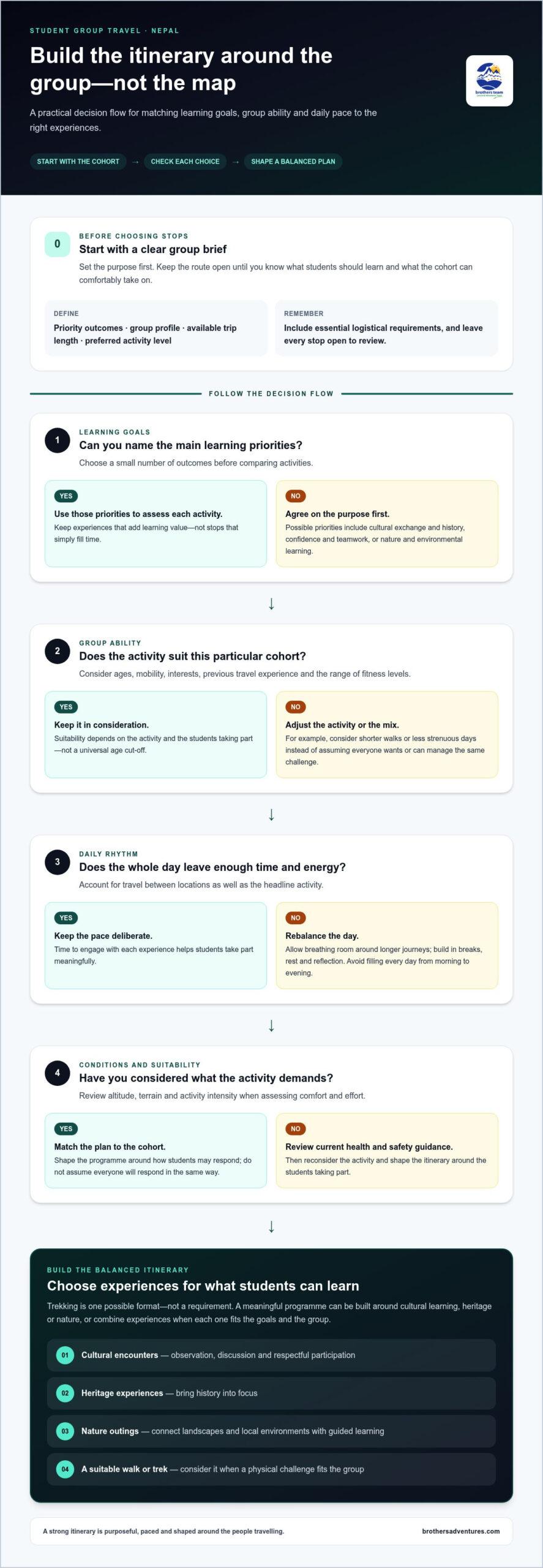
How to prepare and compare student group travel options in Nepal
Turn your planning brief into a decision process, not a race to choose the most exciting activity. For student group travel Nepal, compare each proposed format against the learning goals, students’ capabilities and practical needs. Then review how the complete journey fits together.
Use a five-step planning sequence
- Write the brief. Record learning priorities, student needs, available trip length, preferred activity level and essential requirements.
- Compare formats. Consider cultural, nature-based, trekking and mixed itineraries. Note what each offers and what it asks of the group.
- Review logistics. Look at guiding, local transport, accommodation, permit processing, travel transitions and time to rest. Assess the itinerary as a complete journey, not a collection of appealing activities.
- Prepare students. Set expectations, gather relevant information through school processes and help students connect their preparation to the trip’s purpose.
- Finalise thoughtfully. Revisit the plan against current entry, health, activity and permit guidance before confirming arrangements.
Compare the whole itinerary
Use this overview to start a conversation with students and accompanying adults. The best fit depends on the cohort and how the programme is designed.
| Format | Potential fit | Trade-offs to consider |
|---|---|---|
| Cultural and heritage | Groups prioritising history, cultural learning and observation | Needs time for context, respectful engagement and discussion, not just brief visits |
| Nature-based | Students interested in landscapes and environmental learning | Terrain, travel time and activity demands can affect accessibility and daily energy |
| Trekking | Cohorts seeking an active shared challenge | Requires close attention to fitness, route demands, altitude guidance and recovery time |
| Mixed itinerary | Groups with several learning interests or varied activity preferences | More variety can mean more transitions, so balance is essential |
When reviewing proposals, check how well each format supports the agreed outcomes, whether its pace suits the group and how guiding and key logistics are coordinated. Look for time to rest and adapt. A full schedule may look productive on paper, but students who are too tired to engage may get less from the experience. This guide to choosing a specialist tour operator offers another useful lens for assessing trip planning.
Prepare students before departure
Preparation makes expectations shared rather than assumed. Invite students to research Nepal and bring questions linked to the trip’s learning goals. Talk through respectful travel, flexibility, group conduct and each student’s role in keeping transitions organised.
- Organise current passport, entry and travel-document guidance for each student.
- Gather relevant health needs and review current medical advice for planned activities.
- Discuss cultural respect, group communication and how to respond if plans change.
- Review trekking permits and activity-specific requirements against current guidance if they apply to the itinerary.
Shape a trip around your school’s goals with Brothers Adventures’ School & College Trip planning.
Plan student group travel in Nepal with Brothers Adventures
You’ve now got the essentials: a clear purpose, an itinerary shaped for the group and a practical planning framework. The next step is bringing those pieces together. Brothers International Tours & Trading Pte Ltd’s School & College Trip offering gives school and college leaders a starting point for planning student group travel Nepal around the cohort’s goals, interests and needs.
Brothers International Tours & Trading Pte Ltd is a family-owned travel agency established in 1992. The company designs and operates guided leisure and adventure journeys, with student learning aims at the centre of the itinerary.
What guided group planning can take off the organiser’s plate
Coordinating a student journey means bringing many moving parts into one coherent plan. Brothers International Tours & Trading Pte Ltd’s travel packages include guide services, local transportation, accommodation and permit processing. Bringing these components together helps organisers consider how activities, travel between them and overnight arrangements fit into the same journey.
An itinerary is more than a sequence of stops. A guided package can connect the group’s learning purpose with practical arrangements, helping leaders focus on whether the programme suits their students and school priorities. The plan can be tailored to the group rather than forcing its goals into a fixed route.
- Guiding: supports a structured journey and helps connect experiences to the planned programme.
- Local transport and accommodation: shape the day-to-day flow of the journey.
- Permit processing: is included in the travel package where applicable to the itinerary.
School leaders remain responsible for student preparation and supervision. Coordinated travel arrangements make it easier to see how the journey’s practical elements fit together and provide a clearer foundation for discussing the itinerary with the school community.
Take the next step toward a tailored student journey
Start with what your group hopes to gain from Nepal. Share the learning purpose, students’ interests, broad capability considerations, preferred activity level and practical needs. These details help shape a journey with room for discovery and shared experiences at a pace suited to the cohort.
You don’t need to arrive with every stop decided. Begin with the outcomes you want students to remember, then build the programme around them. Brothers International Tours & Trading Pte Ltd works collaboratively with schools and colleges to connect their goals with guided travel and coordinated logistics.
Ready to turn your planning brief into a journey? Start planning a student journey in Nepal.
Give your students a journey worth carrying home
The most memorable student journeys don’t end when the group returns home. They continue to prompt questions, conversations and new perspectives. Let that lasting impact guide your planning: choose a purpose students can connect with, then shape an experience they can explore together.
With student group travel Nepal, the destination can be the start of a bigger learning story, shaped by shared discovery and experiences suited to your cohort. You don’t need every detail mapped out before you begin. Bring your school’s aspirations and the group’s needs into the planning conversation, then build from there.
Brothers Adventures welcomes school and college leaders ready to turn an idea into a considered student journey. Start planning a student journey in Nepal, and take the first step toward an experience your students can learn from, share and remember.
Frequently Asked Questions
Is Nepal suitable for a school trip?
Yes, Nepal can suit a school trip when the programme reflects students’ interests and capabilities. For student group travel Nepal, a school might choose cultural experiences and gentle nature outings instead of a strenuous trek, or combine activities for variety. Consider how students will manage the travel demands and daily routine, and review current travel advice and conditions before settling on a plan.
How far in advance should a school plan student group travel to Nepal?
Start as early as your school’s approval process and academic calendar allow. Early planning gives leaders time to agree on objectives, coordinate dates, collect passport details and organise school permissions without rushing. It also leaves room to discuss the itinerary with students and families. There’s no single lead time that suits every school, so work back from your intended departure date and set internal decision deadlines.
Do students need a visa to travel to Nepal?
Visa requirements depend on each student’s nationality. As of October 2026, most nationalities can obtain a tourist visa on arrival, and a passport needs at least six months’ validity from arrival. Short-term school trips generally use a tourist visa, not a student visa for long-term academic enrolment. Check current Nepal entry instructions for every traveller before departure, as requirements and procedures may change.
Can student groups travel in Nepal without trekking?
Absolutely. Trekking isn’t essential for a rewarding school journey. A group can focus on cultural encounters, heritage learning or nature experiences, with activities chosen to suit its interests and abilities. Students studying history might prioritise heritage visits and guided discussion, while an environmental theme could centre on observing landscapes. If the itinerary includes trekking, review route-specific permit and guide requirements.
What travel insurance should students have for Nepal?
Schools should ensure every student has suitable travel insurance for the planned itinerary. Review cover for medical care, emergency evacuation, trip interruption and any included activities, especially trekking or travel at altitude. Check policy limits, exclusions and how pre-existing conditions are treated. Make sure students and accompanying adults know how to access policy details and emergency assistance during the journey. Arrange insurance separately from tour planning.
What should students pack for a trip to Nepal?
Pack for the actual itinerary and expected conditions rather than assuming every trip needs trekking equipment. Useful basics can include comfortable walking shoes, adaptable layers, rain protection, sun protection, personal medication and copies of important travel documents. Students joining longer walks should bring footwear they’ve already worn in. Give families a shared packing list and explain which items are essential for the planned activities.
What currency do students use in Nepal?
Nepal’s currency is the Nepalese rupee. Students may find cash useful for small purchases and during travel, while card acceptance can vary, particularly away from larger centres. Agree on a simple approach with families before departure, including how students will carry and look after spending money. Check current payment arrangements for visa processing and the group’s itinerary rather than assuming cards or cash will always be accepted.


Comments are closed