



Everest Base Camp Trek Cost from Singapore: The Complete 2026 Price & Planning Guide
What if the biggest obstacle to reaching the roof of the world isn’t the thin air, but a budget that doesn’t account for the “hidden” extras? We know that calculating the total Everest Base Camp trek cost from Singapore for 2026 can feel like navigating a steep mountain pass. It is easy to get lost in the sea of varying package inclusions and the volatility of flight prices from Changi. You might be worried about unexpected fees appearing at 5,000 meters or whether a 50 USD tourist visa and 3,000 NPR park permit are already covered in your plans.
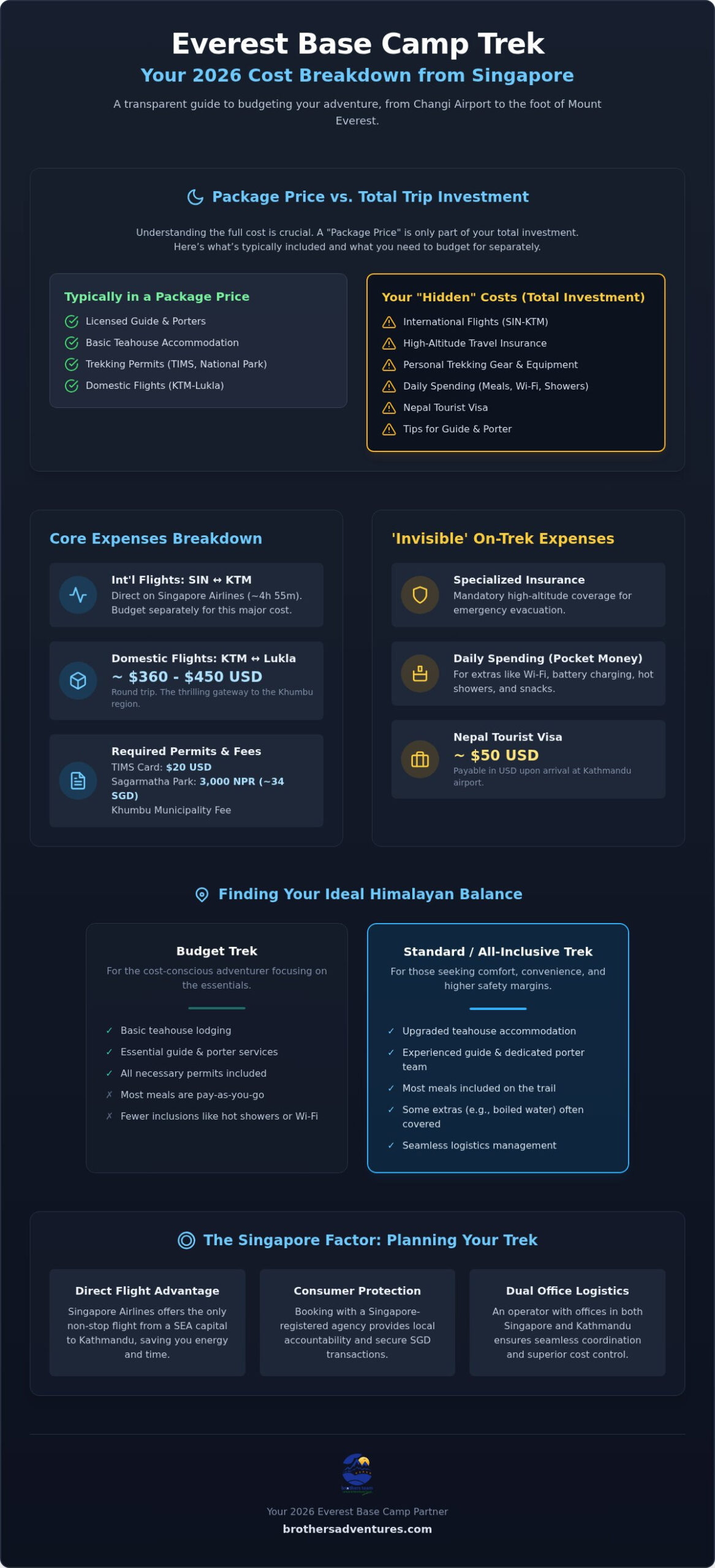
You deserve to focus on the breathtaking Khumbu views, not your spreadsheet. This guide promises to provide a transparent, SGD-ready breakdown of every expense, from the 450 USD Lukla flight to the cost of a simple hot meal on the trail. We will look at exactly how to budget for your 2026 adventure, highlighting where to save and where to splurge on safety. You will walk away with a clear plan and the confidence to choose a Singapore-managed operator that makes your journey truly seamless.
Key Takeaways
- Master the distinction between a “package price” and your “total trip investment” to ensure your 2026 budget remains rock-solid from start to finish.
- Unlock a complete breakdown of the Everest Base Camp trek cost from Singapore, including Changi flight estimates and the latest 2026 permit requirements.
- Identify “invisible” expenses such as specialized high-altitude insurance and daily teahouse spending to avoid any mid-trek financial surprises.
- Compare budget and standard trekking tiers to find your ideal balance of Himalayan wonder and professional safety.
- Discover how a dual-office model in Singapore and Kathmandu provides seamless logistics and superior cost control for your high-altitude expedition.
Navigating the 2026 Everest Base Camp Trek Cost Landscape
Standing at the foot of the world’s highest peak is a dream that hasn’t lost its luster. For Singaporeans, 2026 represents a unique window to experience the Himalayas. For those new to the region, a quick Everest Base Camp overview reveals why this trail remains the gold standard for high-altitude adventure. It is a journey through ancient Sherpa culture, dramatic suspension bridges, and glacial moraines. However, the Everest Base Camp trek cost from Singapore involves more than just a single booking fee. It is a multi-layered investment that requires careful planning to avoid the “sticker shock” often felt by unprepared travelers.
To budget effectively, you must distinguish between the “Package Price” and the “Total Trip Cost.” A package usually covers your guide, basic accommodation, and permits. Your total cost includes international flights from Changi, high-altitude insurance, personal gear, and daily spending for “luxury” items like hot showers or Wi-Fi. In 2026, global economic shifts and Nepal’s updated tourism policies mean that prices are more dynamic than in previous years. While you will likely pay your agency in SGD, you’ll need a mix of USD for your visa and NPR (Nepalese Rupees) for trail-side snacks. Currently, 1 SGD fetches between 85 and 95 NPR, making it vital to track exchange rates as your departure date approaches.
Major Factors Influencing Your 2026 Budget
Timing is everything. Spring (March to May) and Autumn (September to November) remain the premium windows, offering clear skies but higher price points for teahouse stays. In 2026, Nepal’s mandatory guide requirements are strictly enforced, meaning solo trekking is no longer a cost-saving option. You must hire a licensed guide, which adds to the safety and the cost. Additionally, inflation in the Khumbu region has slightly increased the price of fuel and imported goods, so your daily “pocket money” for boiled water and battery charging should be adjusted accordingly.
The ‘Singapore Factor’ in Trek Planning
The Core Expenses: Flights, Permits, and Expedition Packages
Your journey begins long before you step onto the trail. When calculating the total Everest Base Camp trek cost from Singapore, the first major hurdle is securing your passage to Nepal. Changi Airport offers several paths to Kathmandu, but the choice between a direct flight and a transit option significantly impacts both your wallet and your energy levels. Once in Nepal, the logistics shift to the domestic hop to Lukla, the gateway to the Khumbu region. These core expenses form the foundation of your budget, and getting them right ensures a smooth start to your expedition.
Flight Logistics from Changi to Kathmandu
Singapore Airlines is the gold standard for this route, providing the only non-stop flight that lands you in Kathmandu in just under five hours. While full-service carriers often command a higher price, the convenience of avoiding long layovers in cities like Bangkok or Kuala Lumpur is invaluable for peak performance. After arriving in the capital, you must budget for the domestic flight to Lukla, which typically ranges from 360 USD to 450 USD for a round trip. Keep in mind that 2026 travel may still involve diversions to Manthali Airport during peak seasons to manage air traffic. Flexible flight booking is absolutely essential for 2026 Himalayan travel to account for weather-related delays or sudden schedule shifts. For a truly seamless experience, many trekkers look for an Everest Base Camp Trek package that handles these complex internal transfers.
Permits and Local Government Fees
You cannot simply walk into the Everest region; you need the right paperwork. Nepal’s authorities require several specific permits to ensure trekker safety and environmental conservation. You’ll need the TIMS (Trekkers’ Information Management System) card, which costs 20 USD, alongside the Khumbu Pasang Lhamu Rural Municipality permit. Additionally, the entry permit for Sagarmatha National Park costs 3,000 NPR (roughly 34 SGD). For the most accurate and up-to-date official trekking permit information, the Nepal Tourism Board remains the primary resource. Specialist operators usually bundle these fees into their packages, saving you the hassle of navigating government offices in Kathmandu upon arrival.
Expedition packages generally fall into two categories: Standard and Premium. A standard trek focuses on quality teahouse accommodation and expert guiding. Premium options might include luxury lodges in lower altitudes, higher porter-to-trekker ratios, or even helicopter returns from base camp to save time. Deciding which tier fits your needs depends on your comfort threshold and how much you value those extra recovery perks after a long day on the trail.
The ‘Invisible’ Costs: Gear, Insurance, and Daily Spending
Many trekkers focus solely on the booking fee, but the Everest Base Camp trek cost from Singapore includes several “invisible” layers that are just as vital. These are the small daily transactions and the upfront gear investments that form the essential support system for your journey. While your package might cover the big items like lodging and meals, you’ll need a separate stash of cash for the comforts that make life on the trail much more bearable. Preparing for these expenses now ensures that you can focus on the majestic peaks rather than your wallet when you’re at 5,000 meters.
Gear Investment: Buying in Singapore vs. Renting in Kathmandu
Don’t wait until you reach Nepal to think about your feet. Investing in high-quality trekking boots at Singapore outdoor retailers is a non-negotiable expense. You’ll need at least three months to break them in on the Bukit Timah trails or the MacRitchie ridges. However, you can save significant baggage weight and money by renting heavy items like -20°C sleeping bags or professional-grade down jackets in Kathmandu’s Thamel district. This “buy vs. rent” strategy allows you to invest in personal items that require a perfect fit while saving on bulky gear you might only use once. To make sure you’re packing only what you truly need and nothing more, consult our comprehensive Everest Base Camp trek packing list that separates essential gear from the heavy myths that weigh down your pack.
- Invest in Singapore: Moisture-wicking base layers, high-quality merino wool socks, and well-fitted trekking boots.
- Rent in Kathmandu: Heavy-duty down jackets and four-season sleeping bags for a few dollars per day.
- Safety check: Always inspect rented gear for loft and zipper integrity before leaving the shop.
Insurance and Emergency Contingencies
Standard travel insurance plans often exclude activities above 3,000 meters. For EBC, your policy must specifically cover helicopter evacuation up to 6,000 meters. This isn’t just a formality; it’s a critical safety net given the altitude sickness risks inherent in such a rapid ascent. Comprehensive high-altitude insurance is an absolute necessity for 2026 expeditions to ensure that a medical emergency doesn’t become a financial catastrophe. Expect to pay a premium for this coverage, but remember that it’s the most important investment you’ll make for your peace of mind.
Daily Spending and Tipping Culture
The teahouse economy is a cash-based world. Once you leave Lukla, expect to pay for “extras” that aren’t usually in a standard package. Hot showers can cost between 300 and 600 NPR (approximately 3 to 6 SGD), and charging your power bank or camera batteries often incurs a fee of 300 to 500 NPR. Tipping is also a deeply ingrained part of Himalayan culture. It’s common practice to budget roughly 10% to 15% of your trek price for your guides and porters. They’re the backbone of your expedition, and these tips are a direct way to support the local families who make your adventure possible.
Budgeting Tiers: Finding Your Ideal Himalayan ROI
One size rarely fits all when it involves the roof of the world. Your personal Everest Base Camp trek cost from Singapore will fluctuate based on how much comfort you require after a grueling eight-hour hike. Think of your budget as an investment in your success rate. While it’s tempting to hunt for the lowest price, ultra-cheap packages often represent a “false economy.” These bottom-tier options usually cut costs by hiring inexperienced guides or skimping on nutritious meals, which are the very things that keep you moving toward the finish line. If a package is significantly cheaper, the operator likely cut corners on safety equipment or guide wages, which can compromise your entire experience.
For the Budget Trekker, every cent counts. You’ll stay in basic teahouses and carry most of your own gear. However, the Standard Experience is the most popular choice for Singaporean professionals. It strikes a perfect balance between rugged adventure and essential comforts like reliable porters and experienced lead guides. If you prefer the finer things, the Premium Expedition offers heated rooms in luxury mountain lodges and gourmet dining, turning a high-altitude challenge into a sophisticated retreat. Deciding where you sit on this spectrum determines your daily rhythm and recovery speed. Trekkers who find the Khumbu Valley calling to them often also explore the equally dramatic Annapurna Base Camp trek itinerary as a complementary Himalayan adventure that offers a different perspective on Nepal’s 8,000-meter giants.
Standard vs. Premium: What Are You Paying For?
The most critical difference isn’t the thread count of your sheets; it’s the guide-to-trekker ratio. In a premium setup, you might have one guide for every two trekkers. This ensures personalized attention if you struggle with the pace. Standard packages usually offer a 1:4 or 1:5 ratio, which is still highly effective for safety. You’re also paying for dietary flexibility. Premium lodges often provide diverse menus that cater to specific needs, keeping you fueled with high-quality protein and complex carbohydrates.
Strategic Splurging: Where to Spend Extra
Spend extra on an additional acclimatization day. Rushing the ascent is the fastest way to end your trip early due to altitude sickness. This extra day in Namche Bazaar allows your body to produce the red blood cells needed for the final push. Another wise investment is choosing a specialist tour operator who provides end-to-end logistics. Having Singapore-side support means you can walk into an office in the CBD for pre-trip guidance before you ever leave Changi.
Choosing a team that understands the full Everest Base Camp trek cost from Singapore ensures there are no surprises once you reach the mountains. Ready to start your journey with a family-owned team that knows every stone on the path? Explore our Everest Base Camp Trek options to find your perfect fit and begin your 2026 adventure with absolute confidence.
Brothers Adventures: Your 2026 Everest Base Camp Partner
Transparency is the cornerstone of our service. We believe that your focus should remain on the stunning vistas of the Khumbu, not on “mountain surprises” or hidden surcharges. Our pricing models are comprehensive, covering the essential logistics we discussed in earlier sections. Beyond the budget, Brothers International Tours & Trading Pte Ltd prioritizes your life and well-being above all else. Our expert guides are trained in rigorous safety protocols, including daily oxygen saturation monitoring and altitude health checks. This high-touch approach ensures that your journey to the base of the world’s highest peak is as safe as it is exhilarating.
The Advantage of Local & Singaporean Expertise
Imagine being able to walk into a Singapore office to discuss your Everest Base Camp trek planning before you ever set foot in Changi. Brothers International Tours & Trading Pte Ltd provides direct, face-to-face support to help you navigate gear selection, visa requirements, and physical preparation. For Singapore-based trekkers, we offer personalized training advice on how to use our local terrain, like the stairs of Bukit Timah or the trails of MacRitchie, to build the specific stamina required for the Himalayas. Once you land in Kathmandu, our local team takes over seamlessly, managing everything from your Lukla flight logistics to your teahouse bookings with the precision only a local expert can provide.
Ready to Start Your 2026 Journey?
Your 2026 adventure is closer than you think. We are currently opening our departure calendar for the upcoming Spring and Autumn seasons, offering early-bird opportunities for those ready to commit to their Himalayan dreams. Whether you are a solo traveler looking for a supportive group or a private team seeking a customized itinerary, Brothers International Tours & Trading Pte Ltd can tailor a quote that fits your specific needs and comfort level. Don’t let the complexity of planning hold you back from the experience of a lifetime. Reach out to our Singapore team today to discuss your goals, and let us show you how a well-planned budget leads to a legendary expedition.
View our Everest Base Camp Trek packages and start your adventure today.
Step Into the Shadow of Giants
Planning for the roof of the world is a significant undertaking, but as we’ve explored, a transparent Everest Base Camp trek cost from Singapore makes this legendary dream achievable. You now have the tools to navigate international airfare from Changi, the latest 2026 permit regulations, and the daily teahouse expenses that often catch unprepared travelers off guard. By choosing to invest in safety and local expertise rather than hunting for the cheapest package, you are ensuring that your Himalayan journey is defined by wonder rather than financial worry.
Brothers International Tours & Trading Pte Ltd has been a trusted companion for Singaporean explorers since 1992. With our dedicated offices in both Singapore and Kathmandu, we provide a seamless bridge to the mountains, backed by rigorous high-altitude safety protocols that prioritize your well-being. Don’t let the logistics of the Khumbu keep you on the ground. Book your 2026 Everest Base Camp Trek with Brothers International Tours & Trading Pte Ltd and take the first step toward the summit of your own personal ambition. The mountains are waiting, and we’re ready to lead the way.
Frequently Asked Questions
How much should I budget for flights from Singapore to Kathmandu in 2026?
Flight prices from Changi fluctuate based on seasonality and how early you book. Singapore Airlines offers the only direct, non-stop flight which takes about 4 hours and 55 minutes, providing the most comfort for your expedition. While budget transit options via Kuala Lumpur or Bangkok exist, they often involve long layovers that can drain your energy before the trek even begins.
Is it cheaper to book an EBC trek in Kathmandu or from Singapore?
Booking in Kathmandu might seem cheaper on paper, but it often lacks the consumer protection and pre-trip support of a Singapore-registered agency. Choosing an operator with a dual-office presence ensures you have local accountability and reliable logistics. This security is a vital component when calculating the total Everest Base Camp trek cost from Singapore, as it prevents costly “surprises” during your journey.
What is the average cost of travel insurance for the Everest Base Camp trek?
Travel insurance premiums vary, but your policy must specifically cover helicopter evacuation up to 6,000 meters. Standard travel plans don’t usually include high-altitude trekking, so you’ll need a specialized policy. Budgeting for a comprehensive plan that covers altitude-related illnesses is essential to avoid paying out-of-pocket for emergency evacuations, which can cost thousands of dollars.
How much cash should I carry on the trek for daily expenses?
Carry approximately 20 to 30 SGD worth of Nepalese Rupees (NPR) per day for personal trail expenses. This cash covers comforts like hot showers, which cost between 300 and 600 NPR, and charging your electronic devices. Since ATMs are non-existent past Namche Bazaar, it’s best to withdraw all your required NPR in Kathmandu before you fly into Lukla.
Can I save money by trekking to Everest Base Camp without a guide in 2026?
No, you cannot trek independently in 2026 because Nepal has made licensed guides mandatory for all trekkers in the region. This regulation ensures better safety and supports the local economy. While this adds a fixed cost to your budget, the expertise of a professional guide is invaluable for navigating terrain and monitoring your health against altitude sickness.
What are the hidden costs people often forget when budgeting for EBC?
Trekkers often forget the Nepal tourist visa fee, which is 50 USD for a 30-day stay for Singaporean passport holders. Other “invisible” costs include the 3,000 NPR Sagarmatha National Park permit and daily fees for Wi-Fi or boiled drinking water. Factoring these small but frequent expenses into your Everest Base Camp trek cost from Singapore ensures your budget remains realistic.
How much should I tip my guides and porters at the end of the trek?
Tipping is a deeply ingrained part of Himalayan trekking culture and usually totals 10% to 15% of your trek package price. This money is a direct way to thank the local team who carried your gear and ensured your safety. It is customary to present these tips in cash during a small farewell ceremony on your final night in Lukla.
Is the cost of the Lukla flight included in most Singapore tour packages?
Most reputable Singaporean operators include the round-trip flight to Lukla in their all-inclusive packages. However, you should always verify if the internal flight is part of the quoted price or listed as an add-on. Given that these flights can cost up to 450 USD, having them bundled simplifies your planning and protects you from price hikes.




Comments are closed