


Everest Base Camp Trek Packing List 2026: The Expert Myth-Busting Guide
Most trekkers carry five kilograms of gear they’ll never actually use, while missing the one layer that keeps them from shivering at 5,000 meters. It’s completely natural to feel overwhelmed when staring at a wall of expensive technical gear or worrying if your sleeping bag is warm enough for the Khumbu’s biting nights. You want to be prepared, but you also don’t want to exceed the strict 15 kg baggage limit for your flight to Lukla. This 2026 Everest Base Camp trek packing list strips away the marketing noise to show you exactly what belongs in your duffel and what should stay at home.
We understand the pressure of getting your gear right because we’ve been guiding families and adventurers through these trails since 1992. We promise to help you master the science of high-altitude packing by separating essential gear from the heavy myths that weigh down your pack and your budget. In this guide, we break down the mandatory layering system, explain how to navigate Kathmandu’s local gear markets, and ensure you feel total confidence in your gear investment before you step onto the trail.
Key Takeaways
- Build a high-performance Everest Base Camp trek packing list by focusing on a curated system of essentials rather than carrying a fresh outfit for every day.
- Master the professional 4-layer system to trap insulating air and regulate your body temperature effectively as you move through rapidly changing mountain climates.
- Prioritize mid-weight, waterproof trekking boots with strong ankle support over heavy mountaineering boots to maintain agility and comfort on the rocky Himalayan trails.
- Equip yourself with high-capacity power banks instead of relying on solar chargers, which often struggle with the Khumbu’s unpredictable cloud cover and extreme cold.
- Save valuable luggage weight by utilizing Kathmandu’s vibrant gear markets for high-quality rentals like down jackets and sleeping bags.
Debunking the “More is Better” Packing Myth for EBC
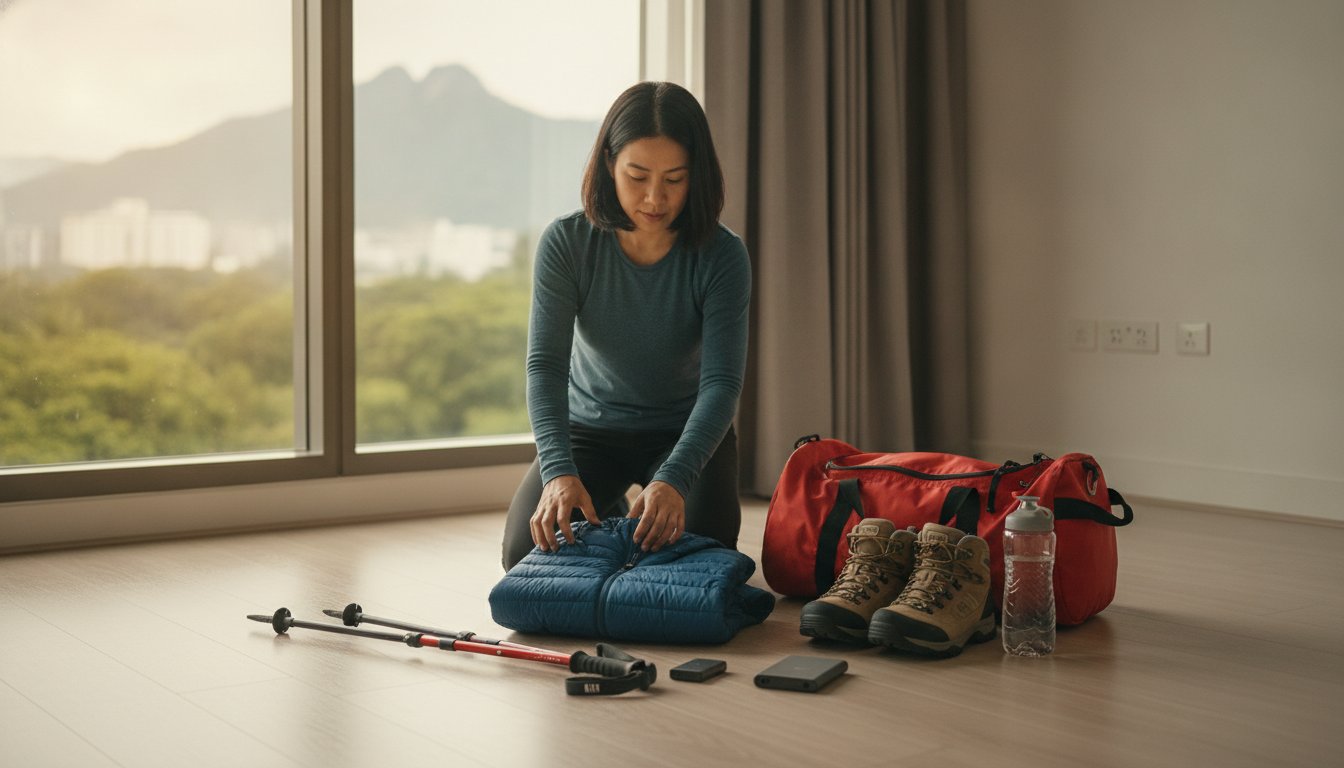
Many first-time trekkers approach their Everest Base Camp trek packing list with a “just in case” mentality that leads to overstuffed bags and unnecessary stress. In the thin air of the Himalayas, every gram matters. We define the modern packing list as a curated system of high-performance gear designed to work together, rather than a collection of individual items. You don’t need a fresh change of clothes for every single day of the trek. In fact, trying to pack fourteen different outfits is a recipe for logistical disaster at Lukla airport.
Why Cotton is Your Greatest Enemy
Cotton is often called the death fabric in high-altitude environments. When you sweat during a steep climb toward the Everest Base Camp trek, cotton fibers soak up that moisture and hold it against your skin. As soon as you stop moving or the wind picks up, that damp fabric saps your body heat at an alarming rate. This leads to rapid chilling and, in extreme cases, hypothermia. The “Death by Denim” myth is equally real; jeans are heavy, offer zero insulation when wet, and restrict your movement on rocky steps. Stick to synthetic blends or wool to stay dry and warm.
The Ethics of Packing Light
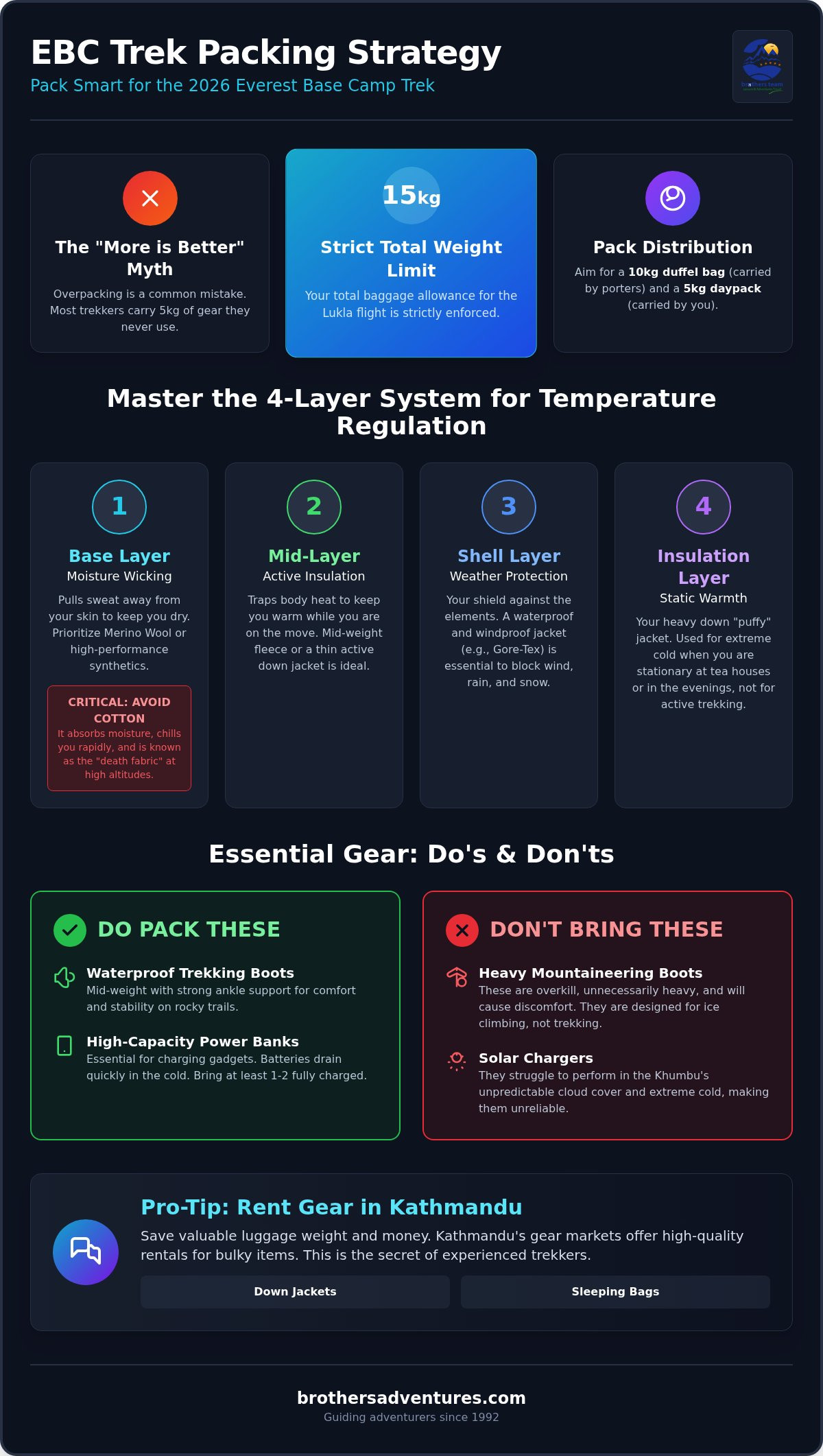
Packing light isn’t just about making your flight; it’s about the health and safety of the incredible porters who make these journeys possible. While our Everest Base Camp trek cost from Singapore includes professional porter support, it’s our collective responsibility to ensure they aren’t overloaded. Aim to keep your main duffel bag around 10 kg, leaving the remaining 5 kg for your personal daypack. This distribution ensures your gear is manageable for the team and allows you to carry your own water, snacks, and camera gear comfortably throughout the day.
The 4-Layer System: Mastering Temperature Regulation
“One massive, heavy jacket will keep me warm.” This is perhaps the most dangerous misconception trekkers bring to the Himalayas. While a heavy parka has its place, relying on it as your sole heat source is a mistake. The real magic happens through temperature regulation. By trapping thin pockets of warm air between multiple layers, you create a customizable microclimate that adapts to your effort level and the environment. This approach is the cornerstone of any successful Everest Base Camp trek packing list.
Your system begins with a high-quality base layer made of merino wool or high-performance synthetics. Merino is a favorite for 2026 because it regulates temperature beautifully and resists odors during long stretches between laundry opportunities. Synthetics are excellent for high-intensity days as they wick moisture away from your skin faster than any other material. Above this, add a mid-layer like a mid-weight fleece or a thin, active down jacket to provide the primary insulation your body needs while moving. This combination ensures you stay warm without the bulk that hinders your movement on steep inclines. The same layering principles apply whether you’re tackling the Khumbu or following an Annapurna Base Camp trek itinerary through the Sanctuary, making this system one of the most versatile investments in your trekking wardrobe.
The Outer Shell: Your Shield Against the Khumbu Wind
Your shell layer acts as the final barrier against the elements. A hard-shell jacket is your best friend when the wind howls or snow begins to fall, providing a completely windproof and waterproof seal. For milder, high-exertion days, a soft-shell offers better breathability and stretch, which prevents you from overheating while climbing steep ridges. Gore-Tex is a breathable, waterproof membrane essential for 2026 treks. This technology allows internal sweat vapor to escape while blocking external moisture from entering. To see how these technical pieces fit into a broader equipment strategy, you can reference REI’s EBC Packing Guide for additional brand-specific insights.
The Down Jacket: The “Big Puff” Myth
The heavy down jacket, or the “big puff,” is often misunderstood. You won’t actually wear this while trekking; you’ll overheat in minutes. Instead, this jacket is your sanctuary once you reach the teahouse or during early morning starts before the sun hits the trail. Look for a jacket with a fill power of 800 or higher. This number represents the quality of the down; an 800-fill jacket provides more warmth for less weight than a 600-fill alternative, which is vital for staying under your baggage limit. For those preparing for an Everest Base Camp trek from Singapore, we recommend testing your full layering system in a local “snow city” or cold chamber to understand exactly how your body reacts to sub-zero temperatures. If you’re ready to put your gear to the test, our guided Everest Base Camp Trek offers the perfect balance of adventure and expert support.
Boots, Backpacks, and Poles: Technical Gear Realities
Your feet are your most important asset on the trail, yet many trekkers mistakenly believe they need heavy, double-soled mountaineering boots designed for summiting peaks. This is a common myth that often leads to heavy feet and unnecessary fatigue. For the rocky, uneven terrain of the Khumbu, mid-weight, waterproof trekking boots with high-quality ankle support are the ideal choice. These provide the necessary stability for the long days of walking without the restrictive bulk of a technical climbing boot.
When finalizing your Everest Base Camp trek packing list, the most critical rule for footwear is the break-in period. Unlike some guides that simply suggest avoiding a local purchase in Kathmandu, we emphasize that you must break in your boots for at least two months before your departure. Your feet need time to bond with the material and identify potential hot spots. While you’re focusing on physical prep, take a moment to review the CDC Health Guidelines for Nepal to ensure your medical preparation is as solid as your gear selection.
Trekking poles are often viewed by beginners as a luxury, but they are a joint-saving necessity. On the steep descents from Namche Bazaar or the rocky moraine near Gorak Shep, poles can reduce the impact on your knees by up to 25 percent. They provide vital balance on slippery surfaces and help maintain a consistent rhythm during the long, rhythmic climbs. Don’t leave home without a pair of lightweight, collapsible poles with comfortable cork or foam grips.
The Daypack: Your Mobile Command Center
Your daypack is the only piece of gear you’ll carry yourself, so choose one with a volume between 25 and 35 liters. It needs to be large enough to hold your hydration bladder, camera, sunblock, and your waterproof shell, but light enough not to strain your shoulders. Look for essential features like a supportive hip belt to transfer weight to your legs, a rain cover for unexpected showers, and a ventilated back panel to keep you cool during the sunny afternoons in the lower valley.
Sleeping Bags: Survival vs. Comfort Ratings
Teahouses can be incredibly cold at night, often dropping well below freezing inside the unheated bedrooms. A sleeping bag with a -15°C (5°F) comfort rating is the non-negotiable standard for EBC. Be careful not to confuse “extreme” ratings with “comfort” ratings; the former only means you’ll survive, while the latter means you’ll actually sleep. A down bag offers the best warmth-to-weight ratio, while a silk liner is a secret weapon that adds roughly 5 degrees of warmth and provides a clean, familiar barrier against teahouse blankets.
The “Hidden” Essentials: Health, Hygiene, and Gadgets
While your boots and layers form the foundation of your journey, the small items often tucked into the corners of your pack determine your daily comfort and safety. Many travelers mistakenly believe they can rely on solar chargers for all their power needs. In reality, the unpredictable cloud cover of the Khumbu and the extreme cold temperatures make high-capacity power banks a much more reliable choice for your Everest Base Camp trek packing list. Cold weather drains lithium batteries at an accelerated rate. A solar panel that takes eight hours to charge in perfect conditions becomes a decorative weight when the afternoon mist rolls in.
Your altitude pharmacy is your most vital safety net. Prepare a kit that includes Diamox for altitude acclimatization, broad-spectrum antibiotics, and plenty of hydration salts to combat the dehydrating effects of thin air. We’ve guided thousands of trekkers since 1992, and we know that small health issues can escalate quickly if ignored. Don’t underestimate the power of the Himalayan sun. At these elevations, UV radiation is approximately 40 percent stronger than at sea level. This makes high-SPF sunblock, lip balm with UV protection, and category 4 polarized sunglasses essential to prevent painful burns and snow blindness.
Sustainable Hygiene in the Himalayas
Maintaining cleanliness is a challenge when hot showers become a rare luxury. Master the “Wet Wipe Bath” by packing large, unscented wipes to stay fresh after a long day of trekking. Always use biodegradable soap and adhere to “Leave No Trace” ethics to protect the fragile alpine ecosystem. Managing your waste is a collective responsibility. Never leave used batteries or electronics in the mountains. Carry them back to Kathmandu where they can be disposed of properly through established recycling channels.
Gadgets that Actually Work at 5,364m
Success with electronics requires proactive battery management. Sleep with your phone, camera batteries, and power bank inside your sleeping bag to prevent the overnight cold from killing their charge. A powerful headlamp with a fresh set of spare batteries is non-negotiable for the early morning push to Kala Patthar. While teahouse Wi-Fi has improved, it remains spotty and expensive at high altitudes. Bring a physical book or ensure your maps are available offline to stay entertained and oriented when the signal fails. If you want a team that handles the logistical heavy lifting so you can focus on the wonder of the trail, book your Everest Base Camp Trek with us today.
Final Preparation: Weight Limits and Pro-Tips from Brothers Adventures
Perform a rigorous gear audit 24 hours before you head to the airport. Check every zipper, test your water filtration system, and ensure your headlamp batteries are fresh. If you realize you’ve forgotten a vital piece of equipment, don’t panic. The Thamel district in Kathmandu is a world-renowned hub for trekking gear. While we recommend bringing your broken-in boots from home, you can easily buy high-quality dry bags, trekking poles, and even sunblock locally. Choosing an experienced tour operator is vital for these final gear logistics, as they provide the bridge between your preparation and the realities of the trail.
The Lukla Flight Weight Constraint
The total baggage allowance for the flight to Lukla is strictly 15 kg per passenger. This is divided into 10 kg for your checked duffel bag and 5 kg for your daypack. To navigate this limit without sacrificing safety, wear your heaviest items on the plane. Put on your trekking boots, zip up your mid-layer, and carry your heavy down jacket over your arm. This simple trick can save you nearly two kilograms of luggage weight. Most hotels in Kathmandu provide secure, free storage for your “city clothes” and non-trekking items, allowing you to keep your trekking duffel lean and efficient. Before you finalize your kit, it’s worth reviewing a complete door-to-door Everest Base Camp trek cost from Singapore so you can budget accurately for every expense from Changi Airport to the Khumbu Glacier.
The Brothers Adventures Family Touch
Since 1992, our family has been helping trekkers navigate the complexities of the Himalayas. Our deep local knowledge means we don’t just give you a list; we provide a safety net. With offices in both Singapore and Kathmandu, we offer hands-on support for gear rentals, including high-quality down jackets and sleeping bags that meet our strict safety standards. We treat every guest like a member of our own family, ensuring you have the right equipment to feel warm, safe, and inspired. Ready to start your journey? Contact Brothers Adventures to plan your 2026 EBC expedition and let us handle the details while you focus on the summit views.
Step Into the Shadow of Giants
You’ve now mastered the essential science of high-altitude preparation. By focusing on a versatile 4-layer system and respecting the strict 15 kg weight limit, you’re already ahead of most trekkers on the trail. Your Everest Base Camp trek packing list isn’t just a collection of gear; it’s a strategic toolkit designed to keep you safe and comfortable in one of the world’s most breathtaking environments. From breaking in your boots months in advance to choosing high-capacity power banks over unreliable solar chargers, every decision you make now paves the way for a successful journey.
Since 1992, we’ve acted as the bridge between adventurous travelers and the majestic peaks of Nepal. Our family-owned expertise and dual offices in Singapore and Kathmandu ensure you’re never alone in your preparation. We prioritize comprehensive, safety-first itineraries that allow you to focus on the wonder of the journey while we handle the logistics. The mountains are calling, and you’re now equipped with the knowledge to answer.
Start your Himalayan journey with Brothers Adventures and experience the magic of the Khumbu with a team that treats you like family. We’ll see you on the trail.
Frequently Asked Questions
How much should my pack weigh for the Everest Base Camp trek?
Your total baggage for the flight to Lukla is strictly limited to 15 kg (33 lbs) per passenger. This weight is typically divided into a 10 kg checked duffel bag carried by a porter and a 5 kg daypack that you carry yourself. Staying within these limits is crucial for flight safety and the health of your trekking team. If you find your Everest Base Camp trek packing list is getting too heavy, consider wearing your heaviest layers and boots on the plane to save space.
Can I rent trekking gear in Kathmandu instead of buying it?
You can easily rent high-quality technical gear in the Thamel district of Kathmandu. Items like heavy down jackets and -15°C sleeping bags are perfect for renting to save on your initial investment. However, never rent trekking boots. You must purchase your own footwear at least two months before your trip to ensure they are fully broken in, which is the only way to prevent painful blisters on the trail.
Do I really need a down jacket for the EBC trek in 2026?
A high-quality down jacket is a non-negotiable item for every trekker in 2026. While you’ll stay warm while walking, temperatures inside unheated teahouses drop significantly once the sun goes down. You’ll need the “big puff” for evenings in the dining hall and for the freezing pre-dawn climb to Kala Patthar. Look for a jacket with at least 800-fill power to get the best warmth-to-weight ratio for your pack.
What kind of water purification should I bring to Nepal?
Use chlorine or iodine purification tablets or a portable UV water purifier like a Steripen. Buying plastic bottled water is discouraged to protect the fragile Himalayan environment and can become quite expensive as you gain altitude. Ensure your purification method is effective against both bacteria and viruses. Many trekkers also bring a lightweight, collapsible water bottle to use as a hot water bottle in their sleeping bag at night.
Are trekking poles absolutely necessary for beginners?
Trekking poles are an absolute necessity for beginners and experienced trekkers alike. They provide vital stability on the uneven, rocky terrain of the Khumbu and can reduce the impact on your knee joints by up to 25 percent during steep descents. Using poles also helps you maintain a steady, rhythmic pace, which is essential for managing your energy levels and successfully reaching Base Camp.
What is the best type of socks for preventing blisters at high altitude?
The best socks for the Himalayas are made of high-quality merino wool. This natural fiber regulates temperature, wicks moisture away from your skin, and is naturally antimicrobial to prevent odors. For maximum blister protection, many experts recommend a “two-layer” system: a thin synthetic liner sock worn under a thicker merino wool trekking sock. This setup reduces the friction that causes hot spots during long days of walking.
How do I keep my electronics charged during the trek?
Rely on high-capacity power banks rather than solar chargers, which often fail in cold or cloudy conditions. Bring at least two 10,000mAh or 20,000mAh banks to keep your phone and camera functioning. To preserve battery life, keep your electronics and power banks inside your sleeping bag at night. The warmth from your body prevents the sub-zero temperatures from draining the lithium batteries while you sleep.
Is there laundry service available on the way to Base Camp?
Limited laundry services are available in larger villages like Namche Bazaar, but they become non-existent as you climb higher. Most trekkers choose to hand wash small items like socks and underwear in the afternoons using biodegradable soap. However, things dry very slowly in the thin, cold air. It’s best to follow a strategic Everest Base Camp trek packing list that utilizes antimicrobial fabrics, allowing you to wear layers for several days without needing a wash.


Comments are closed