



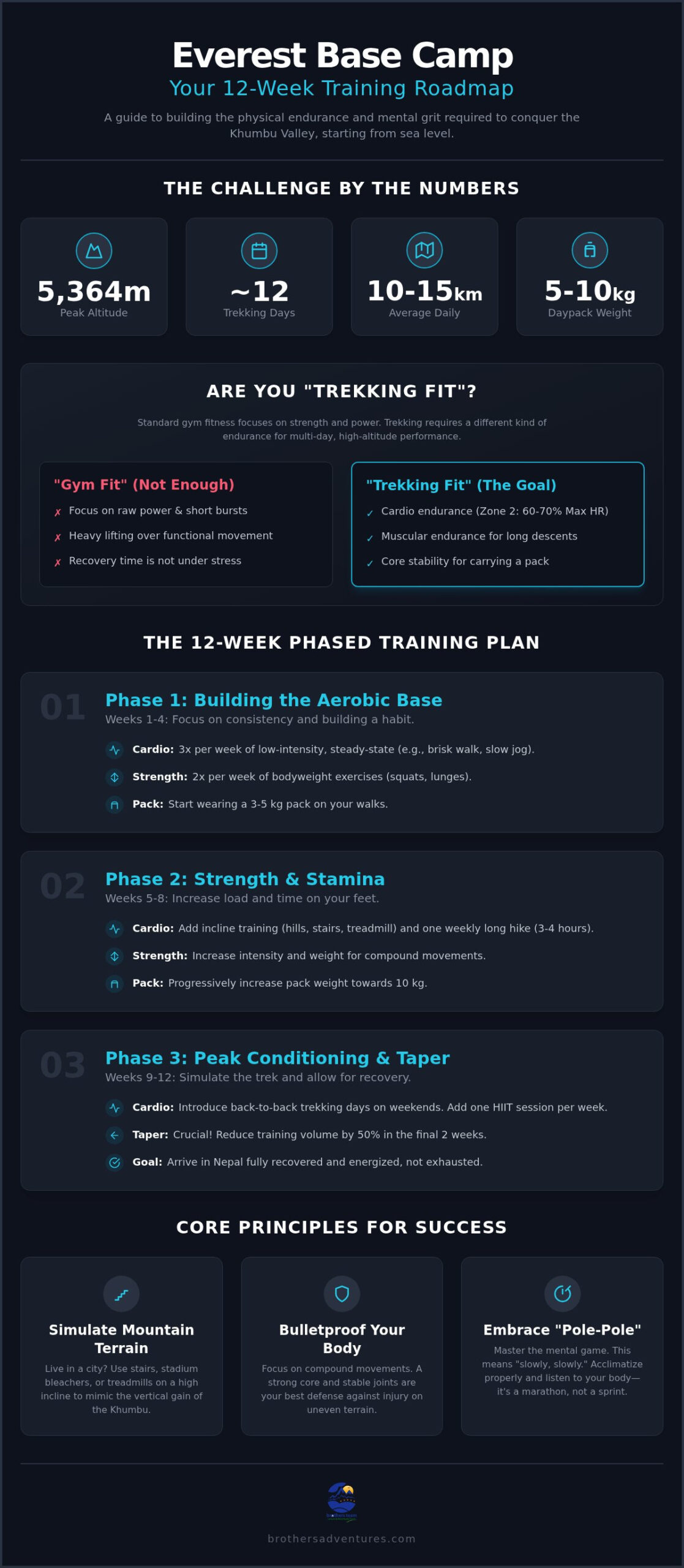
Everest Base Camp Training Plan: The Ultimate 2026 Guide to Success
Standing at the foot of the world’s highest peak doesn’t require the lungs of an elite marathoner, but it does demand a specific kind of grit. Many trekkers fail not because they aren’t strong, but because they trained for the wrong battle. If you’re worried about the 5,364-meter thin air or feeling confused about balancing weights with walking, you’re exactly where you need to be. Our Everest Base Camp training plan is your 12-week roadmap to conquering the Khumbu Valley with a smile rather than a struggle.
We understand the unique challenges of preparing for the Himalayas from a flat, urban environment. That’s why this guide focuses on functional endurance and mental toughness over raw power. You’ll get a day-by-day schedule that simplifies your preparation and practical tips to mimic high-altitude demands at sea level. By the time you touch down in Lukla, you’ll feel like an invited guest of the mountains, ready to handle every rocky switchback with ease. Let’s start building the foundation for your 2026 adventure today.
Key Takeaways
- Understand the specific endurance demands of the Khumbu Valley, focusing on daily vertical gains rather than technical climbing skills.
- Follow a comprehensive 12-week Everest Base Camp training plan designed to build a solid foundation of cardiovascular health and leg strength.
- Learn how to bulletproof your body with compound movements that prepare your core and joints for 12 days of carrying a pack.
- Discover clever ways to simulate mountain terrain in a flat, urban environment using local infrastructure to gain essential vertical elevation.
- Embrace the “Pole-Pole” mindset to master the mental game of acclimatization and build confidence for the 5,364-meter goal.
Understanding the Physical Demands of the Everest Base Camp Trek
The journey to Everest Base Camp is a marathon of the spirit and the body. It’s essential to view this trek as a multi-day endurance event rather than a technical mountaineering expedition. You won’t need ropes, harnesses, or ice axes to reach the Khumbu Glacier. You will, however, need the stamina to cover 10 to 15 kilometers of rugged terrain every single day for nearly two weeks. Your Everest Base Camp training plan must prepare you for the reality of consistent vertical gains and losses that test your joints and resolve alike.
Altitude changes the rules of physical performance. At high elevations, the atmospheric pressure drops, meaning there’s less oxygen available with every breath. This environment significantly impacts your cardiovascular system and slows down muscle recovery. While you might feel “gym fit” from lifting weights or short cardio bursts, “trekking fit” is a different beast. It’s the ability to maintain a steady pace for six hours while carrying a weighted pack, then doing it all over again the next morning after a night in a basic tea house.
The Role of Cardiovascular Endurance
A deep aerobic base is your best defense against the crushing fatigue of the Himalayas. When your heart and lungs are highly efficient, they can transport limited oxygen to your muscles more effectively, which helps mitigate the onset of AMS symptoms. Building this foundation allows you to stay energized enough to soak in the staggering views of Nuptse and Ama Dablam. To achieve this, focus on Zone 2 training, which is a steady, conversational pace where your heart rate remains between 60% and 70% of its maximum capacity to maximize aerobic adaptation. This focus on long-term endurance is a principle shared by many world-class outfitters, such as Discover Kokoda Treks, who emphasize physical readiness for challenging terrain.
Don’t let the uphill climb fool you; the descent is often much harder on your body. Walking downhill requires your muscles to perform eccentric contractions, essentially acting as brakes to stabilize your weight against gravity. This repetitive impact puts immense pressure on your quadriceps and calves, often leading to “jelly legs” if you aren’t prepared. Core stability is equally vital, as it keeps your posture aligned while your pack shifts with every step on uneven rocks. By prioritizing these muscle groups in your Everest Base Camp training plan, you protect your knee health and ensure you finish the trek feeling strong rather than broken.
The 12-Week Everest Base Camp Training Plan: A Phased Timeline
Phase 1: Building the Aerobic Base (Weeks 1-4)
In the first month, your goal is to build a habit. Focus on low-intensity steady-state (LISS) cardio three times a week. This could be a brisk walk or a slow jog where you can still hold a conversation. Introduce basic bodyweight strength exercises like squats and lunges twice a week to stabilize your joints. Start wearing your trekking boots and a light daypack weighing 3 to 5 kilograms during your walks to get used to the weight and build better trekking posture.
Phase 2: Strength and Stamina (Weeks 5-8)
Now, we turn up the heat. Increase your pack weight progressively toward 10 kilograms. If you live in a flat city, use a gym treadmill on an incline or find a local stadium with stairs. Add one “long hike” of 3 to 4 hours to your weekly routine. This phase is about time on your feet. While you push your limits, keep in mind that understanding altitude sickness and its symptoms is just as vital as your physical stamina.
Phase 3: Peak Conditioning and Taper (Weeks 9-12)
The final push of your Everest Base Camp training plan involves simulating back-to-back trekking days on weekends to mimic the actual journey. Incorporate a high-intensity interval training (HIIT) session once a week to boost your VO2 max. This helps your heart handle the thin air more efficiently. Crucially, the last two weeks are for the taper. Reduce your volume by 50% to ensure you arrive in Kathmandu fully recovered and bursting with energy. If you’re looking for a partner to turn this preparation into reality, the experts at Brothers Adventures can help you navigate the trail safely.
Functional Strength: Exercises to Bulletproof Your Body
Functional strength is the secret weapon of every successful trekker. While a general gym routine is helpful, a specialized Everest Base Camp training plan prioritizes movements that mimic the actual mechanics of the trail. You’ll be navigating everything from swaying suspension bridges to steep, dusty switchbacks. This requires more than just raw power; it demands stability, balance, and the ability to stabilize a shifting load over 12 consecutive days. If you are currently coordinating your Everest Base Camp trek from Singapore, starting these exercises early will bridge the gap between urban life and the rugged Khumbu terrain.
Lower Body Power and Stability
Your legs are your engine. Building unilateral strength ensures that each leg can independently support your weight on uneven, rocky paths. This is vital for maintaining momentum during long days in your Everest Base Camp training plan. Focus on these key movements:
- Step-ups: These are arguably the most important exercise. They perfectly replicate the action of climbing the thousands of stone stairs that lead to the heart of the mountains.
- Lunges and Bulgarian Split Squats: These build the necessary unilateral balance and stability required for crossing boulder fields and rocky moraines.
- Calf Raises: Strengthening your calves provides the propulsion needed for the steep 600-meter vertical climb into Namche Bazaar and protects your ankles from strain.
Core and Upper Body Support
Your core serves as the anchor for your 10kg daypack. Without a strong midsection, your posture will collapse, leading to premature fatigue and back pain. While your legs do the heavy lifting, your upper body must remain stable to keep you efficient. Incorporate these into your routine:
- Planks and Side-Planks: These build the deep abdominal endurance required to keep your spine neutral over long trekking hours.
- Back Extensions: Often overlooked, these are vital for supporting the lumbar region as fatigue sets in during the final hours of the day.
- Shoulder Stability (Ys and Ts): Simple stability exercises prevent the discomfort often caused by pack straps, keeping your neck and shoulders relaxed.
Balance and proprioception are your best allies on the trail. The ability of your joints to sense their position helps prevent rolled ankles on loose scree. While physical conditioning is paramount, remember that your body’s ability to perform at height is also linked to acclimatization and preventing altitude sickness. A bulletproof body is one that is both strong and well-rested, ready to adapt to the thin Himalayan air.
Training at Sea Level: Strategies for Urban Residents
Living in a flat, sea-level city shouldn’t dampen your Himalayan dreams. While you might lack natural alpine slopes, your urban environment is a playground of hidden peaks if you know where to look. The secret to a successful Everest Base Camp training plan for city dwellers is creativity. You aren’t just walking; you’re conditioning your body to handle verticality and weight in a world of pavement and elevators. It’s about making the most of the infrastructure around you to build the grit needed for the Khumbu.
One of the best hacks is the “Weighted Pack” method. Instead of just walking long distances, start carrying the exact gear you’ll use in Nepal. This conditions your shoulders and hips for the constant pressure of a daypack. Reviewing the Everest Base Camp trek cost from Singapore underscores why investing in quality boots and a well-fitted pack early is a smart move. Training with weight transforms a simple park walk into a focused endurance session that prepares your body for the physical load, not just the mileage.
Mastering the Stairwell
Your local high-rise or stadium is the most effective tool in your arsenal. Aiming for 40 or more flights of stairs in a single session mimics the sustained climbing found in the Himalayas. When going up, focus on a steady, rhythmic pace. On the way down, take small, deliberate steps to minimize the impact on your knee joints. For a busy professional, a high-impact stair session involves 45 minutes of continuous climbing and descending, performed once a week while wearing your weighted pack.
Incline Treadmill and Heat Training
The gym is your laboratory for vertical gain. Set your treadmill to a steep 12% to 15% incline and maintain a slow, steady pace of 3 to 4 km/h. This isn’t about speed; it’s about building the specific leg strength needed for the trail. If you live in a warm, humid climate, use that heat to your advantage. Training in the heat builds cardiovascular resilience by increasing your blood plasma volume, which helps your heart work more efficiently under stress. Just remember to simulate the high water intake required at altitude by staying consistently hydrated throughout every session. If you’re ready to put this training to the test, join the Everest Base Camp Trek with Brothers Adventures for a safe and expert-guided journey.
The Mental Game and Acclimatization Principles
Physical strength is the foundation of your journey, but your mindset is what carries you across the finish line at 5,364 meters. Even the most elite athletes can face challenges in the Khumbu if they ignore the mental game. Himalayan trekking follows the “Pole-Pole” philosophy, a Swahili term meaning “slowly, slowly.” In Nepal, our guides often use the phrase “Bistari, Bistari” to remind you that speed is your enemy at altitude. Embracing a slow, rhythmic pace allows your body to adapt while keeping your heart rate stable. This mental shift from “conquering” to “coexisting” with the mountains is a vital part of any Everest Base Camp training plan.
Building resilience also means preparing for the realities of trail life. You’ll encounter freezing nights, basic tea house accommodations, and a lack of familiar comforts. Use your training sessions to practice mindfulness and focus on your breathing when the incline gets tough. Choosing a specialist tour operator significantly reduces your mental load. When you know that logistics, safety protocols, and daily health checks are handled by experts, you can devote your full energy to the experience of the trek itself.
Understanding Altitude Sickness (AMS)
There is a golden rule in the Himalayas: physical fitness does not prevent Acute Mountain Sickness (AMS). It does, however, help your body recover faster from the daily physical strain, giving you a better chance of successful acclimatization. You must stay vigilant and recognize early symptoms such as persistent headaches, loss of appetite, or unusual fatigue. Our guides prioritize your safety by monitoring oxygen saturation levels daily with pulse oximeters. This data-driven approach ensures that every guest moves upward only when their body is ready, providing peace of mind during the most challenging stretches.
Gear Integration: Training in Your Trekking Boots
Your gear is an extension of your body on the trail. You must never start a trek in brand-new, stiff boots. Use your 12-week Everest Base Camp training plan to break in your footwear during every long walk or stair session. This prevents blisters and ensures your feet are calloused in the right places. Additionally, use your early morning or late evening training sessions to test your layering system. Learning how to quickly adjust your thermal layers, fleece, and down jacket during a workout helps you manage your body temperature efficiently when the Himalayan sun disappears behind a peak.
Start Your Himalayan Journey Today
Conquering the Khumbu is a feat of both body and spirit. By committing to a structured Everest Base Camp training plan, you’ve already taken the most important step toward the roof of the world. You now have the tools to build functional strength in a city environment and the mental strategies to handle the thin mountain air. Success isn’t about speed; it’s about the steady preparation that turns a challenging trail into an unforgettable discovery.
While your training builds the engine, our expertise provides the road. Brothers Adventures has been a family-owned specialist since 1992, blending deep local Kathmandu knowledge with comprehensive high-altitude safety protocols. We don’t just lead treks; we share our heritage with every guest. Book your 2026 Everest Base Camp adventure with the experts at Brothers Adventures and let us guide you home to the mountains. Your 5,364-meter milestone is closer than you think. Let’s make it a reality together.
Frequently Asked Questions
How many months before EBC should I start training?
Start your preparation at least 3 months (12 weeks) before your scheduled departure date. This timeframe allows your body to build a solid aerobic base and develop the muscular endurance needed for the trail. If you are starting from a lower fitness level, consider a 6-month lead time to avoid injury. Consistency is vital, so use this period to gradually increase your pack weight and the duration of your weekend hikes.
Do I need to be a marathon runner to reach Everest Base Camp?
No, you don’t need elite athletic status or marathon experience to succeed on this journey. The trek is a test of steady endurance rather than high-speed performance. While cardiovascular health is important, the ability to walk 5 to 7 hours a day at a slow, rhythmic pace is what matters most. Focus on being “trekking fit” rather than “racing fit” to enjoy the incredible scenery through the Khumbu Valley.
What is the best exercise for Everest Base Camp preparation?
Weighted step-ups are widely considered the most effective exercise for your Everest Base Camp training plan. This movement perfectly replicates the action of climbing the thousands of stone steps found throughout the Himalayas. By performing step-ups with a loaded daypack, you strengthen your glutes, quads, and calves while building the specific stability required for vertical gains. Complement these with long weekend walks to build overall stamina and mental grit.
Can I use a gym to train for a Himalayan trek?
A gym is an excellent environment for focused conditioning, especially for urban residents. Use a treadmill on its maximum incline at a slow walking speed to simulate steep mountain climbs. Stair-climber machines and weight benches for step-ups are also invaluable tools for building leg power. Incorporating strength training for your core and lower body helps protect your joints from the repetitive impact of trekking on rugged, uneven terrain.
How do I train for high altitude if I live at sea level?
You can’t truly replicate thin air at sea level, but you can build a powerful aerobic engine. Focus on Zone 2 heart rate training to make your body highly efficient at processing oxygen during exertion. High-intensity interval training once a week can also improve your VO2 max. These cardiovascular improvements help your body cope better with decreased oxygen levels, making the transition to high altitude much smoother for your system.
Should I carry a heavy pack during my training sessions?
You should progressively increase your pack weight during your Everest Base Camp training plan, but start with a light load. Begin with 3kg to 5kg and gradually work up to 10kg or 12kg toward the end of your 12-week schedule. This preparation conditions your shoulders, back, and core for the weight of your daily gear. Training with a slightly heavier load than you’ll actually carry on the trek builds a helpful physical buffer.
What happens if I am not fit enough during the trek?
Our expert guides are trained to manage varying fitness levels and will adjust the daily pace to ensure your safety. We follow strict high-altitude safety protocols and monitor oxygen levels daily to detect early signs of exhaustion or AMS. If a trekker cannot continue, we coordinate the safest descent or evacuation options based on the situation. Your health is always our priority, backed by our history of service since 1992.




Comments are closed