


Bhutan Trek Cost from Singapore: The Complete 2026 Pricing & Planning Guide
The “high price” of a Himalayan adventure is actually your golden ticket to a private, pristine paradise free from the crushing crowds of more commercial trails. We know that calculating the total Bhutan trek cost from Singapore can feel like solving a complex puzzle while you’re just trying to plan a dream escape. You’re likely balancing the excitement of the Druk Path with concerns about the Sustainable Development Fee (SDF) and those specific flight schedules from Changi. It’s natural to want total clarity before committing to such a significant journey.
This guide provides a clear, realistic budget for 2026, ensuring you have every dollar and detail accounted for before you even pack your boots. You’ll discover exactly how to navigate the USD 100 daily SDF, confirm your visa requirements, and master the logistics of direct flights to Paro. We’re pulling back the curtain on hidden expenses so you can focus on the crisp mountain air and ancient monasteries that await you. Let’s turn that uncertainty into an actionable plan for your Bhutanese expedition.
Key Takeaways
- Confirm your budget against the 2026 Sustainable Development Fee (SDF) of USD 100 per night to ensure complete financial clarity for your mountain escape.
- Discover the total Bhutan trek cost from Singapore for the legendary 10-day Druk Path Trek, covering everything from permits to expert local guides.
- Secure your logistics by understanding the direct flight frequencies from Changi Airport to Paro with Drukair’s specialized, high-altitude service.
- Prepare for non-negotiable trekking essentials, including specialized high-altitude evacuation insurance and the specific gear you should source in Singapore.
- Gain peace of mind by booking with a Singapore-based, family-owned agency that combines deep Himalayan knowledge with the accountability of a local office.
Understanding the Foundation: Bhutan’s Sustainable Development Fee (SDF) in 2026
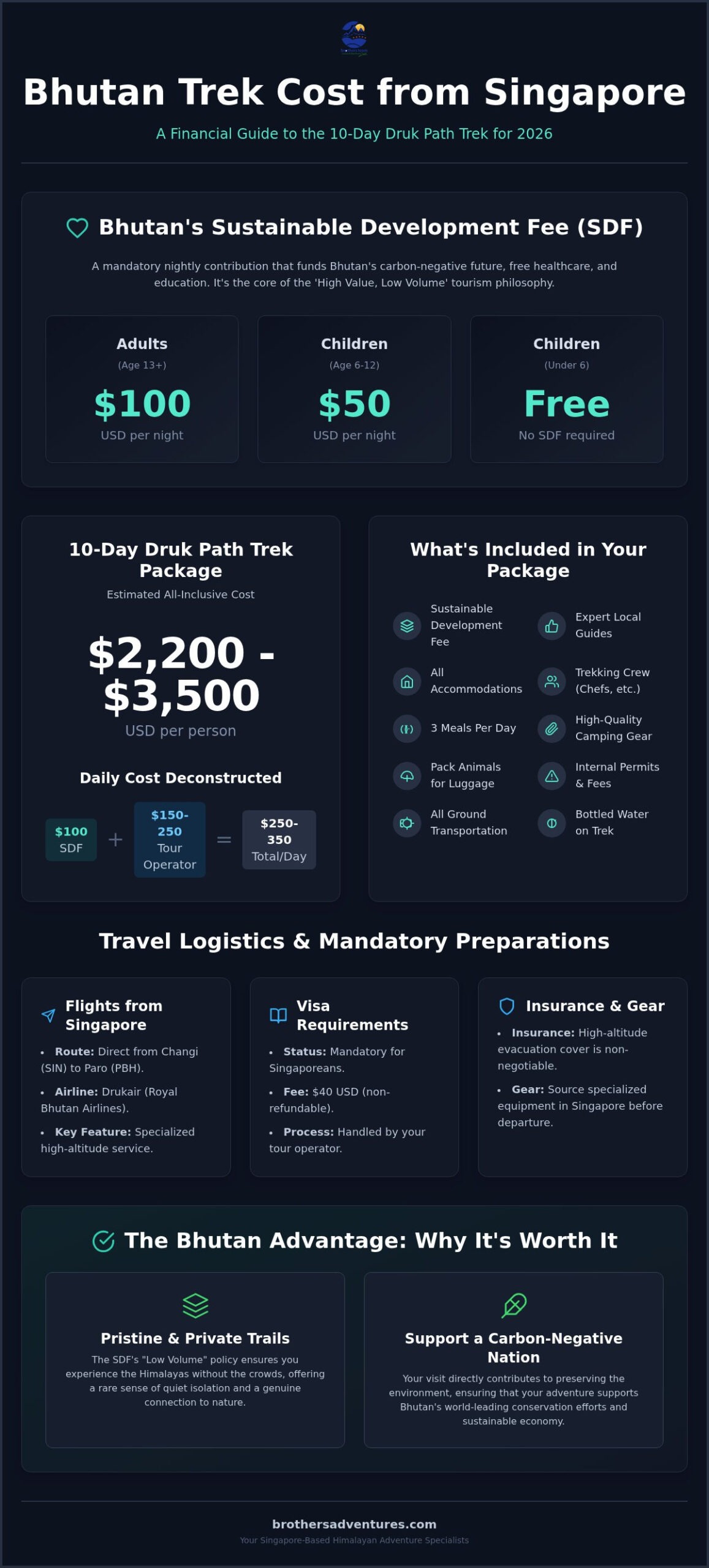
Bhutan doesn’t just invite you to visit; it invites you to invest in the future of the Himalayas. When you start calculating the Bhutan trek cost from Singapore, the first and most significant figure you’ll encounter is the Sustainable Development Fee (SDF). For 2026, the Bhutanese government has set this rate at USD 100 per person, per night for most international travelers, including Singaporeans. This isn’t a hidden tax or a simple entry fee. Instead, it’s the bedrock of the country’s unique approach to preservation. Children aged 6 to 12 benefit from a reduced rate of USD 50 per night, while those under 6 are exempt from the fee entirely.
Visa Requirements for Singapore Passport Holders
If you’re holding a Singapore passport, you’ll need a formal visa to enter the Kingdom. While some neighbors like Indian nationals have different arrangements, Singaporeans must follow the standard international protocol. The process is straightforward when you work with a licensed operator. You’ll provide a digital copy of your passport and pay a non-refundable visa fee of USD 40. We handle the heavy lifting by submitting your application to the Department of Tourism. Once approved, you’ll receive a visa clearance letter, which is the golden ticket you’ll present at Changi Airport and again upon landing in Paro.
The ‘High Value, Low Volume’ Tourism Philosophy
This policy is what makes the Bhutan trek cost from Singapore feel like a premium investment rather than just another travel expense. By limiting visitor numbers through the SDF, Bhutan avoids the overcrowding seen on popular trails in Nepal. You won’t find yourself in a queue to take a photo of a mountain peak here. Instead, you’ll enjoy a sense of deep, quiet isolation that is increasingly rare in the modern world. Tourism in Bhutan is designed to be intentional and restorative for both the guest and the land. The SDF is a mandatory sovereign contribution to Bhutan’s carbon-neutral economy. This ensures that your presence supports the environment rather than depleting it, keeping the trails of the Druk Path as wild as they were centuries ago.
Bhutan Druk Path Trek: A 10-Day Cost Breakdown for 2026
The Druk Path is widely considered the quintessential gateway into the Thunder Dragon’s mountain kingdom. It connects Paro and Thimphu through a series of high ridges, turquoise lakes, and ancient ruins. For many adventurers, this is the first choice when researching the Bhutan trek cost from Singapore because it offers a perfect balance of physical challenge and cultural immersion. You aren’t just walking; you’re stepping through a landscape that has remained largely unchanged for centuries, making it one of travel’s hottest destinations for those seeking authenticity. Singaporean trekkers who want to compare Himalayan options often also explore the Everest Base Camp trek cost from Singapore to understand the full spectrum of high-altitude adventures available from Changi.
Expect a total package cost for a 10-day itinerary to range between USD 2,200 and USD 3,500. This might seem like a broad spectrum, but it accounts for the specialized logistics required to maintain a high standard of service in the wilderness. Unlike treks in other regions where you might carry your own heavy pack, Bhutanese trekking is a “luxury” experience. Your gear is transported by sturdy pack animals, and a dedicated team of camp chefs and tent-hands precedes you to ensure a hot meal and a set-up camp are waiting at every stop. This all-inclusive approach covers your accommodation, three hearty meals a day, high-quality camping equipment, and all ground transportation.
Daily Expenditure Breakdown
To understand the math, look at the daily components. Your daily rate is typically comprised of the USD 100 SDF plus a tour operator fee that usually sits between USD 150 and USD 250. This operator fee covers the complex machinery of your trek: the guide’s expertise, the crew’s wages, and the fresh ingredients for your meals. Group size plays a massive role here. Solo travelers or couples often pay a premium, while groups of four or more can distribute the fixed costs of the support team and logistics, bringing the per-person price down significantly.
Comparing Trekking vs. Cultural Tour Costs
You might wonder why a trekking itinerary costs more than a standard road-based tour. While a Bhutan scenic tour 7 days offers incredible value through hotel stays and van travel, the Druk Path requires a mobile village of support. The cost of hiring horses, transporting fresh food to remote camps, and employing a full trekking crew adds a layer of expense that hotel-based tours simply don’t have. The value lies in the exclusivity. Standing alone by the shores of Jimilang Tsho lake is an experience that no city tour can replicate. If you’re ready to see these peaks for yourself, our 10Days Bhutan Druk Path Trek offers a seamless way to manage these complex logistics.
Airfare and Logistics: Flying from Singapore to Paro
Your journey to the Kingdom of Bhutan begins long before you set foot on the trail. When calculating the total Bhutan trek cost from Singapore, airfare is the most significant external variable. Unlike flying to Bangkok or Bali, you can’t just pick from a dozen budget carriers. Drukair, the Royal Bhutan Airlines, maintains a specialized link between Changi Airport (SIN) and Paro International Airport (PBH). This boutique flight experience is part of the adventure, offering a level of service and a view that standard commercial flights simply can’t match.
Direct flights from Singapore typically operate on a Sunday and Thursday schedule. Because of the limited frequency and the small size of the aircraft, seats fill up months in advance, especially during the peak trekking seasons of Spring and Autumn. Round-trip fares in 2026 generally range from SGD 1,271 to over SGD 1,569. To get the best value, plan your trip at least six months out. You’ll also encounter a brief technical stop in Guwahati, India. This 40-minute layover is seamless; you’ll stay on the plane while the aircraft refuels, giving you a moment to prepare for the dramatic descent into the Paro valley.
Ticketing and Booking Strategies
We strongly recommend letting your tour operator handle your flight bookings. Drukair operates on a different system than the major global alliances, and their cancellation and rescheduling policies are notoriously specific. When we manage the ticketing, we ensure your flight arrival aligns perfectly with your trekking permits and guide pickup. This SIN-PBH route is one of the most scenic flights in the world, passing four of the world’s five highest peaks. Keep your camera ready as the pilot navigates the narrow valley passes, providing a perspective of the Himalayas that few people ever see.
Baggage and Gear Allowance
Packing for a trek requires a balance between necessity and weight limits. Standard economy allowance on Drukair is usually 30kg, which is generous but can disappear quickly if you’re carrying heavy cold-weather gear. Focus on high-quality, lightweight layers that you can source in Singapore before you depart. If you’re curious how these logistics stack up against other Himalayan destinations, you can compare this to the Everest Base Camp trek cost from Singapore for a broader regional perspective. While Bhutan has more rigid flight monopolies, the ease of a direct flight from Changi often outweighs the multi-leg journeys required for other mountain ranges.
Hidden Costs: Gear, Insurance, and Personal Expenses
Beyond the permits and plane tickets, your Bhutan trek cost from Singapore includes the essential gear and safety nets that ensure a smooth journey. High-altitude trekking is an investment in your well-being, and it starts with the right protection. Travel insurance is the most critical “hidden” cost. Standard travel policies often exclude activities above 3,000 meters, but the Druk Path will take you significantly higher. You must secure a policy that specifically covers helicopter evacuation and high-altitude medical care. This typically adds about 5% to your total trip budget, but it’s the one expense you can’t afford to skip when venturing into the remote Himalayas.
Tipping is another vital consideration that travelers often overlook. While not mandatory, it’s a deeply ingrained part of the local culture and a way to show gratitude for the grueling work your crew performs. Budget approximately USD 5 to 10 per day for your lead guide and USD 3 to 5 per day for the support staff. For personal spending, keep USD 50 to 150 aside for souvenirs like hand-woven textiles, local SIM cards, or a celebratory glass of ‘Ara’, the potent traditional spirit made from fermented rice or maize. These small expenses add up, but they’re the details that make your trip feel complete.
The Singapore Gear Guide
Don’t wait until you land in Paro to find your boots. Reliable gear is hard to rent locally, and a blister on day two can ruin the experience. Visit specialized retailers in Singapore like those at Queensway Shopping Centre or Velocity to break in your boots months in advance. A full high-altitude kit, including moisture-wicking layers, a down jacket, and sturdy trekking poles, can cost between SGD 500 and SGD 1,200 depending on the brands you choose. Buy quality once; these items will serve you for years of exploration. If you’re ready to start your packing list, book your 10-day Druk Path adventure with us and we’ll provide a detailed gear checklist tailored for 2026 conditions.
Cash and Currency in a Digital World
Bhutan uses the Ngultrum (BTN), which is pegged to the Indian Rupee (INR). While you can use INR in many places, Singaporean travelers should carry a mix of cash and cards. ATMs are available in Thimphu and Paro, but they’re non-existent once you hit the Druk Path. Credit cards are accepted in major souvenir shops, but the connection is often ‘hit or miss’ in the mountains. Carry enough cash to cover your tips and small village purchases. We recommend changing your currency at the airport or in Thimphu before the trek begins to avoid any logistical headaches on the trail.
Maximizing Value: Why Booking with a Specialist Tour Operator Matters
Investing in your Himalayan dream involves more than just tallying up the Bhutan trek cost from Singapore. It’s about ensuring that every dollar spent translates into a safe, seamless, and deeply moving experience. While the individual components like the SDF and airfare are fixed, the quality of your journey depends entirely on the expertise behind the scenes. A specialist operator doesn’t just book a hotel; they act as your local anchor, managing the invisible logistics that make high-altitude trekking possible for everyday adventurers.
Safety is the most significant “invisible” cost included in a premium package. When you trek the Druk Path, you aren’t just paying for a guide to show you the way. You’re paying for a safety expert trained in high-altitude medicine, the provision of emergency oxygen supplies, and a robust communication network that reaches even the most remote ridges. These protocols are non-negotiable for us. We ensure that our teams are equipped to handle the unique challenges of the Bhutanese wilderness, allowing you to focus on the breathtaking views of Mt. Gangkar Puensum rather than worrying about logistics. If your ambitions extend beyond trekking into technical summits, our training for Nepal peak climbing guide provides a comprehensive 2026 preparation roadmap for those ready to take the next step into the high-altitude climbing world.
The ‘Brothers’ Difference: 30 Years of Himalayan Expertise
Since 1992, Brothers International Tours & Trading Pte Ltd has operated as a family-owned business with a deep-rooted passion for these mountains. Our dual-office presence in Singapore and the Himalayas streamlines your entire trip. You get the accountability of a Singapore-registered office for easy payments and face-to-face consultations, combined with the ground-level knowledge of a local specialist. It is essential to work with a tour operator who understands both ends of the flight from Changi to Paro.
Our long-standing relationships with local communities mean our guests often enjoy better campsite selections and exclusive cultural access that larger, more corporate agencies simply can’t provide. Whether you are looking at our 10Days Bhutan Druk Path Trek or a more relaxed 7Days Scenic Bhutan tour, we customize the pace to suit your personal goals.
Final Planning Checklist for 2026
To get the most out of your Bhutan trek cost from Singapore, timing is everything. We recommend booking at least six months in advance to secure your preferred Drukair seats and the best trekking crews. While we handle the permits, you can focus on physical preparation. Training in Singapore’s tropical climate is actually a great way to build cardiovascular endurance. Spend some time on the Bukit Timah trails or find a tall HDB block for stair-climbing sessions to prepare your legs for the mountain passes. Ready to start? Contact us today for a tailored quote based on your specific group size and let’s begin planning your 2026 Bhutanese expedition.
Ready to Begin Your Himalayan Legacy?
Planning your 2026 adventure doesn’t have to be a logistical mountain in itself. You now have a complete picture of the Bhutan trek cost from Singapore, from the USD 100 nightly Sustainable Development Fee to the specialized Drukair flights departing from Changi. Remember that a trek in Bhutan is more than a standard holiday; it’s a curated investment in a carbon-neutral future and a private encounter with the world’s most pristine peaks. By accounting for your high-altitude insurance and gear early, you eliminate surprises and leave room for pure wonder on the trail.
As a Singapore-registered agency operating since 1992, we’re here to bridge the gap between your ambition and the mountains. We’re specialists in high-altitude Himalayan safety and provide all-inclusive pricing with absolutely no hidden fees. Don’t let the complexity of permits or flight schedules hold you back from the turquoise lakes and ancient ridges of the Druk Path. Book Your 2026 Bhutan Druk Path Trek with Brothers Adventures today and let our family take care of yours. The mountains are calling, and we’re ready to lead the way.
Frequently Asked Questions
Is the Bhutan trek cost from Singapore inclusive of the visa?
Most all-inclusive packages for a Bhutan trek cost from Singapore include the mandatory visa fee, but you should always confirm this with your specific operator. The standard government visa fee is USD 40 per person and is non-refundable once processed. We handle the entire application on your behalf, ensuring your clearance letter is ready for presentation at Changi Airport well before your departure.
How much is the Bhutan Sustainable Development Fee (SDF) in 2026?
The Sustainable Development Fee for 2026 is USD 100 per adult, per night. This current rate is effective until August 31, 2027, after which the government may review the pricing. Children between the ages of 6 and 12 pay a reduced rate of USD 50 per night, while adventurers under the age of 6 are exempt from the fee entirely.
Can I trek the Druk Path solo to save on costs?
Trekking the Druk Path solo is possible under current regulations, but it won’t actually save you money. Solo travelers are subject to a small group surcharge and must bear the full cost of the mandatory guide, trekking chef, and pack animals alone. Joining a small group is the most effective strategy to distribute these fixed logistical expenses and lower your overall Bhutan trek cost from Singapore.
What is the best month to trek in Bhutan for the best price-to-weather ratio?
April and October offer the most pristine trekking conditions, though these months are also the busiest. For a better balance of quiet trails and reliable weather, consider the shoulder weeks in late May or early September. While the SDF remains fixed year-round, you’ll often find better flight availability and more camp selection if you avoid the peak festival dates in Thimphu and Paro.
Do Singaporeans get a discount on the Bhutan daily fee?
Singapore passport holders pay the standard international SDF rate of USD 100 per night. Currently, there are no specific discounts or fee waivers for Singaporean citizens. Only nationals from India, Bangladesh, and the Maldives benefit from different fee structures due to existing regional agreements. Your fee serves as a vital contribution to Bhutan’s carbon-neutral economy and social welfare programs.
How much should I budget for tips for a 10-day trek in Bhutan?
You should budget approximately USD 100 to USD 150 for tips over a 10-day expedition. A good guideline is to set aside USD 5 to 10 per day for your lead guide and USD 3 to 5 per day for the support crew, including your horsemen and camp cooks. These tips are deeply appreciated and reflect the high level of personal service provided throughout your journey in the mountains.
Is travel insurance for high altitude mandatory for Bhutan?
Yes, specialized insurance that covers trekking up to 5,000 meters and helicopter evacuation is a requirement for all our trekking guests. While the trails are well-maintained, the remote nature of the Himalayas means that rapid medical transport is only possible by air. We require a copy of your policy during the booking process to ensure you are fully protected against any high-altitude contingencies.
What happens to the SDF if my trip is cancelled?
The Sustainable Development Fee is refundable if you cancel your journey before you actually enter the Kingdom of Bhutan. However, the USD 40 visa processing fee is kept by the government and is not refundable. It’s important to distinguish between the government’s SDF refund policy and your tour operator’s specific cancellation terms, which cover the costs of pre-booked hotels, transport, and staff.




Comments are closed