


The Ultimate Annapurna Base Camp Trek Guide: Planning Your 2026 Journey
What if the most daunting part of standing at 4,130 meters isn’t the thin air, but the complex maze of permits and logistics required to get there? It’s a common feeling. You dream of the golden light hitting the peaks from Poon Hill, yet the fear of altitude sickness or the confusion over mandatory guide regulations keeps your boots in the closet. This Annapurna Base Camp trek guide is designed to turn that uncertainty into unwavering confidence. We understand that planning a high-altitude journey feels like a mountain of its own, especially when you want every detail to be perfect for your 2026 adventure.
You’ll master every essential detail, from the rhythmic climb through rhododendron forests to the specific physical preparation needed to thrive on the trail. We’ve been acting as a bridge between travelers and the Himalayas since 1992, and we’re here to ensure your logistics are as seamless as the mountain views. This guide provides a clear preview of the ideal itinerary, updated permit requirements, and the expert safety measures that make this iconic trek accessible. Get ready to transform your curiosity into a concrete plan for the journey of a lifetime.
Key Takeaways
- Explore the unique geography of the Annapurna Sanctuary, a stunning natural amphitheater of peaks that offers richer biodiversity than many other Himalayan routes.
- Discover why our Annapurna Base Camp trek guide recommends the detour via Poon Hill to capture the most iconic sunrise views of the Dhaulagiri and Annapurna ranges.
- Prepare for the physical reality of the “Annapurna Stairs” with practical insights on balancing stamina and altitude acclimatization for a successful ascent.
- Navigate the essential 2026 logistics with ease, from choosing between rhododendron spring and crystal-clear autumn to securing necessary ACAP and TIMS permits.
- Learn how a family-owned specialist with over 30 years of experience acts as your reliable bridge to the Himalayas, ensuring every detail is handled with care.
Why the Annapurna Base Camp Trek is the Ultimate Himalayan Introduction
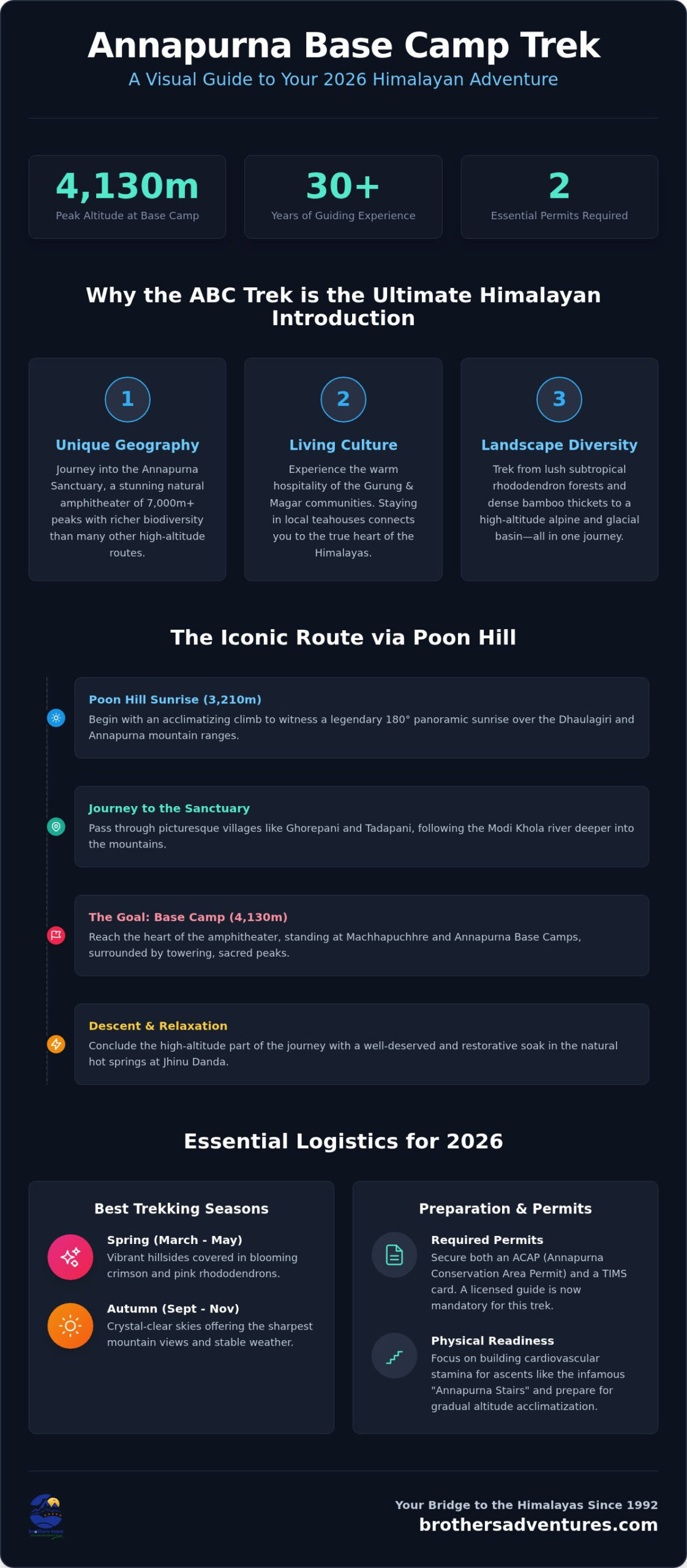
The Annapurna Sanctuary is a geological marvel. Imagine standing in a high-altitude basin where every direction you look reveals a 7,000-meter giant. This isn’t just a hike; it’s an entry into a natural amphitheater that feels both massive and strangely intimate. While many first-timers look toward Everest, this Annapurna Base Camp trek guide highlights why the ABC route is often the superior choice for those seeking a complete Himalayan experience. Unlike the rocky, high-altitude desert of the Khumbu, the journey to Annapurna Base Camp offers a rich emotional arc. You start in lush, humid jungles and end in a frozen glacial basin, making the transition feel like a true expedition. This sense of being “tucked away” inside the mountains creates a connection to the peaks that is hard to find elsewhere. For those planning their route, this Annapurna Sanctuary trek guide provides excellent context on the specific stages you’ll encounter.
The Cultural Heart of the Annapurna Region
The trail isn’t just about the mountains; it’s about the people who call them home. You’ll walk through the ancestral lands of the Gurung and Magar communities, famous for their bravery as Gurkha soldiers and their deep hospitality. Staying in local teahouses isn’t just a logistical necessity. It’s a chance to sit by a warm stove, share stories with family owners, and taste authentic dal bhat prepared with local ingredients. These interactions ground the adventure. They remind you that the Himalayas are a living, breathing cultural landscape, not just a playground for climbers. You’ll see prayer flags fluttering over suspension bridges and ancient stone-paved paths that have connected these villages for centuries.
Landscape Diversity: From Subtropical to Alpine
Few trails on Earth pack such ecological variety into a single week. If you trek in the spring, you’ll find yourself wandering through vibrant rhododendron forests where the hillsides turn shades of crimson and pink. The sensory experience is incredible. You’ll hear the rush of the Modi Khola river below as you climb through dense bamboo thickets. Eventually, the trees disappear. You’ll enter the alpine zone where the air is crisp and the vegetation consists of hardy shrubs and moss. Throughout this transition, the “Fishtail” peak, or Machhapuchhre, remains your constant companion. Its unique, double-pointed summit dominates the skyline, shifting its shape as you move deeper into the heart of the mountains. This peak is sacred and unclimbed, adding a layer of mystery to your journey.
The Iconic Route: Navigating the Sanctuary via Poon Hill
While some itineraries rush you straight to the top, the most rewarding Annapurna Base Camp trek guide will always point you toward the ridge of Poon Hill first. This isn’t just a detour; it’s the ultimate way to experience the full scale of the Himalayas. By starting with the lush forests of Ghorepani, you give your body time to adjust while treating your eyes to some of the most famous vistas on Earth. This route balances the physical challenge with moments of pure wonder, ensuring you aren’t just ticking a box, but truly absorbing the landscape.
The journey flows through a series of picturesque villages, each offering a unique perspective of the mountains. You’ll stop in Ghorepani, a bustling hub for trekkers, and Tadapani, where the sunrise views from your teahouse porch can rival any viewpoint. Later, after the high-altitude challenge, you’ll descend to the natural hot springs at Jhinu Danda. These stops aren’t just places to sleep. They’re essential chapters in your story, providing the recovery and cultural connection that make trekking in the Annapurna region so special.
The Poon Hill Sunrise Experience
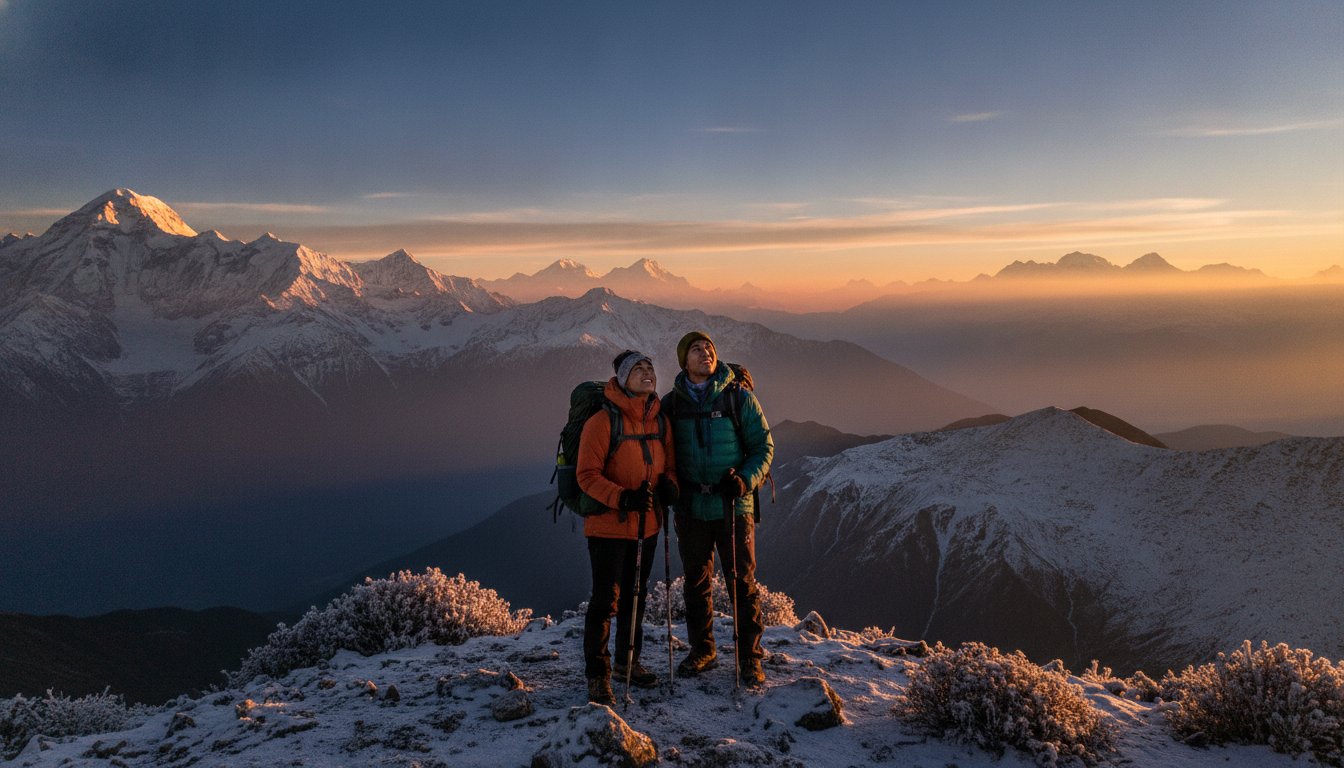
The early morning climb to the 3,210m summit of Poon Hill is a rite of passage. You’ll wake up in the dark, guided by headlamps and the crisp mountain air. As you reach the top, the first light of dawn hits the Dhaulagiri and Annapurna ranges, painting the 8,000-meter peaks in shades of gold and violet. It’s a massive 180-degree panoramic view that puts the entire journey into perspective. You’ll see the deep Kali Gandaki gorge and the distant peaks of the Mustang region. It’s a sensory overload of scale and beauty that stays with you long after you’ve descended.
Reaching the Sanctuary: Machhapuchhre and Annapurna Base Camps
After the high of Poon Hill, the trail moves through Chomrong, eventually narrowing into the deep valley that leads to the Sanctuary. The final push through the “gate” between Machhapuchhre and Hiunchuli is transformative. You’ll transition from the rhododendron forests into a high-alpine world of rock and ice. Spending the night at 4,130m at Annapurna Base Camp means being completely surrounded by a wall of peaks. The glacial basin acts as a natural amphitheater, where the silence is only broken by the distant crack of shifting ice. If you’re looking for a partner to handle these intricate logistics, our specialized Annapurna Base Camp Trek via Poon Hill itinerary ensures you don’t miss a single highlight.
Assessing Difficulty: Is the ABC Trek Right for You?
Don’t let the “moderate” label fool you. While this Annapurna Base Camp trek guide aims to encourage you, it’s vital to be honest about the terrain. The defining feature of this journey isn’t just the altitude; it’s the legendary “Annapurna Stairs.” You’ll encounter thousands of hand-hewn stone steps that test your knees and resolve. On the way to Ulleri alone, there are over 3,000 steps to conquer. Unlike the steady inclines found on other routes, this trek is a rhythmic dance of steep ascents followed by immediate descents into river valleys. It’s a workout that demands stamina over sheer power, especially when your pack feels heavier with every kilometer.
When compared to the Everest Base Camp trek, the ABC route is often considered more accessible because the maximum altitude is lower (4,130m vs. 5,364m). However, the frequency of elevation changes can be more taxing on your muscles. Our professional guides, who’ve been leading expeditions since 1992, are trained to monitor your pace and watch for subtle signs of Acute Mountain Sickness (AMS). They act as your safety net, ensuring you reach the Sanctuary without pushing past your limits. This personal, high-touch approach is what distinguishes a family-owned specialist from a large corporation.
Physical Preparation and Training
Start your training at least three months before you land in Kathmandu. Focus on cardiovascular health by running, cycling, or swimming to build the lung capacity needed for the thin air at 4,000m. Don’t ignore your legs. Squats and lunges are your best friends here, as they prepare your quads for the relentless descents that often feel harder than the climb. Most importantly, break in your boots. Wear them on every training hike to avoid blisters that can ruin a perfectly planned expedition. If you can comfortably walk for five to seven hours on hilly terrain at home, you’re ready for the Sanctuary.
Managing Altitude and High-Altitude Safety
The golden rule in the Himalayas is “Bistari, Bistari,” which means slowly, slowly. Rushing is the fastest way to invite altitude sickness. Our team emphasizes a steady pace that allows your body to acclimatize naturally. Stay hydrated by drinking at least 3 to 4 liters of water daily, and don’t skip meals. Your body needs the fuel to generate heat and energy. For a deeper dive into protecting yourself on the trail, read our comprehensive guide on high altitude trekking safety. It covers everything from recognizing early symptoms to the specific nutrition strategies our experts recommend for high-altitude success.
Essential Logistics: Best Time, Permits, and Preparation
Timing is the first hurdle in any Annapurna Base Camp trek guide. If you want a riot of color, aim for Spring (March to May). This is when the hillsides explode with red and pink rhododendrons. If you prioritize razor-sharp views of the peaks, Autumn (September to November) is your window. The monsoon rains have cleared the dust, leaving the sky a deep, crystal blue. Both seasons offer stable weather, but they provide entirely different sensory experiences of the sanctuary.
Life on the trail revolves around the teahouse. These cozy mountain lodges provide a warm place to rest, but managing expectations is key. You’ll find hearty meals like dal bhat or pasta, which are perfect for refueling. Electricity for charging cameras and Wi-Fi are usually available for a small fee, though the signal gets weaker as you climb higher. Hot showers are a luxury you’ll appreciate even more after a long day on the trail. This Annapurna Base Camp trek guide suggests carrying enough local currency, as there are no ATMs once you leave the main hubs.
Permits and Paperwork Made Simple
Don’t let the bureaucracy of Kathmandu dampen your spirits. Since April 1, 2023, all foreign trekkers must hire a licensed guide, making independent trekking a thing of the past. Booking with a professional tour operator removes this weight from your shoulders. We handle the Annapurna Conservation Area Permit (ACAP) and the Trekkers’ Information Management System (TIMS) card for you. You just need to provide your passport details and a few photos. Your guide then manages every checkpoint along the trail, letting you focus entirely on the scenery.
What to Pack for the Annapurna Sanctuary
The secret to staying comfortable is a smart layering strategy. Temperatures can soar to 25°C in the lowland sun and plummet to -10°C at the Base Camp. You need moisture-wicking base layers, an insulating fleece, and a high-quality down jacket for the evenings. Waterproof trekking boots are non-negotiable. The terrain is varied, and keeping your feet dry is the difference between a joyful trek and a painful one. Don’t forget trekking poles to save your knees on those thousands of stone steps. For a complete list of everything from headlamps to power banks, check our Himalayan adventure packing guide.
Ready to stand in the heart of the Annapurna Sanctuary? Plan your 2026 journey with Brothers Adventures and let our family-owned team handle every logistics detail for you.
Planning Your Expedition with Brothers Adventures
Choosing a partner for your Himalayan journey is a decision built on trust. We aren’t just another travel agency; we’re a family-owned specialist that has lived and breathed these mountains since 1992. This Annapurna Base Camp trek guide has covered the “what” and the “how” of the trail, but the “who” is just as important. Our unique dual-office advantage, with teams in both Singapore and Kathmandu, ensures that your coordination is seamless from the moment you book until you return home. We act as a reliable bridge between your world and the high peaks, providing a level of personalized service that large, cold corporations simply cannot match.
Our expert guides are our greatest asset. They possess deep local knowledge and a long history of service, making them experts in high-altitude safety. Whether you’re planning a private adventure, a family reunion, or a specialized School & College Trip, we have the flexibility to customize your experience. We understand that every group has a different rhythm. We prioritize the quality of your experience above all else, ensuring that the pace of the trek matches your physical comfort and sense of wonder.
A Legacy of Himalayan Excellence
With over 30 years of experience, we’ve developed deep, long-standing relationships with teahouse owners along the route. This translates to better room selections and more reliable service for our guests, even during the busy peak seasons. Our commitment to ethical trekking is unwavering. We believe in fair treatment for our porters and staff, ensuring they are well-equipped and respected as vital members of our expedition family. When you walk with us, you aren’t just a customer. You’re an invited guest. This high-touch approach allows us to share the hidden stories of the trail that most trekkers never hear.
Your Journey Starts Here
Booking your Annapurna Base Camp Trek via Poon Hill is the first step toward a life-changing adventure. We don’t just hand you a permit and a map. We provide extensive pre-departure support to help you prepare your gear and your mindset before you even leave home. Our team is always available to answer questions about fitness, logistics, or culture, ensuring you feel confident and excited. The golden light of a Poon Hill sunrise and the towering walls of the Sanctuary are waiting for you. Contact Brothers Adventures to start planning your 2026 journey today and let’s turn your Himalayan dreams into a concrete reality.
Start Your Himalayan Story in the Heart of the Sanctuary
Standing in the center of a glacial basin surrounded by 7,000-meter giants is an experience that stays with you forever. This Annapurna Base Camp trek guide has mapped out the journey, from the golden sunrise at Poon Hill to the physical demands of the legendary stone stairs. You’ve seen that while the path is challenging, the rewards are unmatched. Success on this trail is about finding that perfect balance between rugged adventure and the warm hospitality of a mountain teahouse.
Since 1992, our family-owned team has acted as a bridge for travelers seeking these heights. We combine deep local Kathmandu knowledge with rigorous high-altitude safety protocols to ensure your journey is as secure as it is breathtaking. We handle the permits and logistics so you can focus entirely on the wonder of the peaks. The mountains are calling, and we’re ready to welcome you as a guest of the family. Book Your 2026 Annapurna Base Camp Trek via Poon Hill and take the first step toward the sanctuary today. Your ultimate Himalayan adventure is closer than you think.
Frequently Asked Questions
How long does the Annapurna Base Camp trek take?
The standard duration for the journey is between 7 and 12 days, depending on your pace and chosen route. Our specialized itinerary for the Annapurna Base Camp trek via Poon Hill typically spans 11 days to ensure you have ample time for acclimatization and that iconic sunrise view. This timeframe allows you to experience the transition from lush rhododendron forests to the high alpine sanctuary without feeling rushed or overwhelmed by the daily physical demands.
Do I need a guide for the Annapurna Base Camp trek?
Yes, all foreign trekkers are legally required to hire a licensed guide as of April 1, 2023. Independent trekking is no longer permitted in the Annapurna region. This regulation ensures your safety and provides vital support for the local economy. When you book through this Annapurna Base Camp trek guide, we provide a seasoned expert who handles all permit applications and manages every logistical detail, letting you focus entirely on the mountain views.
What is the maximum altitude of the ABC trek?
The highest point you’ll reach is Annapurna Base Camp itself, sitting at an elevation of 4,130 meters (13,549 feet). While this is significantly lower than the maximum heights reached on the Everest circuit, it’s still high enough to require careful acclimatization. Our guides monitor your health daily to ensure your body adjusts safely to the thinning air. Reaching this glacial basin puts you right in the heart of the 7,000 meter giants.
Is the Annapurna Base Camp trek harder than Everest Base Camp?
The difficulty depends on your physical strengths. Everest Base Camp reaches a much higher altitude (5,364m), making the air thinner and more challenging for breathing. However, the Annapurna route is famous for its thousands of stone stairs, which can be more taxing on your knees and leg muscles. If you prefer lush landscapes and can handle steep, repetitive steps, ABC is often considered the more diverse and accessible introduction to Himalayan trekking.
What kind of food is available on the Annapurna trail?
Teahouses offer a surprisingly varied menu that caters to international tastes. You’ll find the local staple, dal bhat (lentil soup, rice, and vegetable curry), which is perfect for sustained energy. Other options include pasta, momos, pancakes, and even pizza in the lower villages. We recommend sticking to vegetarian options at higher altitudes to ensure freshness. Your guide will help you choose the best meals to keep your energy levels high throughout the day.
Is there Wi-Fi and mobile signal on the ABC trek?
You’ll find Wi-Fi available at most teahouses along the trail, though they usually charge a small fee for the service. Mobile signals from local providers are generally reliable in the lower villages but become spotty or disappear entirely as you enter the deep valley of the sanctuary. It’s a great opportunity to disconnect, though you can usually send a quick update home from the lower teahouse hubs when the weather is clear.
What permits do I need for the Annapurna region in 2026?
You need two essential documents: the Annapurna Conservation Area Permit (ACAP) and the Trekkers’ Information Management System (TIMS) card. As of August 2026, the ACAP fee for foreign nationals is NPR 3,000, while the TIMS card for agency supported trekkers is NPR 1,000. These permits must be obtained in Kathmandu or Pokhara before you start. Our team handles the entire application process for you, ensuring all your paperwork is ready before you hit the trail.
Can beginners do the Annapurna Base Camp trek?
Absolutely. This trek is an excellent choice for beginners with a good level of physical fitness. While the “Annapurna Stairs” are a challenge, the lower maximum altitude makes it more manageable than other high altitude expeditions. If you can walk for five to seven hours a day and have spent time training on hills or stairs at home, you’re well prepared. This Annapurna Base Camp trek guide emphasizes that a steady, patient pace is the secret to a successful first journey.



Comments are closed