



How to Assess Trek Fitness Before the Himalayas
The first long climb often tells the truth. If a few flights of stairs leave you breathless, a Himalayan trek may feel harder than the photographs suggest. Knowing how to assess trek fitness before you book gives you time to choose a suitable route, train with purpose and arrive ready to enjoy the mountains rather than simply endure each day.
Trek fitness is not about looking athletic or running a fast 5K. It is your ability to walk for several consecutive days over uneven ground, often carrying a small daypack, while recovering well enough to do it again tomorrow. In Nepal, altitude adds another variable: even very fit people must slow down, acclimatise properly and listen to their bodies.
How to assess trek fitness for your chosen route
Start with the itinerary, not a vague idea of being “fit enough”. A Poon Hill trek and an Everest Base Camp route both offer extraordinary Himalayan scenery, but their physical demands are very different. Poon Hill commonly involves several hours of walking each day and plenty of stone steps, at lower elevations. Everest Base Camp requires more sustained effort over roughly two weeks, with many days above 3,000 metres and a much greater need for careful acclimatisation.
Look at four practical details in the day-by-day plan: walking hours, ascent and descent, number of consecutive trekking days, and maximum sleeping altitude. Distance alone can mislead. A 10-kilometre hill day on rough trails with 800 metres of ascent is not comparable to a 10-kilometre walk on level pavements at home.
Be honest about your recent routine. If you regularly walk, cycle, swim, play sport or use stairs, you have a useful base. If activity has been occasional, that does not rule out a trek, but it should influence your route choice and preparation time. For many first-time trekkers, a well-paced lower-altitude trek is a far better introduction than trying to force a demanding high-altitude itinerary into a short training window.
The weekend walking test
A simple field test is more valuable than guessing. Find a hilly route, local nature reserve or stair-based circuit and walk for three to five hours at a steady, conversational pace. Wear the footwear and socks you plan to trek in, and carry a light daypack containing water, layers and snacks.
The question is not whether you can complete it by pushing through discomfort. Notice how you feel during the final hour, later that evening and the following morning. Can you keep your balance on uneven ground? Are your knees sore on descents? Do blisters appear? Can you imagine repeating a similar effort the next day?
If you finish tired but functional, recover by the next day and feel able to continue, you are moving in the right direction. If you need several days to recover, experience sharp joint pain, dizziness, chest discomfort or unusual breathlessness, pause and seek medical advice before increasing training. The useful outcome is information, not a pass or fail score.
Assess strength, balance and downhill resilience
Uphill stamina gets most of the attention, yet descents frequently cause more trouble. Long downhill sections challenge the quadriceps, knees, ankles and concentration, especially when trails are rocky, wet or crowded with pack animals. Strong legs also make it easier to maintain good posture when fatigue sets in.
You do not need a complicated gym programme. Two or three weekly sessions built around controlled squats, step-ups, lunges, calf raises and core work can make a meaningful difference. Use a step or staircase for step-ups and gradually add a loaded backpack only after your movement feels stable. Quality matters more than chasing high repetitions with poor form.
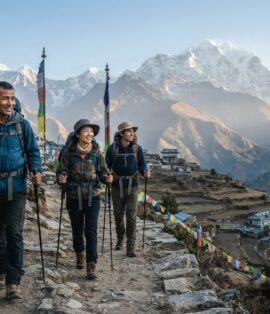
Balance deserves equal care. Practise standing on one leg while brushing your teeth, take uneven walking paths where safe, and work on ankle mobility. Trekking poles can reduce strain on steep descents and provide useful stability, but they work best when they support sound footwork rather than replace it.
Your feet are part of your fitness assessment too. Walking boots should be worn in before departure, without becoming so old that their grip and support have deteriorated. A training walk is the right place to identify rubbing, slipping heels or socks that hold too much moisture. Small problems at home are easy to fix; blisters on day three of a trek can change the whole experience.
Fitness and altitude are not the same thing
A common misconception is that excellent cardio fitness protects you from altitude illness. It does not. A marathon runner and a first-time trekker can both develop acute mountain sickness, because altitude response is individual and cannot be predicted by fitness alone.
Fitness helps you walk efficiently, but safe altitude travel depends on sensible pacing, gradual ascent, rest or acclimatisation days, hydration, adequate food and open communication with your guide. It also means respecting symptoms. A headache that persists, nausea, loss of appetite, poor sleep, unusual fatigue or worsening breathlessness should never be dismissed as a lack of toughness.
Choose an itinerary with enough time built in. Shortcuts in the mountains often look attractive on paper, particularly when annual leave is limited, but rushed ascents remove the very margin that helps travellers adapt. A carefully planned route may include a day with a short acclimatisation walk followed by rest, local exploration or time in a village. This is part of the trek, not time lost.
A realistic readiness check
Around six to eight weeks before departure, you should ideally be able to complete a full day of brisk walking on hills or stairs, then undertake another easier session the next day without excessive soreness. You should be comfortable carrying a daypack and able to walk steadily rather than relying on bursts of speed followed by long stops.
Consider these four areas together:
- Cardiovascular endurance: can you sustain several hours of walking while still speaking in short sentences?
- Leg strength: can you manage repeated steps and controlled descents without knee pain or shaky legs?
- Recovery: do you return to normal movement within a day or two after a longer walk?
- Confidence: can you adjust layers, eat and drink regularly, use poles if needed, and continue calmly when the trail becomes rougher?
One weak area does not automatically mean you should cancel. It may mean choosing a gentler route, allowing more training time, using a porter service where appropriate, or extending the itinerary to create a more comfortable pace.
Build fitness gradually, not heroically
The best preparation resembles the trek itself: regular movement, increasing time on your feet and exposure to hills. Begin with three or four sessions each week, mixing walking with strength work and a lower-impact activity such as cycling or swimming if that suits your joints. Increase the longest walk gradually, rather than doubling it in one ambitious weekend.
In the final month, prioritise back-to-back walks. For example, a longer hill walk on Saturday followed by a gentler but purposeful walk on Sunday teaches your body to move on tired legs. It also reveals practical issues with footwear, nutrition and pacing.
Avoid arriving exhausted. The final week should be about maintaining movement, sleeping well and preparing your kit, not attempting last-minute endurance challenges. Travel, changing schedules and the first days at altitude will ask enough of your body.
If you have a heart or lung condition, diabetes, a history of significant injury, are recovering from surgery, or have concerns about medication at altitude, speak with your doctor well before departure. This is particularly worthwhile for travellers returning to exercise after a long break. A specialist trekking operator can advise on route demands and logistics, but personal medical clearance must come from a qualified clinician.
Choose challenge with room to enjoy it
A rewarding trek should stretch you without reducing every day to a survival exercise. For some travellers, that means beginning with Annapurna foothills and the sunrise view from Poon Hill. For others with a strong walking background and sufficient preparation, Everest Base Camp, Gokyo Lakes or a high pass route may be the right next adventure.
At Brothers Team, our guides see that readiness is more than a fitness number. It is the combination of preparation, sensible expectations, a well-paced itinerary and the willingness to walk at your own safe rhythm. Start where you are, train consistently, and give yourself the time to look up when the mountains finally come into view.


Comments are closed