


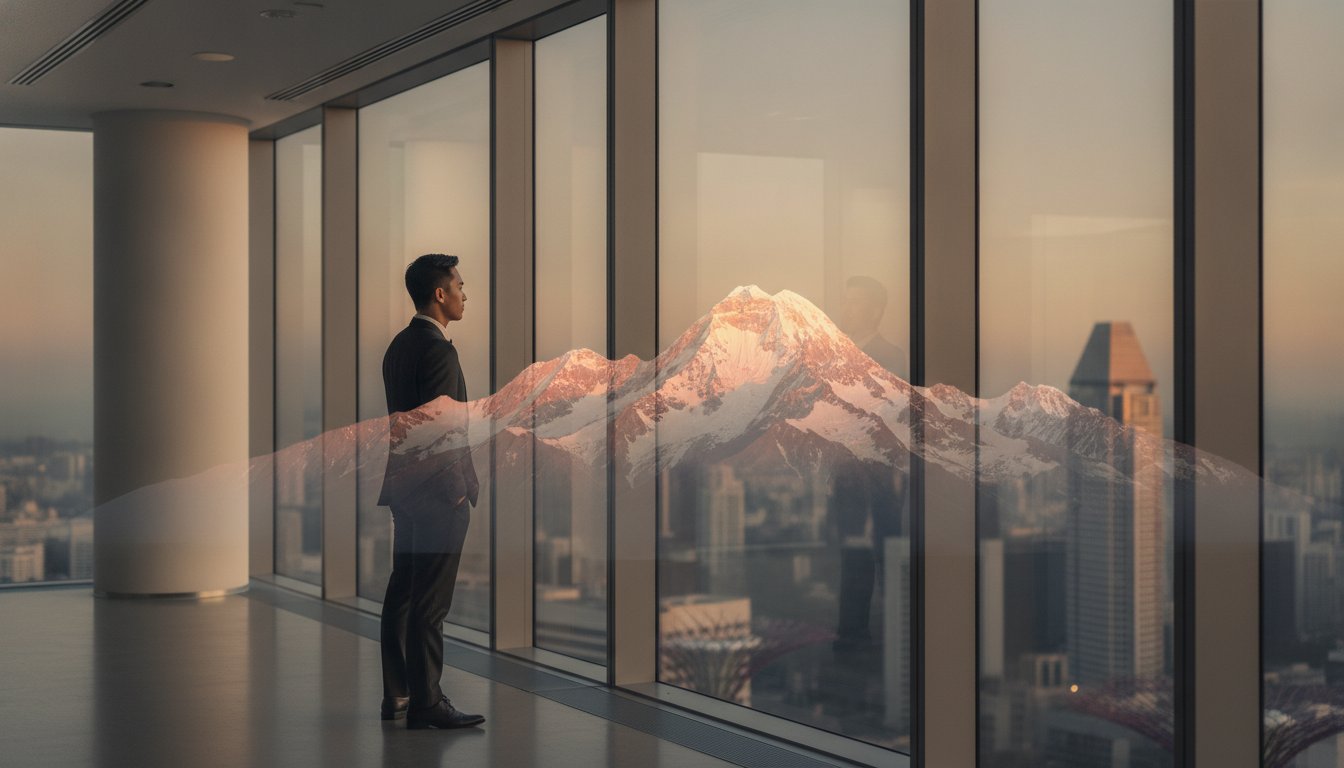
Himalayan Peak Climbing from Singapore: The Ultimate 2026 Mountaineering Guide
What if your next holiday didn’t just involve walking toward a mountain, but standing triumphantly on its summit? For many local adventurers, Himalayan peak climbing from Singapore feels like a distant dream reserved for elite professionals. It’s easy to feel stuck between the burning desire for a 6,000m peak and the practical reality of living in a country where the highest point is a gentle, forested hill.
We understand that the jump from trekking to true mountaineering is intimidating. You’re likely worried about technical gear, training for altitude at sea level, and the complex new 2026 permit regulations. This guide is designed to bridge that gap. As a family-owned specialist with offices in both Singapore and Kathmandu since 1992, we provide the professional authority and local knowledge needed to make your first summit a reality.
We’ll walk you through selecting the perfect peak, mastering logistics, and preparing your body for the thin, crisp air of the high Himalayas. You’ll discover how our seamless door-to-door approach ensures you focus on the climb while we handle the expert-led safety protocols and essential paperwork required for a successful expedition.
Key Takeaways
- Understand the distinction between trekking and mountaineering to confidently target your first 6,000m summit in 2026.
- Compare the technical demands of Island, Mera, and Lobuche peaks to find the ideal match for your Himalayan peak climbing from Singapore journey.
- Implement a practical training strategy using Singapore’s high-rise architecture to build the specific endurance and leg strength needed for high-altitude inclines.
- Simplify your expedition logistics by mastering the 2026 permit updates and the transition from Changi’s terminals to the mountain trails of Nepal.
- Gain peace of mind by partnering with a dual-office specialist that provides direct accountability from Singapore and expert Sherpa leadership on the ground.
What is Himalayan Peak Climbing for Singaporean Adventurers?
For many adventurers, standing at Everest Base Camp feels like the ultimate achievement. However, a growing number of local trekkers are looking higher. Himalayan peak climbing from Singapore represents the next logical evolution for those who have mastered the trails and now crave the summit. It is the transition from being a spectator of the great peaks to becoming a participant in their history. To truly understand what is mountaineering, one must look past the well-trodden paths and toward the vertical challenges of ice, rock, and snow.
In the world of high-altitude adventure, we often talk about “Trekking Peaks.” Don’t let the name fool you; these are significant 6,000m summits like Island Peak or Mera Peak. They require basic technical skills rather than decades of elite mountaineering experience. For the 2026 climbing season, the primary windows remain the Spring (March to May) and Autumn (September to November) months. During these times, the weather stabilizes, offering the clear skies and manageable temperatures necessary for a safe ascent. Choosing Himalayan peak climbing from Singapore means moving beyond the horizontal journey of a trek and embracing the vertical psychological shift of a climber.
Trekking vs. Peak Climbing: Key Differences
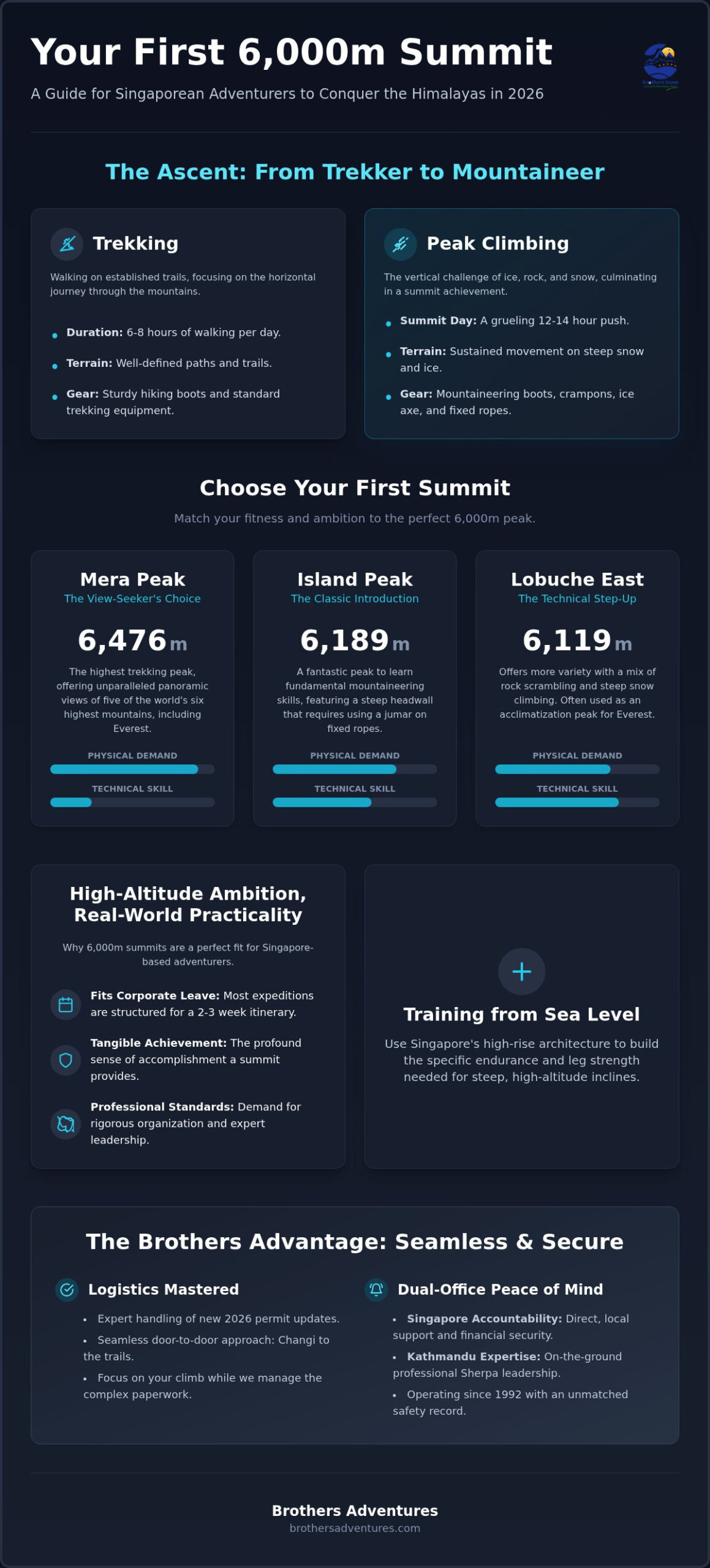
The primary difference lies in the intensity of the physical and technical demands. While trekking involves walking for six to eight hours a day on established trails, peak climbing introduces sustained movement on steep snow and ice. You’ll move from sturdy hiking boots to specialized mountaineering boots equipped with crampons. You will learn to use an ice axe for balance and safety, and master the art of moving along fixed ropes. The defining moment of any expedition is Summit Day. This is a grueling 12 to 14 hour push that often begins in the middle of the night, testing your stamina and resolve in ways a standard trek never could.
The Popularity of 6,000m Summits in Singapore
Why are so many Singaporeans trading their office wear for down suits? The answer lies in a mix of “bucket list” culture and practical accessibility. Most 6,000m peak expeditions fit perfectly into a 2 to 3 week itinerary, making them ideal for those managing corporate leave cycles. There’s a profound sense of tangible achievement in reaching a summit that a base camp trek simply cannot match. We define the Singaporean Himalayan niche as a unique blend of high-altitude ambition and professional safety standards. It caters to the driven individual who demands rigorous organization and expert leadership while pursuing extraordinary personal goals.
Choosing Your First Summit: Island Peak vs. Mera Peak vs. Lobuche
Selecting your first summit is more than a logistical choice; it’s a decision that defines your entire experience. Choosing the right mountain for your Himalayan peak climbing from Singapore ensures you enjoy the journey as much as the summit. The “big three” trekking peaks in Nepal—Mera, Island, and Lobuche—each offer a unique flavor of adventure. Your task is to match your current fitness and technical comfort with the mountain’s specific demands to ensure a safe and triumphant return.
Mera Peak: The View-Seeker’s Choice
Standing at 6,476m, Mera Peak is the highest of the trekking peaks. It’s the ultimate prize for those who want to stand high above the world without navigating complex vertical ice. The ascent is physically grueling due to the sheer altitude, but technically it remains straightforward. Think of it as a very high-altitude walk on snow. The reward is arguably the best view in the Himalayas. From the summit, you’ll see five of the world’s six highest mountains, including Everest, Lhotse, and Makalu, all glowing in the morning light. It’s the ideal peak for strong hikers who have an excellent aerobic base but minimal technical climbing experience.
Island Peak and Lobuche: The Technical Step-Up
If you’re eager to use crampons, ice axes, and fixed ropes, then Island Peak (6,189m) or Lobuche East (6,119m) will suit your ambitions. Island Peak is a classic. It features a legendary “Headwall,” a steep section of ice and snow that requires you to use a jumar on fixed ropes. It’s a fantastic place to learn crevasse crossing and basic mountaineering skills. For those who want more technical variety, Lobuche East offers a mix of rock scrambling and steep snow finishes. It’s frequently used as an acclimatization peak for Everest climbers. To see what a full technical itinerary looks like, explore our Island Peak climbing package.
Deciding between these peaks requires an honest look at your “Mountaineering Quotient.” Are you looking for a physical endurance test or a technical skill-building mission? Himalayan peak climbing from Singapore is a journey of self-discovery, and we’re here to guide that process. If you’ve already conquered a high-altitude trek and want to see what’s next, our Nepal Expeditions & Peak Climbing programs are designed to help you make that leap. We’ve been helping Singaporeans find their perfect summit since 1992, providing the dual-office accountability you need to climb with total confidence.
Training in Singapore: Preparing for 6,000m in a Flat Country
Preparing for Himalayan peak climbing from Singapore might seem like a contradiction, but our city’s urban landscape is a hidden gym for the aspiring mountaineer. You don’t need a mountain in your backyard to build the iron legs and massive lung capacity required for a 6,000m summit. Success on a peak like Island or Mera is built on the stairs of our HDB blocks and the humid trails of our nature reserves. It’s about discipline, consistency, and a willingness to embrace the “Stairmaster” strategy in the heart of the tropics.
Focus your conditioning on building a rock-solid Zone 2 aerobic base. This is the foundation of high-altitude endurance; it’s the ability to keep moving for ten hours straight when the air is thin and every step feels like a lead weight. Aim for long, slow sessions where you can still hold a conversation. Supplement this with heavy weighted pack walks. Your core and leg stability will be tested when you’re navigating rocky moraines or kicking steps into a snow slope. If you can’t carry a 12kg pack up 40 stories in Singapore, you’ll struggle when the altitude triples that perceived weight.
Don’t ignore the mental game. High-altitude “tent life” is a far cry from a staycation at Marina Bay. It involves cold toes, broken sleep, and the persistent discomfort of thin air. You can’t train for the altitude itself here, but you can train your grit. Push through your final set of stairs when you’re exhausted. Stay disciplined with your early morning rucks. This mental toughness is what will carry you through the midnight start on summit day.
Local Training Ground Recommendations
Hit the trails at Bukit Timah Nature Reserve or the Southern Ridges for repeated elevation gains. While these inclines are short, they are perfect for “Vertical Kilometre” training. Strap on your boots, load your pack, and find a high-rise staircase or a stadium with steep seating. Interestingly, Singapore’s heat and humidity provide a unique advantage. Training in these conditions stresses your cardiovascular system in a way that can improve your overall efficiency, making the cool, crisp Himalayan air feel like a relief once you finally arrive.
High-Altitude Safety and AMS Awareness
Understanding Acute Mountain Sickness (AMS) is just as vital as your physical fitness. AMS doesn’t care how many marathons you’ve run; it only cares how well your body adapts to decreasing oxygen. Look out for persistent headaches, loss of appetite, or dizziness. Our guides strictly follow “Climb High, Sleep Low” protocols to give your body the best chance to acclimatize naturally. For a deeper dive into staying healthy on the trail, check out our guide on high altitude trekking safety. Safety is never an accident; it’s the result of rigorous preparation and expert oversight.
Expedition Logistics: From Changi to the Himalayan Summit
The journey of Himalayan peak climbing from Singapore begins at Changi Airport, long before your boots touch the trails of the Khumbu. Mastering the logistics is what separates a stressful trip from a successful summit. Most local adventurers prefer the direct convenience of Singapore Airlines for the four-hour flight to Kathmandu, though transit options through hubs like Bangkok or Delhi are available. Once you land in Nepal, the real logistical dance begins with the flight to Lukla. These small aircraft have strict weight limits, usually capped at 15kg total per person. We recommend building at least two buffer days into your 2026 itinerary to account for the unpredictable mountain weather that frequently pauses flight schedules.
Your gear strategy should be split between two cities. Purchase your high-quality base layers, moisture-wicking socks, and specialized electronics in Singapore where you can test the fit. However, heavy technical hardware like 12-point crampons or double mountaineering boots are often better sourced or inspected in Kathmandu. This approach saves you significant excess baggage fees on your international flight. Remember that quality gear is your primary life-support system at 6,000m; don’t compromise on your layering or hardware.
The Essential 2026 Gear List
- Layering Systems: You need a versatile system that handles +25°C in the lower valleys and -20°C on the summit ridge. Focus on high-fill power down jackets and Gore-Tex outer shells.
- Technical Hardware: Ensure your harness is adjustable over thick layers and your 12-point crampons are compatible with your specific mountaineering boots.
- Electronics: Power banks are essential as charging becomes expensive and scarce. In 2026, satellite communication devices are increasingly popular for staying connected in the remote Khumbu regions.
Permits and Paperwork Simplified
Navigating the permit maze is one of the biggest hurdles for independent climbers. For the 2026 season, the Nepal Mountaineering Association (NMA) has implemented stricter digital submission requirements. You must provide digital passport photos and appoint a certified expedition leader (sardar) at the time of your application. Furthermore, your travel insurance must be specialized; it must explicitly cover “mountaineering with ropes” and helicopter evacuation up to 6,500m. It’s a complex process, but Brothers Adventures handles all permit processing and government liaison as part of our comprehensive service. If you’re ready to stop worrying about paperwork and start focusing on your training, explore our full range of Nepal Expeditions & Peak Climbing packages today.
The Brothers Advantage: Singapore Accountability, Kathmandu Expertise
When you’re planning a journey as significant as Himalayan peak climbing from Singapore, the partner you choose makes all the difference. Most operators fall into two camps: purely local Singaporean agencies that outsource to third parties, or purely Nepalese companies with no local presence. We offer a unique bridge. Brothers Adventures has been a Singapore-registered ACRA business since 1992, but our heart and operations are firmly rooted in Kathmandu. This dual-office model means you get the legal accountability and financial peace of mind of a Singaporean business, combined with the deep, local expertise of a team that owns its entire supply chain.
We don’t just “find” you a guide; we employ them. Our Sherpa guides, kitchen staff, and logistics teams are direct employees, not seasonal contractors. This lack of outsourcing is critical for your safety and the quality of your experience. Choosing Himalayan peak climbing from Singapore shouldn’t be a gamble on who will be waiting for you at the airport. Because we are a family-owned business, we have a personal commitment to every climber’s success. Our 24/7 support system ensures immediate communication between our Singapore office and the crew on the mountain, providing a safety net that third-party aggregators simply cannot match.
30+ Years of Himalayan Heritage
Our three decades of operation in Nepal have allowed us to build relationships that others simply can’t buy. We secure the most reliable flight slots to Lukla and the highest-quality tea houses because we’ve been a trusted part of the mountaineering community since 1992. This local knowledge informs everything from our meticulous route selection to our conservative, safety-first acclimatization schedules. If you’re curious about why these operational details are so vital for your 2026 expedition, read our thoughts on choosing a specialist tour operator.
Customizing Your Expedition
We believe that every climber’s journey is personal. Whether you’re looking for the camaraderie of a group departure or the focused pace of a private expedition, we can tailor the experience to your specific goals. Many of our climbers choose to celebrate their summit with luxury extensions in Pokhara or Kathmandu, turning a grueling physical challenge into a well-rounded holiday. We’re here to handle the complexity so you can focus on the climb. Ready to summit? Contact our Singapore office for a 2026 peak climbing consultation.
Your Journey to the Summit Starts Today
Standing on a 6,000m peak is the ultimate evolution for any trekker. You’ve learned how to choose between the technical challenge of Island Peak and the panoramic heights of Mera Peak. You now have a strategy for training on Singapore’s staircases and an understanding of the 2026 permit landscape. Himalayan peak climbing from Singapore is no longer just a distant ambition; it’s a practical, achievable goal when you have the right support system behind you.
Since 1992, we’ve acted as the bridge between Changi and the high Himalayas. As a Singapore-registered agency with direct Kathmandu operations and our own Sherpa teams, we handle every detail of your permit and logistics management. You get the accountability of a local business with the deep technical expertise of a mountain specialist. Don’t let your training go to waste or your dreams stay grounded. The thin, crisp air of the Khumbu is waiting for you.
View our 2026 Himalayan Peak Climbing Expeditions and start your ascent with a team that treats you like family.
Frequently Asked Questions
Do I need prior climbing experience for Island Peak or Mera Peak?
You don’t need elite mountaineering skills, but you should have a solid foundation in high-altitude trekking. For Island Peak, we provide basic technical training on the glacier to teach you fixed-rope climbing and crampon use. Mera Peak is technically simpler but physically demanding. Most Singaporeans find that a prior trek to Everest Base Camp provides the perfect experience base for their first 6,000m summit attempt.
How much does a Himalayan peak climbing expedition cost from Singapore?
Costs for Himalayan peak climbing from Singapore vary based on your choice of summit and duration. Key components include the NMA permit fee, which for 2026 is USD 350 in Spring and USD 175 in Autumn. You should also budget for round-trip flights from Changi, averaging USD 400 to USD 425 as of August 2026. Other expenses include park entry fees of USD 30 and licensed guide rates from USD 35 per day.
What is the best month for peak climbing in Nepal in 2026?
The best windows for your 2026 expedition are the Spring (March to May) and Autumn (September to November) seasons. Spring offers longer daylight hours and blooming rhododendrons, while Autumn typically provides the crispest, clearest views of the high peaks. Both seasons offer the stable weather patterns necessary for a safe summit push. Avoid the summer monsoon months when heavy rains and clouds can obscure the trails and cancel domestic flights.
How do I manage altitude sickness during the climb?
Managing altitude during Himalayan peak climbing from Singapore requires a conservative acclimatization schedule. Our itineraries follow the climb high, sleep low principle to help your body adapt naturally. Stay hydrated, eat a high-calorie diet even if your appetite decreases, and communicate any symptoms like persistent headaches to your guide immediately. Using prophylactic medication like Diamox is common, but you should consult a doctor in Singapore before your 2026 departure.
Can I rent technical climbing gear in Kathmandu?
You can certainly find high-quality technical gear for hire in Kathmandu’s Thamel district. Items like double mountaineering boots, crampons, ice axes, and harnesses are readily available. While we recommend buying your personal base layers and boots in Singapore to ensure a perfect fit, renting heavy hardware in Nepal is a practical way to manage your international luggage weight. Our team can assist you in selecting reliable, safety-tested equipment upon arrival.
What kind of travel insurance do I need for a 6,000m peak?
You must secure a specialized policy that explicitly covers mountaineering up to 6,500m. Standard travel insurance often excludes activities involving ropes or altitudes above 4,000m. Ensure your coverage includes emergency helicopter evacuation and medical expenses in Nepal. In 2026, these specialized policies typically cost between USD 150 and USD 400. Always check the fine print to confirm that trekking peaks are included, as solo climbing is not permitted and requires a licensed guide.
How many days of leave should I plan for a Singapore-Himalaya expedition?
Plan for a minimum of 18 to 22 days for a full expedition from Singapore. This timeframe includes your international travel, the trek to base camp, essential acclimatization days, and a buffer for potential weather delays in Lukla. While some shorter itineraries exist, rushing the process significantly increases the risk of altitude sickness. Giving yourself a three-week window ensures a more relaxed, safer, and ultimately more successful journey to the summit.
Is it possible to combine an EBC trek with a peak climbing attempt?
Combining an Everest Base Camp (EBC) trek with an Island Peak or Lobuche East climb is a highly effective strategy. Walking the EBC trail first provides the ideal acclimatization period before you attempt the technical summit push. It allows your body to get used to the thin air while you enjoy the classic Khumbu scenery. Many of our 2026 itineraries are designed this way to maximize your chances of standing on the summit.


Comments are closed