



Everest Base Camp Trek Cost from Singapore: The Complete 2026 Budget Guide
Why do two seemingly identical trekking itineraries come with price tags that are worlds apart? It’s the question that keeps many Singaporean adventurers awake at night. You’re ready to stand at the foot of the world’s tallest peak, but the confusing price variations between local agencies and international giants can make your head spin. We understand the fear of hidden costs lurking in the shadows of a “budget” deal and the uncertainty of fluctuating flight prices from Changi. It’s frustrating to plan a dream when the financial goalposts feel like they’re constantly moving.
Mastering your Everest Base Camp trek cost from Singapore doesn’t have to be a guessing game. This guide provides a clear, itemized breakdown of your 2026 expedition budget, from Singapore Airlines fares to the latest Khumbu permit fees. You’ll discover how much to set aside for professional gear, teahouse meals, and those essential safety nets like high-altitude insurance. We’ll also explore why choosing a partner with offices in both Singapore and Kathmandu ensures your money buys local expertise rather than hidden markups. Get ready to plan your journey with total financial confidence and the infectious enthusiasm this majestic landscape deserves.
Key Takeaways
- Identify the perfect balance between comfort and safety by comparing budget, standard, and premium trekking tiers for your 2026 adventure.
- Master the Everest Base Camp trek cost from Singapore by analyzing direct flight options from Changi and timing your booking for the best value.
- Secure your journey with a complete checklist of 2026 permit fees and non-negotiable insurance coverage for altitudes up to 6,000 meters.
- Save on preparation by weighing the costs of purchasing technical gear in Singapore against the convenience of high-quality rentals in Kathmandu.
- Leverage the reliability of a dual-office specialist to eliminate middleman markups and ensure your funds go directly toward a safe, high-quality experience.
Breaking Down the Everest Base Camp Trek Budget Components
Planning for the Himalayas starts with a realistic financial blueprint. When you look at the Everest Base Camp trek cost from Singapore, you’ll notice three distinct tiers. Budget treks usually offer the bare essentials, often leaving you to pay for meals or hot showers out of pocket. Standard packages provide a balanced experience with most logistics handled. Premium tiers include higher-end teahouses and perhaps a helicopter return from Everest Base Camp itself. Every tier has its merits, but your choice depends on how much comfort you need after a long day on the trail.
You also need to decide between “Land Only” and flight-inclusive deals. Land Only packages start in Kathmandu, giving you the freedom to book your own international flights or extend your stay. Flight-inclusive deals are simpler for Singaporeans, as they bundle everything from Changi Airport to the trailhead. Always check what “all-inclusive” really means. Some agencies exclude bottled water, battery charging, or WiFi. These small costs can quickly drain your cash on the mountain. Working with a tour operator with deep local roots ensures these details are handled before you leave Singapore.
Fixed vs. Variable Costs
Think of your budget in two buckets. Fixed costs are the non-negotiables. These include your Khumbu region permits, Sagarmatha National Park entry fees, and the daily rates for your guide and porter. These prices are set by local authorities and don’t change based on your preferences. Variable costs are where you have more control. Your round-trip flight from Singapore to Kathmandu is a major factor, as are your training sessions and gear purchases. Keep in mind that 2026 inflation and potential fuel surcharges on domestic Lukla flights may slightly nudge these figures higher than in previous years. Stay flexible and build a small buffer into your savings plan.
The Value of an All-Inclusive Package
It’s tempting to pick the cheapest sticker price, but independent trekking often hides a mountain of extra expenses. When you manage everything yourself, you’re responsible for sudden price hikes in teahouse meals or emergency logistics if weather shuts down Lukla airport. An all-inclusive package might feel like a larger investment upfront, but it saves you from being “nickeled and dimed” at every village. At Brothers Adventures, we structure our logistics to be transparent. We believe your focus should be on the thinning air and the majestic peaks, not on whether you have enough rupees for a hot shower. Our dual-office presence means we control the quality from the moment you book in Singapore until you return safely from the trail.
Airfare and Logistics: Traveling from Singapore to Kathmandu
Your journey to the roof of the world starts at the familiar terminals of Changi Airport. Managing the total Everest Base Camp trek cost from Singapore requires a keen eye on flight logistics before you even set foot in Nepal. While several carriers offer connecting routes through Bangkok or Kuala Lumpur, the direct connection from Singapore to Kathmandu remains the gold standard for trekkers who value their recovery time. Arriving fresh is vital, as your body needs every bit of energy to begin acclimatizing to the thinning mountain air. Early booking is your best defense against price spikes, especially for the peak trekking windows in 2026.
Singapore Airlines (SQ) vs. Budget Carriers
Singapore Airlines typically operates direct flights that take roughly five hours. For 2026, economy class fares are estimated to range between SGD 639 and SGD 1,156 depending on how far in advance you secure your seat. While budget carriers might tempt you with lower base fares, always look closely at the baggage allowances. You’ll likely be carrying professional-grade boots and heavy layers, so excess baggage fees can quickly erase any initial savings. Choosing a premium carrier often includes the 30kg allowance you need for a stress-free departure. It’s also a good idea to review health and safety guidelines regarding air travel and altitude before your flight to ensure you’re prepared for the physiological shift.
The Kathmandu-Lukla Flight Logistics
The domestic flight from Kathmandu to Lukla is a legendary part of the adventure. This short hop costs approximately USD 350 to USD 400. However, during peak seasons, many flights are diverted to Ramechhap Airport to ease congestion. This shift requires a four-hour drive from Kathmandu, which adds a layer of ground logistics to your budget. Weather in the Himalayas is notoriously unpredictable. Clouds can shut down Lukla for days, making a buffer budget essential for unplanned nights in Kathmandu. Many savvy trekkers now set aside funds for a shared helicopter upgrade, which can sometimes fly when fixed-wing planes cannot. These upgrades provide a vital safety valve if you’re on a tight schedule. To avoid the headache of coordinating these moving parts, using a specialist tour operator ensures your airport transfers and domestic connections are handled with professional precision. If you’re ready to start mapping out your itinerary, our flagship Everest Base Camp Trek includes the high-touch logistical support needed to navigate these mountain transitions smoothly.
Permits, Insurance, and Essential On-Trek Expenses
Beyond the flights and gear, your budget must account for the legalities and safety nets that make a Himalayan expedition possible. Managing your Everest Base Camp trek cost from Singapore effectively means looking at the fine print of local regulations. In 2026, every trekker entering the region must secure two primary permits. The Khumbu Pasang Lhamu Rural Municipality Entrance Permit costs NPR 2,000, which is roughly USD 20. Additionally, the Sagarmatha National Park Entry Permit is NPR 3,000, or about USD 30. These fees directly support the preservation of the trails you’ll walk upon. For a deeper dive into the logistics of these requirements, check out our Everest Base Camp trek cost from Singapore guide.
High-Altitude Travel Insurance
Don’t leave Changi without a policy that specifically names high-altitude trekking up to 6,000 meters. Most standard travel insurance policies stop coverage at 2,500 or 4,000 meters; this won’t help you when you’re approaching the base of the world’s highest peak. You need a policy that covers search and rescue, medical expenses, and helicopter evacuation. A helicopter lift from the Khumbu region can cost between USD 4,000 and USD 10,000. This makes a USD 150 to USD 250 premium for a 15-day trek a very wise investment. Always verify that your policy includes medical evacuation rather than just medical repatriation to ensure you’re covered for the flight to a hospital in Kathmandu.
Daily Cash Requirements on the Trail
Life in a teahouse comes with its own unique economy. While your package might cover bed and board, you’ll need local currency for the extras that make the journey more comfortable. Expect to pay between USD 3 and USD 10 for Wi-Fi access and USD 5 to USD 10 for a hot shower. Charging your power bank or camera batteries typically costs USD 2 to USD 5 per device. As you climb higher, the price of bottled water increases significantly. Budgeting USD 20 to USD 30 per day for these incidental expenses is a safe bet. Finally, remember the tipping culture. It’s customary to budget around 10-15% of your package fee for your guides and porters. This is a vital part of their income and a wonderful way to show appreciation for their hard work.
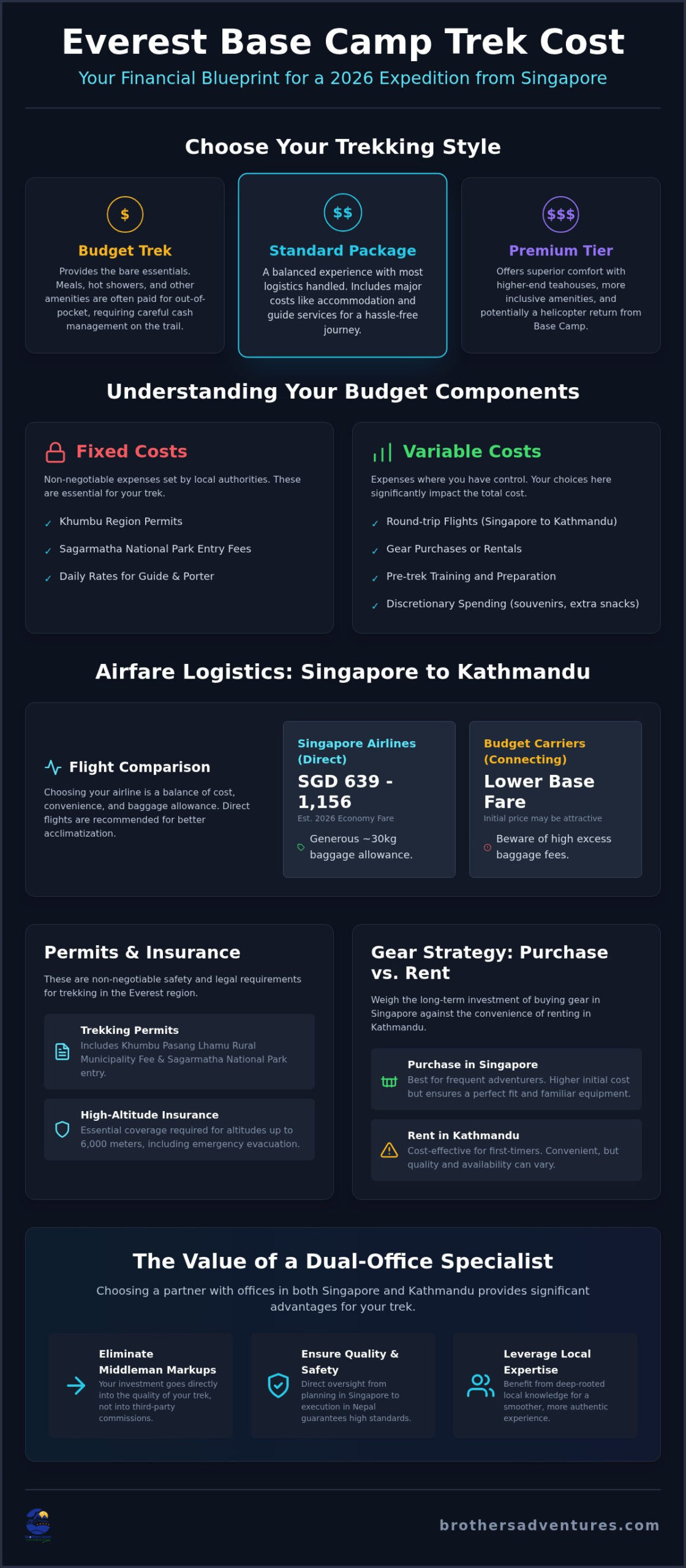
Preparation Costs: Gear and Training in Singapore
Your journey to the Himalayas begins long before you check in at Changi Airport. For many Singaporeans, the preparation phase is where the initial Everest Base Camp trek cost from Singapore starts to take shape. It’s an exciting time of gear shopping and physical conditioning, but it requires a strategic approach to avoid overspending on items you might only use once. Whether you’re browsing the outdoor specialists at Velocity @ Novena or hunting for deals at Queensway Shopping Centre, you’ll find that a professional-grade Himalayan gear set in Singapore can cost upwards of SGD 800. To ensure you’re investing in the right equipment, consult our detailed how to prepare for Everest Base Camp guide before you head to the shops.
The biggest budget dilemma for first-time trekkers is the “Rental vs. Buying” debate. If you don’t plan on making high-altitude trekking a regular hobby, renting heavy items like down jackets and -20°C sleeping bags in Kathmandu is a brilliant way to save. You can rent these essentials for as little as USD 1 to USD 3 per day. This allows you to focus your Singapore budget on high-quality trekking boots and moisture-wicking base layers, which are personal items you’ll want to break in well before your departure date.
The Essential Gear Investment
Investing in a proper layering system is non-negotiable. You’ll need moisture-wicking base layers to manage sweat during the day and heavy-duty thermals for the freezing nights. A high-quality down jacket is your shield against the biting Khumbu wind; don’t skimp on quality here. In Singapore, look for authentic brands that offer high fill-power down. Your boots are perhaps the most critical purchase. Expect to spend between SGD 200 and SGD 350 for a pair of waterproof, high-ankle trekking boots. Remember to buy them early and wear them on your training hikes to prevent blisters on the trail.
Physical Training and Medical Check-ups
Physical readiness is a form of insurance that doesn’t come from a policy. While Singapore lacks mountains, our HDB blocks and nature reserves are perfect training grounds. Budget for a few months of focused training, which might include gym memberships for strength work or weekend trips to Bukit Timah Hill. Many trekkers also find that climbing 40 stories of stairs with a weighted pack is the best way to simulate the relentless inclines of the Nepal trails. Additionally, factor in the cost of a pre-trek medical clearance. Visit a polyclinic or travel clinic for a health check and to discuss vaccinations like Hepatitis A and Typhoid. You’ll also need to budget for a first-aid kit stocked with altitude medication like Diamox. If you’re ready to put your training to the test, explore our flagship Everest Base Camp Trek and start your journey with a team that prioritizes your safety and preparation.
Why Brothers Adventures is the Strategic Choice for 2026
Choosing the right partner for your Himalayan journey is the most critical decision you’ll make. When you evaluate the Everest Base Camp trek cost from Singapore, it’s easy to get lost in spreadsheets and gear lists. However, the true value of your investment lies in the “Dual-Office Advantage.” We maintain active offices in both Singapore and Kathmandu, creating a seamless bridge between your planning phase and the actual trek. This structure ensures that the person you speak with in Singapore is directly connected to the team on the ground in Nepal. It’s a high-touch approach that large, faceless corporations simply cannot replicate.
Since 1992, we’ve operated as a family-owned specialist with a commitment to in-house operations. By managing every detail ourselves, we effectively eliminate the middleman markups that often inflate the Everest Base Camp trek cost from Singapore. You aren’t paying for a third-party agency’s marketing budget; you’re paying for decades of local expertise and a team that treats you like an invited guest. Our direct control over logistics means we can pivot quickly if mountain weather shifts or if a domestic flight schedule changes, ensuring your journey remains as smooth as possible.
Safety remains our absolute priority. Our guides are specialists in Himalayan safety and conduct daily monitoring of oxygen levels and AMS symptoms for every trekker. We believe that an adventurous spirit should always be backed by professional competence. By choosing a partner with deep local roots, you’re investing in a system that has been refined over thirty years to prioritize your well-being at every altitude.
Expertise Born in the Himalayas
Our heritage is built on the rugged trails of the Khumbu region. This isn’t just a business for us; it’s a lifelong passion for exploration that we’re eager to share. Because our Kathmandu office ensures real-time logistics management, we can provide a level of personalized service that starts the moment you reach out to us in Singapore. You’ll benefit from route knowledge that only comes from decades of walking these paths. Whether it’s knowing the best teahouse for a sunset view or the exact timing needed for a safe acclimatization hike, our expertise is woven into every day of your itinerary.
Booking Your 2026 Expedition
We make the transition from dreamer to trekker remarkably simple. You can handle your payments in SGD, avoiding the hassle of international wire fees or fluctuating exchange rates. Our Singapore team is always available to answer your questions, providing a local point of trust for all your planning needs. We take the weight off your shoulders by handling the complex permit applications and domestic flight logistics, leaving you free to focus on your physical preparation. If you’re ready to stand at the foot of the world’s highest peak, the Everest Base Camp Trek is your ultimate 2026 goal. Reach out to us today to book a consultation and let’s start crafting your custom itinerary for the adventure of a lifetime.
Your Himalayan Adventure Awaits
Standing at the base of the world’s highest peak is no longer a distant dream. By mastering the Everest Base Camp trek cost from Singapore, you’ve taken the most important step toward making this 2026 expedition a reality. You now understand the balance between fixed permit fees and the strategic choices you can make regarding gear and flights. This financial clarity allows you to shift your focus toward the physical and mental preparation required for the thinning air of the Khumbu region.
Choosing a partner with family-owned expertise since 1992 means your investment is protected by decades of specialized route knowledge. With offices in both Singapore and Kathmandu, we ensure every logistical detail is managed with professional precision. Our specialized AMS safety protocols and daily health monitoring provide the peace of mind you need to fully embrace the wonder of the mountains. Start planning your Everest Base Camp journey with Brothers Adventures today! The Khumbu is calling, and we’re ready to guide you through every step of this life-changing discovery.
Frequently Asked Questions
How much does the average Everest Base Camp trek cost from Singapore in 2026?
The total Everest Base Camp trek cost from Singapore typically ranges from SGD 3,500 to SGD 5,500 for a standard 15-day journey. This estimate covers your international flights from Changi, trekking permits, basic accommodation, meals, and professional guide services. While budget options exist, a standard package ensures higher safety standards and more reliable logistics. It’s wise to build in a small buffer for personal spending and gear to ensure a stress-free experience.
Do trekking packages usually include international flights from Changi?
Most standard trekking packages are sold as “Land Only” and do not include international flights from Changi Airport. However, some specialized Singapore operators offer flight-inclusive bundles to simplify your planning process. For 2026, you should budget between SGD 639 and SGD 1,156 for a return flight on Singapore Airlines. Booking your own flights offers flexibility, but a bundled deal provides a single point of contact for any travel disruptions or schedule changes.
What is the most expensive part of the EBC trek budget?
The trekking package and your international airfare are the two largest components of your budget. Beyond these, the domestic flight from Kathmandu to Lukla is a significant expense, costing approximately USD 350 to USD 400. High-quality personal gear is another major upfront cost if you choose to buy everything in Singapore. Strategic planning, such as renting heavy items in Nepal, can help you manage these larger financial pillars effectively without compromising on safety.
Is it cheaper to book with a local Nepal agency or a Singapore operator?
Booking with a Singapore operator like Brothers Adventures offers the security of local payment and planning combined with direct execution in Kathmandu. While local Nepal agencies might show lower headline prices, they often lack the high-touch support and accountability of a dual-office specialist. Choosing an operator with a physical presence in both cities ensures your money goes directly to the team on the ground without hidden middleman fees or frustrating communication gaps.
How much should I budget for tips for my guide and porter?
You should budget approximately 10% to 15% of your total trekking package fee for tips. This amount is typically shared between your lead guide, assistant guides, and porters at the conclusion of the trek. For a standard group journey, this often works out to about USD 150 to USD 200 per trekker. Tipping is a deeply ingrained part of the mountain culture and serves as a vital supplement to the income of local mountain staff.
Are there hidden costs like Wi-Fi and hot showers on the Everest trek?
Yes, incidental expenses like Wi-Fi, hot showers, and battery charging are common costs on the trail. Teahouses often charge between USD 3 and USD 10 for internet access and a similar amount for a single hot shower. Charging a power bank can cost up to USD 5 per device. Budgeting roughly USD 20 to USD 30 per day in local currency will comfortably cover these small but essential comforts as you climb higher.
Does travel insurance for EBC cost more than standard policies?
High-altitude travel insurance for EBC costs more than standard policies because it must cover helicopter evacuation up to 6,000 meters. For a 15-day trek, expect to pay between USD 150 and USD 250 for a comprehensive policy. Standard insurance usually excludes activities above 4,000 meters, so a specialized mountaineering policy is non-negotiable. This expense is a critical safety net that protects you from massive medical and rescue bills if an emergency occurs.
Can I rent trekking gear in Kathmandu to save on my Singapore budget?
Renting gear in Kathmandu is an excellent way to reduce your Everest Base Camp trek cost from Singapore. You can rent heavy, specialized items like -20°C sleeping bags and professional down jackets for just USD 1 to USD 3 per day. This is much more cost-effective than buying expensive equipment in Singapore that you might never use again. Save your Singapore budget for high-quality trekking boots that you can break in before your flight.



Comments are closed