



Everest Base Camp Trek Cost from Singapore: The Complete 2026 Price & Planning Guide
What if the biggest hurdle to standing at the foot of the world’s tallest peak isn’t the thin air, but the confusing math of your travel budget? You’ve likely spent hours scrolling through stunning Himalayan vistas while wondering why one package costs double another. It’s natural to feel uneasy about flight price volatility from Changi or those dreaded hidden costs that often appear mid-trek. This guide provides a clear, SGD-ready breakdown of the Everest Base Camp trek cost from Singapore for 2026. We’ll help you plan with the absolute confidence of a seasoned explorer.
We believe this journey is a significant investment in your personal growth and sense of wonder. You’ll discover how to navigate 2026 flight estimates, which usually range from SGD 639 to SGD 1,156, and learn exactly where to splurge for safety versus where to save. From mandatory permit fees to the recommended daily SGD 25 buffer for hot showers and Wi-Fi, we’ve mapped out the essential expenses you’ll encounter. This roadmap ensures you can choose a reliable, Singapore-managed operator and keep your focus on the majestic peaks rather than the logistics.
Key Takeaways
- Learn how to distinguish between base package prices and the true Everest Base Camp trek cost from Singapore to eliminate mid-trip budgeting surprises.
- Discover the 2026 price trends for international flights from Changi and the critical logistics of the Kathmandu-to-Lukla mountain hop.
- Identify essential hidden expenses, including specialized high-altitude travel insurance and daily trail costs for Wi-Fi and hot showers.
- Understand the safety and logistical benefits of partnering with a dual-office agency based in both Singapore and Kathmandu for seamless support.
- Explore different budgeting tiers to find your ideal balance of comfort, safety, and investment for your successful 5,364m ascent.
Navigating the 2026 Everest Base Camp Trek Cost Landscape
Standing at the foot of the world’s highest peak is a dream that has captivated Singaporean adventurers for decades. For 2026, the allure remains stronger than ever as we seek experiences that offer both profound challenge and breathtaking beauty. However, the first step toward the Khumbu icefall isn’t a physical one; it’s a financial one. Understanding the Everest Base Camp trek cost from Singapore requires a sharp eye for detail. You aren’t just paying for a walk in the mountains. You’re investing in a complex logistical operation that spans two countries and high-altitude environments.
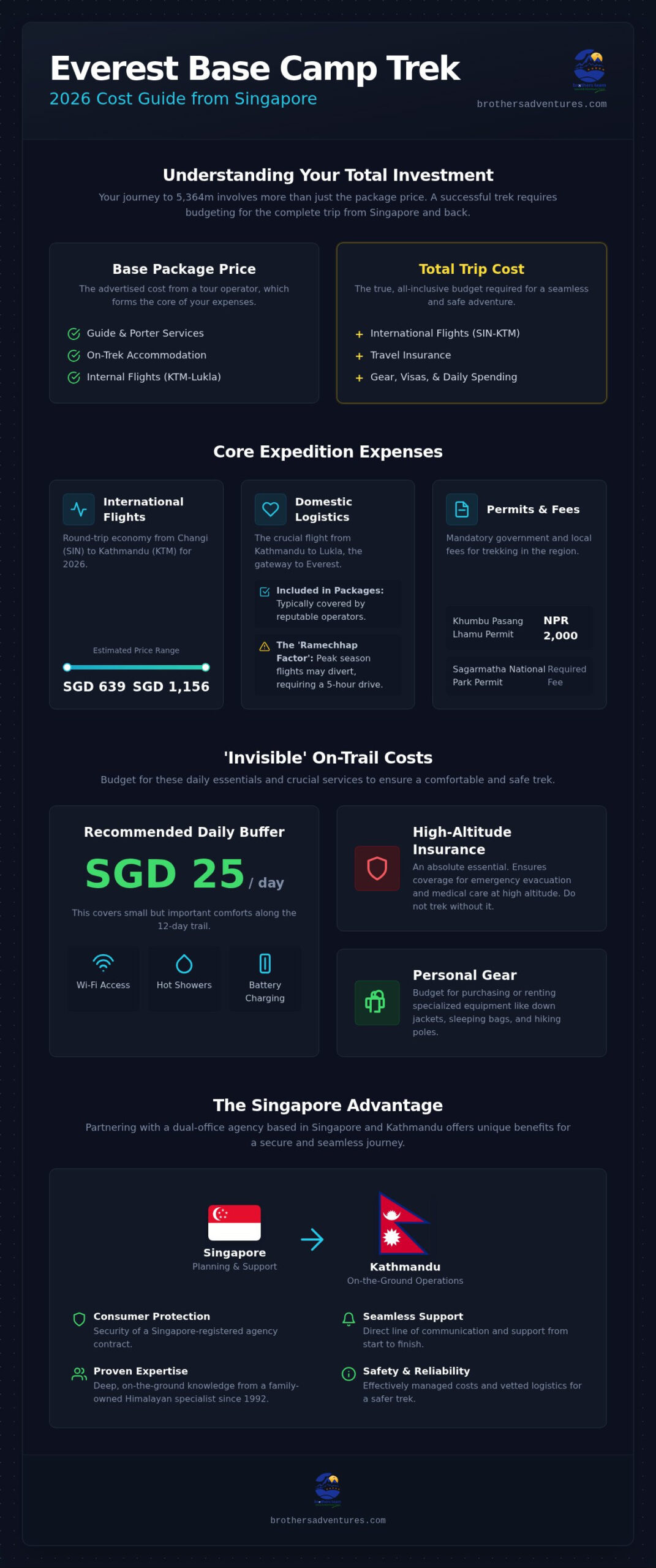
It’s vital to distinguish between the “Package Price” and your “Total Trip Cost.” Many trekkers get caught out by budgeting only for the tour itself. Your total investment includes international flights from Changi, Nepal entry visas, gear upgrades, and those essential daily comforts like a hot shower or a battery charge. In 2026, global economic shifts and Nepal’s updated tourism policies mean that your budget needs to be more precise than ever. While you’ll likely track your savings in SGD, you must prepare for transactions in USD for visas and Nepalese Rupees (NPR) for trail-side expenses. For a transparent, SGD-ready breakdown of every expense you’ll encounter, our complete 2026 Everest Base Camp trek cost from Singapore price and planning guide covers everything from the Lukla flight to trail meal costs.
Major Factors Influencing Your 2026 Budget
Seasonality is your biggest cost driver. Choosing the peak windows of March to May or September to November offers the best weather, but these months command a premium for everything from flights to tea house rooms. Nepal’s regulatory landscape has also shifted. For example, the Khumbu Pasang Lhamu Rural Municipality now manages its own entry permits, priced at NPR 2,000 for 2026. While a guide isn’t strictly mandatory for permits on the Everest Base Camp trek, the trend toward guided safety is now the industry standard. This ensures you aren’t just paying for a pathfinder, but for a lifeline in the thin air.
The ‘Singapore Factor’ in Trek Planning
Planning from the Little Red Dot gives you unique advantages. Direct flights from Changi to Kathmandu via Singapore Airlines provide a seamless start. Booking through a Singapore-registered agency like Brothers International Tours & Trading Pte Ltd provides a layer of consumer protection and accountability that’s hard to find when booking with offshore entities. Our dual-office presence in Singapore and Kathmandu allows us to manage costs effectively, ensuring your SGD goes further. You get the security of a local contract with the deep, on-the-ground expertise of a family-owned Himalayan specialist that has operated since 1992.
The Core Expenses: Flights, Permits, and Expedition Packages
Calculating the Everest Base Camp trek cost from Singapore begins at Changi Airport. While the trek itself happens in the thin air of the Himalayas, your financial planning starts at sea level with the three pillars of expedition budgeting: international airfare, regional logistics, and government permits. These fixed costs form the foundation of your 2026 journey and are the least flexible parts of your budget. Getting these right early ensures you won’t be scrambling for funds when you’re supposed to be focused on the scenery.
Flight Logistics from Changi to Kathmandu
Singaporean trekkers enjoy a significant advantage with direct access to Kathmandu. For 2026, economy class fares typically range from SGD 639 to SGD 1,156, depending on how far in advance you secure your seat. While budget carriers with layovers in Kuala Lumpur or Bangkok can shave a few hundred dollars off the price, the convenience of a direct flight often outweighs the savings. Consider the physical toll of a long journey; arriving fresh in Kathmandu is a better preparation for a 12 day trek than spending 15 hours in transit.
Once you land in Nepal, the next logistical hurdle is the legendary flight to Lukla. This short, scenic hop is included in most reputable packages, but you should also prepare for the “Ramechhap factor.” During peak 2026 seasons, flights often divert to Manthali Airport to ease Kathmandu’s congestion, requiring a five hour drive from the capital. Flexible flight booking is essential for 2026 Himalayan travel because mountain weather and seasonal airport diversions can shift your itinerary without warning. If you’re looking to bypass these delays, a private helicopter upgrade from Kathmandu to Lukla is a popular splurge, though it can add several hundred dollars to your total spend.
Permits and Local Government Fees
The permit system in Nepal has evolved to prioritize local management. According to Nepal’s official trekking regulations, the previously required TIMS card is no longer necessary for the Everest region. Instead, you’ll need two specific documents. First is the Sagarmatha National Park Entry Permit, which costs NPR 3,000 plus 13% VAT. Second is the Khumbu Pasang Lhamu Rural Municipality Permit, priced at NPR 2,000. These fees are paid in Nepalese Rupees, and specialists like Brothers International Tours & Trading Pte Ltd typically handle these applications on your behalf to ensure you don’t spend your first day in Kathmandu stuck in a government office.
Don’t forget the Nepal Tourist Visa, which Singaporean passport holders can obtain on arrival. For a standard trek, the 30 day multiple entry visa at US$50 is the most practical choice. When you book a comprehensive Everest Base Camp Trek with an established agency, these logistical headaches disappear. A “Standard” package generally includes your internal flights, tea house accommodation, and guide fees, while “Premium” tiers might add luxury stays in Kathmandu or oxygen support. Choosing the right tier is about balancing your comfort needs with the raw, authentic experience of the trail.
The ‘Invisible’ Costs: Gear, Insurance, and Daily Spending
Beyond the obvious flights and permits discussed earlier, your total budget for the Everest Base Camp trek cost from Singapore must account for several “invisible” variables. These are the expenses that don’t always appear on a standard tour brochure but are vital for a successful journey. Think of these as your tactical investments. They range from the specialized gear on your back to the digital connection that lets you share your progress with friends back in Singapore. Ignoring these can lead to a significant budget shortfall mid-trek.
Gear Investment: Buying in Singapore vs. Renting in Kathmandu
Equipping yourself for the Himalayas is a balancing act between quality and cost. For Singaporeans, the temptation is to visit local outdoor retailers to buy everything brand new. While you should definitely purchase your trekking boots in Singapore at least three months before your trip to break them in, other high-ticket items are better rented. Items like -20°C sleeping bags or heavy down jackets are expensive to buy and take up massive space in your HDB storage. Renting these bulky items in Kathmandu’s Thamel district is a brilliant cost-saving move. You’ll get professional-grade gear for a small daily fee, allowing you to save your SGD for the experience itself. Before you finalize your gear decisions, our Everest Base Camp trek packing list for 2026 separates essential items from the heavy myths that unnecessarily inflate your pack weight and budget.
Safe items to rent locally include:
- Heavy Down Jackets: High-quality, expedition-grade warmth.
- Sleeping Bags: Rated for extreme sub-zero temperatures.
- Trekking Poles: Lightweight and sturdy for the rocky terrain.
Insurance and Emergency Contingencies
Don’t make the mistake of assuming your standard annual travel insurance covers a trek to 5,364 meters. Most basic policies cap out at 2,500 meters, leaving you completely exposed. A helicopter rescue from the Khumbu region can cost between US$4,000 and US$10,000 if you aren’t covered. Your policy must specifically include medical evacuation up to 6,000 meters. This isn’t just about money; it’s about your health and safety at high altitudes. High-altitude specific insurance is a non-negotiable prerequisite for 2026 expeditions to protect against the significant financial and physical risks of mountain emergencies.
Daily Trail Spending and Tipping
Once you’re on the trail, you’ll need a daily cash buffer of SGD 15 to SGD 25. While your meals and accommodation are usually pre-paid in your package, tea houses charge extra for “luxuries” as you climb higher. Wi-Fi cards from Everest Link cost between NPR 500 and 1,000, while a hot shower or charging your power bank typically costs between SGD 3 and SGD 6. Finally, remember the tipping culture. Your Sherpa guides and porters are the backbone of your expedition. Tipping is a deeply ingrained way to show gratitude for their local knowledge and physical labor. Budgeting roughly 10% to 15% of your trek cost for tips ensures your team feels valued and respected.
Budgeting Tiers: Finding Your Ideal Himalayan ROI
Choosing how much to invest in your Everest Base Camp trek cost from Singapore is about more than just numbers on a spreadsheet. It’s about the return on investment for your safety, comfort, and ultimate success in reaching 5,364 meters. For 2026, while the total cost for a 14 to 16 day journey typically ranges from SGD 3,800 to over SGD 7,500, where you fall on this spectrum depends on whether you’re looking for a rugged, self-supported adventure or a high-touch, fully managed expedition.
The “Budget” tier often appeals to those looking to minimize upfront costs. However, be wary of the “false economy” found in ultra-cheap packages. If a price seems too good to be true, the operator might be cutting corners on porter insurance, guide-to-trekker ratios, or the quality of your meals. Saving a few hundred dollars isn’t worth it if you’re left without adequate oxygen supplies or professional support during an emergency. Your safety in the thin air is the one thing you should never discount.
For most Singaporean professionals, the “Standard” experience offers the best balance. This tier provides reliable logistics, experienced guides, and comfortable tea house stays without the price tag of extreme luxury. It’s the sweet spot where you get professional-grade safety protocols and a supportive team that understands the specific needs of trekkers coming from sea-level Singapore.
Standard vs. Premium: What Are You Paying For?
The difference between a standard and a premium trek often comes down to the details of your daily life on the trail. Premium expeditions might feature a 1:1 or 1:2 guide-to-trekker ratio, ensuring you have personalized attention every step of the way. You’ll also see a jump in accommodation quality. While standard treks utilize authentic, charming tea houses, premium tiers often include luxury mountain lodges with heated rooms and private bathrooms. These small comforts become massive morale boosters when the temperature drops well below freezing at night.
Strategic Splurging: Where to Spend Extra
If you’re going to spend extra, put your money toward an extra acclimatization day. Rushing your ascent is the fastest way to trigger altitude sickness. Investing in a specialist tour operator who builds these safety days into the itinerary is a brilliant move. At Brothers International Tours & Trading Pte Ltd, our dual-office model in Singapore and Kathmandu ensures that your logistics are seamless from the moment you leave Changi until you return home. You aren’t just buying a tour; you’re buying 30 years of family-owned heritage and local expertise.
Secure your spot on our next Everest Base Camp Trek and experience the Himalayas with the peace of mind you deserve.
Brothers Adventures: Your 2026 Everest Base Camp Partner
Choosing an operator is the final, most critical piece of your budgeting puzzle. When you evaluate the Everest Base Camp trek cost from Singapore, you’re looking for more than just a line item on a spreadsheet; you’re looking for accountability. By maintaining active offices in both Singapore and Kathmandu, we eliminate the middleman markups that often inflate prices for Singaporean travelers. This dual-office model gives us total control over your logistics, ensuring that every dollar you invest goes directly into the quality of your experience and the safety of your team.
Since 1992, our family-owned agency has acted as a bridge between the Little Red Dot and the highest peaks on Earth. We don’t believe in “mountain surprises.” Our pricing is transparent from the start, covering the essentials we’ve discussed in this guide without the hidden surcharges that often plague budget operators. With over 30 years of heritage, we’ve refined our operations to handle everything from seasonal flight diversions to permit updates, allowing you to focus entirely on the trail ahead.
Safety isn’t a buzzword for us; it’s our baseline. Our guides are seasoned experts who conduct daily health checks using pulse oximeters to monitor your oxygen saturation levels. We understand how the body reacts to altitude, especially for those coming from a sea-level environment like Singapore. This proactive approach to Everest Base Camp trek cost from Singapore ensures that your investment is protected by the highest safety standards in the industry.
The Advantage of Local & Singaporean Expertise
Our unique structure means you get direct, face-to-face support in Singapore for your pre-trip Everest Base Camp trek planning. You don’t have to wait for time-zone-delayed emails to get answers about your gear or itinerary. Once you land in Kathmandu, our dedicated Nepal team takes over, providing a seamless transition that only a dual-office specialist can offer. We even provide personalized training advice tailored for Singapore-based trekkers, helping you find the best spots like Bukit Timah or MacRitchie to prep your legs for the Khumbu.
Ready to Start Your 2026 Journey?
The mountains are calling, and 2026 is the perfect year to answer. Whether you’re planning a solo bucket-list adventure or a group expedition with friends, we’re ready to help you map out a journey that fits your goals and budget perfectly. Request a customized quote today to see how we can turn your Himalayan dreams into a reality with the professional care of a local Singaporean partner.
Don’t leave your dream to chance. View our Everest Base Camp Trek packages and start your adventure today. We have several upcoming 2026 departure dates available, including early-bird opportunities for those who want to secure their spot well in advance.
Claim Your Place at the Roof of the World
Your 2026 journey to the Himalayas is no longer a collection of “what-ifs” and vague estimates. You now have the roadmap to navigate the Everest Base Camp trek cost from Singapore with absolute precision. From timing your Changi departure to choosing the right gear and insurance, every dollar spent is a step toward a successful ascent. By prioritizing safety and local expertise over ultra-cheap packages, you ensure that your focus remains on the stunning vistas of the Khumbu region rather than unexpected expenses.
Since 1992, Brothers Adventures has served as a reliable bridge for Singaporean explorers. Our dual-office presence in Singapore and Kathmandu, combined with specialist high-altitude safety protocols, guarantees a seamless and secure expedition. We don’t just organize trips; we welcome you into our family of adventurers. Take the first step toward your bucket-list goal today. Book your 2026 Everest Base Camp Trek with Brothers Adventures and prepare for the adventure of a lifetime. The majestic peaks are waiting for you!
Frequently Asked Questions
How much should I budget for flights from Singapore to Kathmandu in 2026?
Budget between SGD 639 and SGD 1,156 for your economy class flights from Changi Airport. These rates fluctuate based on your booking lead time and whether you choose a peak trekking season like April or October. While direct flights via Singapore Airlines offer the most comfort, you can sometimes find lower fares by opting for transit flights through regional hubs.
Is it cheaper to book an EBC trek in Kathmandu or from Singapore?
Booking through a Singapore-registered agency like Brothers Adventures provides the best balance of value and security. While local Kathmandu operators might offer lower initial quotes, they often lack the consumer protections and seamless pre-trip support found in Singapore. Our dual-office model ensures you get competitive pricing without sacrificing the accountability of a local Singaporean contract.
What is the average cost of travel insurance for the Everest Base Camp trek?
Expect to pay a premium for specialized high-altitude insurance that specifically covers helicopter evacuation up to 6,000 meters. Standard travel policies usually exclude activities above 2,500 meters, leaving you vulnerable to massive costs. Given that a single helicopter rescue in the Khumbu region can cost between US$4,000 and US$10,000, this specialized coverage is a mandatory investment for your peace of mind.
How much cash should I carry on the trek for daily expenses?
Carry a daily cash buffer of approximately SGD 15 to SGD 25 in Nepalese Rupees for miscellaneous trail expenses. This pocket money covers essential comforts like Wi-Fi cards, which typically cost between NPR 500 and 1,000, as well as hot showers and device charging fees. Most tea houses don’t accept credit cards, so having small denominations of local currency is vital for a smooth journey.
Can I save money by trekking to Everest Base Camp without a guide in 2026?
While a guide isn’t legally mandatory for the Everest region in 2026, trekking solo is a risky way to try and save money. Professional guides provide life-saving health monitoring and handle complex logistics during weather delays or flight diversions. The small daily savings of going without a guide are far outweighed by the safety and deep local knowledge a professional team provides.
What are the hidden costs people often forget when budgeting for EBC?
Trekkers often overlook the US$50 Nepal entry visa fee and the cumulative cost of renting technical gear like down jackets and sleeping bags in Kathmandu. Other easily forgotten expenses include battery charging fees at high-altitude tea houses and the recommended 10% to 15% tip for your support team. Factoring these into your Everest Base Camp trek cost from Singapore prevents budgeting stress mid-trek.
How much should I tip my guides and porters at the end of the trek?
Budget roughly 10% to 15% of your total trek cost for tipping your guides and porters. This is a deeply respected tradition in the Himalayas that recognizes the immense physical labor and expertise your team provides. It’s best to prepare these tips in Nepalese Rupees and present them on your final night in Lukla to celebrate a successful journey together.
Is the cost of the Lukla flight included in most Singapore tour packages?
Reputable Singapore-based operators almost always include the return Kathmandu-to-Lukla flights within their comprehensive package prices. These flights are a major component of the Everest Base Camp trek cost from Singapore and require careful coordination. Always verify your package inclusions to ensure these internal flights and any necessary airport transfers are covered to avoid significant last-minute expenses.




Comments are closed