


What Causes Mountain Sickness at High Altitude?
The first steep climb above Namche Bazaar, a clear morning at Poon Hill, or a flight into the thin air of Ladakh can feel exhilarating. It can also be the point at which a perfectly fit traveller develops a headache, loses their appetite or feels unusually exhausted. So, what causes mountain sickness? The short answer is ascending to altitude faster than the body can adapt to the reduced oxygen pressure in the air.
Mountain sickness is not a sign of weakness or poor preparation alone. It can affect young, fit trekkers as well as seasoned hikers, and it deserves calm, early attention. On Himalayan journeys, good itinerary pacing, open communication and guides who take symptoms seriously are part of enjoying the adventure safely.
What causes mountain sickness?
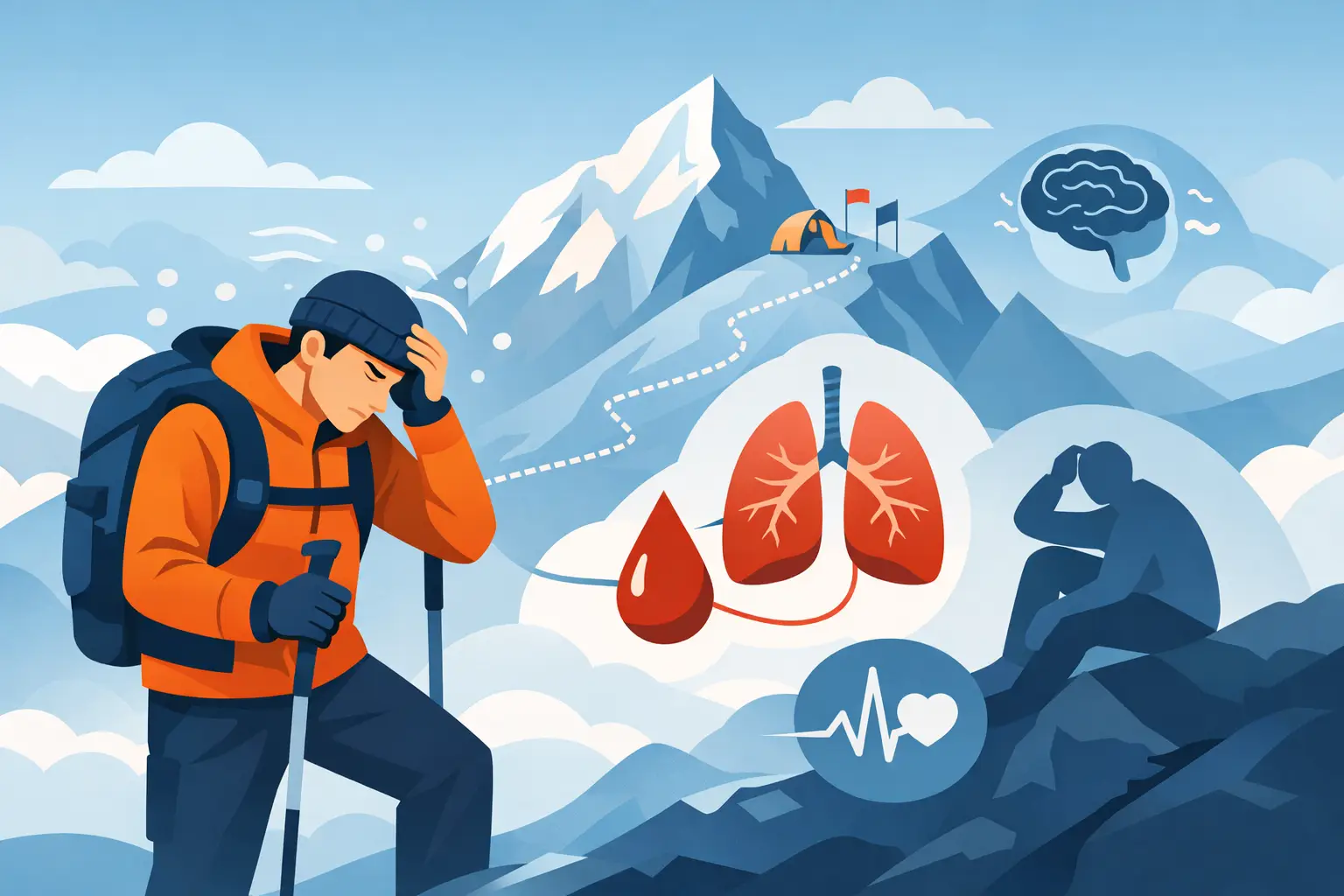
At higher elevations, the percentage of oxygen in the atmosphere remains close to 21 per cent, but the air pressure falls. Each breath therefore delivers fewer oxygen molecules to the lungs and bloodstream. Your body has to work harder to supply oxygen to the brain, muscles and organs.
Given time, it responds by breathing faster, increasing heart rate and making longer-term adjustments to how oxygen is carried in the blood. This process is acclimatisation. It begins within hours but cannot be rushed. If you climb or travel to sleep at a higher altitude before these adaptations have caught up, mountain sickness can develop.
For most trekkers, this begins as acute mountain sickness, often called AMS. Symptoms commonly appear six to 24 hours after gaining altitude, though timing varies. A headache is the classic early sign, especially when accompanied by nausea, poor sleep, dizziness, unusual tiredness or a loss of appetite.
The important distinction is that ordinary tired legs after a long day are expected. A persistent headache combined with feeling generally unwell at altitude is different. It should never be dismissed as simply being out of shape, dehydrated or reluctant to continue.
The biggest risk factor: ascending too quickly
How high you sleep matters more than the highest point you reach during the day. A trek may climb to a viewpoint, pass or summit and then descend to a lower lodge, which is generally easier on the body than sleeping at the day’s highest point. Trouble often arises when an itinerary gains sleeping altitude aggressively for several days in succession.
There is no single safe altitude gain for every traveller, because starting elevation, route, weather, access to descent and personal history all matter. As a useful principle once above about 3,000 metres, increase sleeping altitude gradually and build in rest or acclimatisation days. A well-planned rest day is not necessarily spent indoors. It may include a gentle walk higher during the day, followed by a return to sleep lower – the familiar mountain approach of climb high, sleep low.
Flying can make the transition especially abrupt. Arriving directly into places such as Lhasa, Leh or Lukla does not cause sickness by itself, but it removes the gradual rise in elevation that a road journey or lower-altitude trek may provide. The first days need sensible pacing, hydration, light activity and close awareness of symptoms.
Fitness helps the trek, but does not prevent AMS
Strong cardiovascular fitness makes walking uphill more comfortable and helps travellers cope with long days carrying a pack. It does not guarantee protection from mountain sickness. In fact, very fit people may be tempted to push the pace, climb farther than planned or ignore an early headache because their legs still feel strong.
Previous experience offers useful clues but not certainty either. Someone who felt well on an Annapurna trek may develop AMS on an Everest Base Camp route, particularly if the ascent profile, sleep, illness, exertion or weather is different. Conversely, a person who had mild symptoms on one journey may be entirely well on the next with a slower ascent.
The factors that can increase risk include a previous history of altitude illness, rapid ascent, sleeping at a greater elevation, overexertion in the first days and drinking alcohol. Respiratory infections, poor sleep and dehydration can make a traveller feel worse and complicate the picture, although dehydration alone is not the root cause of AMS.
Age and gender are not reliable protection. Nor is physical toughness. The mountain does not reward bravado; it rewards sensible decisions made early.
Why exertion, alcohol and illness can make things worse
A hard push uphill raises the body’s demand for oxygen precisely when supply is limited. Moving slowly is therefore not merely a comfort measure. It gives the body a better chance to adapt and allows guides and trekking partners to spot changes in how someone is feeling.
Alcohol can worsen dehydration, disturb sleep and blur judgement around symptoms. It is wise to avoid it during the early days at altitude and whenever acclimatisation is still underway. Sleeping tablets and medicines that suppress breathing also need medical advice before a high-altitude trip.
Cold, wind and a demanding route can drain energy, while a chest infection or stomach upset can reduce resilience. These factors do not replace altitude as the main cause, but they can turn a manageable day into one where symptoms become more pronounced. Eating regular, carbohydrate-rich meals, keeping warm and drinking according to thirst are simple supports, not substitutes for a gradual ascent.
When mountain sickness becomes an emergency
Most mild AMS improves with rest, no further ascent and careful observation. However, mountain sickness can progress to two rare but life-threatening conditions: high-altitude cerebral oedema, or HACE, and high-altitude pulmonary oedema, or HAPE.
HACE involves swelling in the brain. Warning signs include severe headache, confusion, altered behaviour, extreme drowsiness, difficulty walking in a straight line or poor coordination. A simple concern is a normally steady trekker stumbling repeatedly or being unable to complete a heel-to-toe walk.
HAPE involves fluid in the lungs. Look for breathlessness while resting, a persistent cough, chest tightness, marked weakness, rapid breathing or a gurgling sound in the chest. Blue or grey lips and severe fatigue are late and serious signs.
In either case, the response is immediate descent, emergency help and oxygen if available. Do not wait for morning, hope that sleep will fix it or leave the affected person alone. Descent is the priority, even if it is inconvenient, dark or disappointing. The itinerary can change; a medical emergency must not be negotiated with.
Practical habits that reduce the risk
The most effective prevention starts before the first trekking day. Choose an itinerary with realistic acclimatisation time rather than selecting only by the number of days or lowest price. Allow contingency time in case weather, fatigue or symptoms require a slower schedule. This matters on classic routes, but also on cultural tours that visit high-altitude locations by road or air.
Once on the trail, walk at a conversational pace and let the slowest safe pace set the day. Drink regularly, eat even when appetite is reduced, dress in layers and tell your guide about symptoms promptly. A daily check-in is valuable because people often minimise discomfort when they fear holding back the group.
Medication may have a role for some travellers. Acetazolamide is commonly prescribed to support acclimatisation or, in specific circumstances, prevention, but it is not a licence to ascend too fast. It has side effects and may not be suitable for everyone, so discuss it with a qualified clinician who understands your medical history before departure. Other medicines used in altitude emergencies require professional direction and should never be treated as casual trekking supplies.
Travellers with heart, lung, neurological or significant chronic conditions should seek individual medical advice well in advance. The question is not always whether they can travel at altitude, but which route, altitude profile and support arrangements are appropriate.
Let the itinerary serve the mountain
A good high-altitude journey leaves room to notice more than your breathing: prayer flags above a village, tea shared in a lodge, changing light on a ridge and the quiet satisfaction of arriving under your own power. At Brothers Team, our Himalayan programmes are paced with acclimatisation and local guide support in mind, because a successful trek is measured by returning safely with strong memories, not by rushing through a route.
Listen to your body early, speak up without embarrassment and be willing to take an extra night when needed. The summit, pass or base camp will still be there. Giving yourself time is often the decision that lets you enjoy it properly.



Comments are closed