


Annapurna Base Camp Trek Itinerary: The Definitive 2026 Guide to the Sanctuary
What if the secret to standing amidst the world’s highest peaks isn’t just about grit, but about a rhythm that respects the mountain? Most trekkers feel a mix of electric excitement and genuine worry about the complex logistics of permits or the looming shadow of altitude sickness. It’s a lot to manage when you just want to experience the magic of the Himalayas. This Annapurna Base Camp trek itinerary is designed to turn that uncertainty into a clear, exhilarating path forward.
We’ve been guiding adventurers through these trails since 1992, and we believe the “Sanctuary” is best entered with a blend of local wisdom and careful planning. You’ll master the perfect 11-day route via Poon Hill, featuring essential acclimatisation stops and day-by-day highlights that ensure you feel strong every step of the way. We’ll walk you through everything from securing your mandatory 2026 ACAP permits to finding the most reliable teahouses for a safe, delicious meal. Get ready to witness a sunrise over the Annapurna Massif that will stay with you forever.
Key Takeaways
- Discover why an 11-day Annapurna Base Camp trek itinerary is the gold standard for balancing safe acclimatisation with breathtaking mountain views.
- Learn the latest 2026 requirements for ACAP and TIMS permits to ensure your journey through the sanctuary is smooth and fully compliant.
- Understand the specific cardiovascular and strength training needed to confidently navigate the trails and stone steps of the Annapurna region.
- Identify the peak trekking windows in Spring and Autumn to experience the best weather and vibrant teahouse culture.
- Gain peace of mind by learning how a dedicated operations team in both Singapore and Kathmandu provides essential safety monitoring and local expertise.
Understanding the Annapurna Base Camp Trek: Why It’s Nepal’s Most Iconic Sanctuary
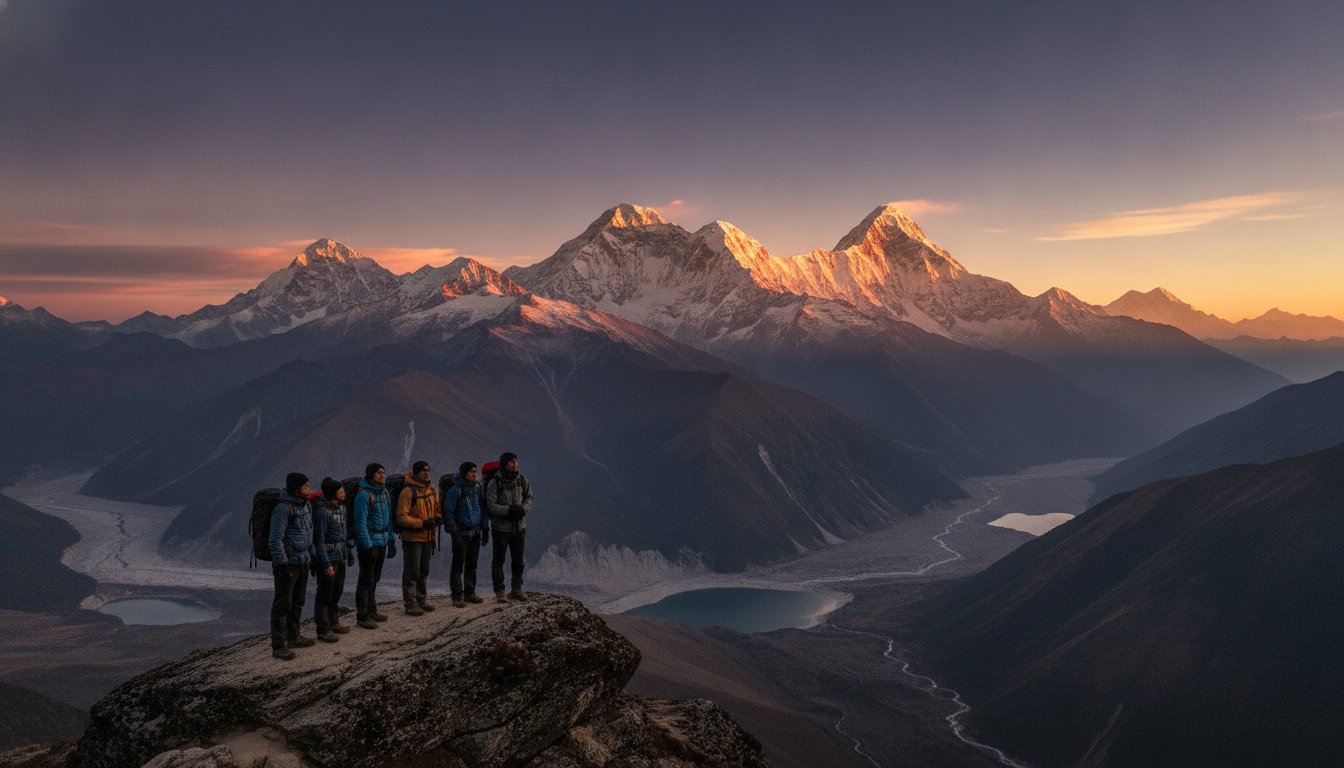
Imagine standing in a place where every direction you turn reveals a wall of ice and rock soaring over 7,000 meters. This is the heart of the Himalayas. The Annapurna Sanctuary is a sacred glacial basin protected by a ring of mountains, offering a sense of isolation and grandeur that few other places on Earth can match. For many, choosing an Annapurna Base Camp trek itinerary is about more than just checking a box; it’s about entering a natural amphitheater where the peaks of Annapurna I, Annapurna South, and Machhapuchhre (Fishtail) cradle you in their frozen embrace.
As you wind through the lower foothills, you’ll walk through the ancestral lands of the Gurung and Magar people. These villages aren’t just stops on a map. They’re vibrant communities where the scent of woodsmoke and the sound of prayer flags fluttering in the breeze define the day. This cultural immersion adds a layer of warmth to the adventure, making you feel less like a tourist and more like an invited guest in a high-altitude home. Our family-owned roots mean we value these connections deeply, ensuring your journey is as much about the people as it is about the peaks.
Annapurna Base Camp vs. Everest Base Camp
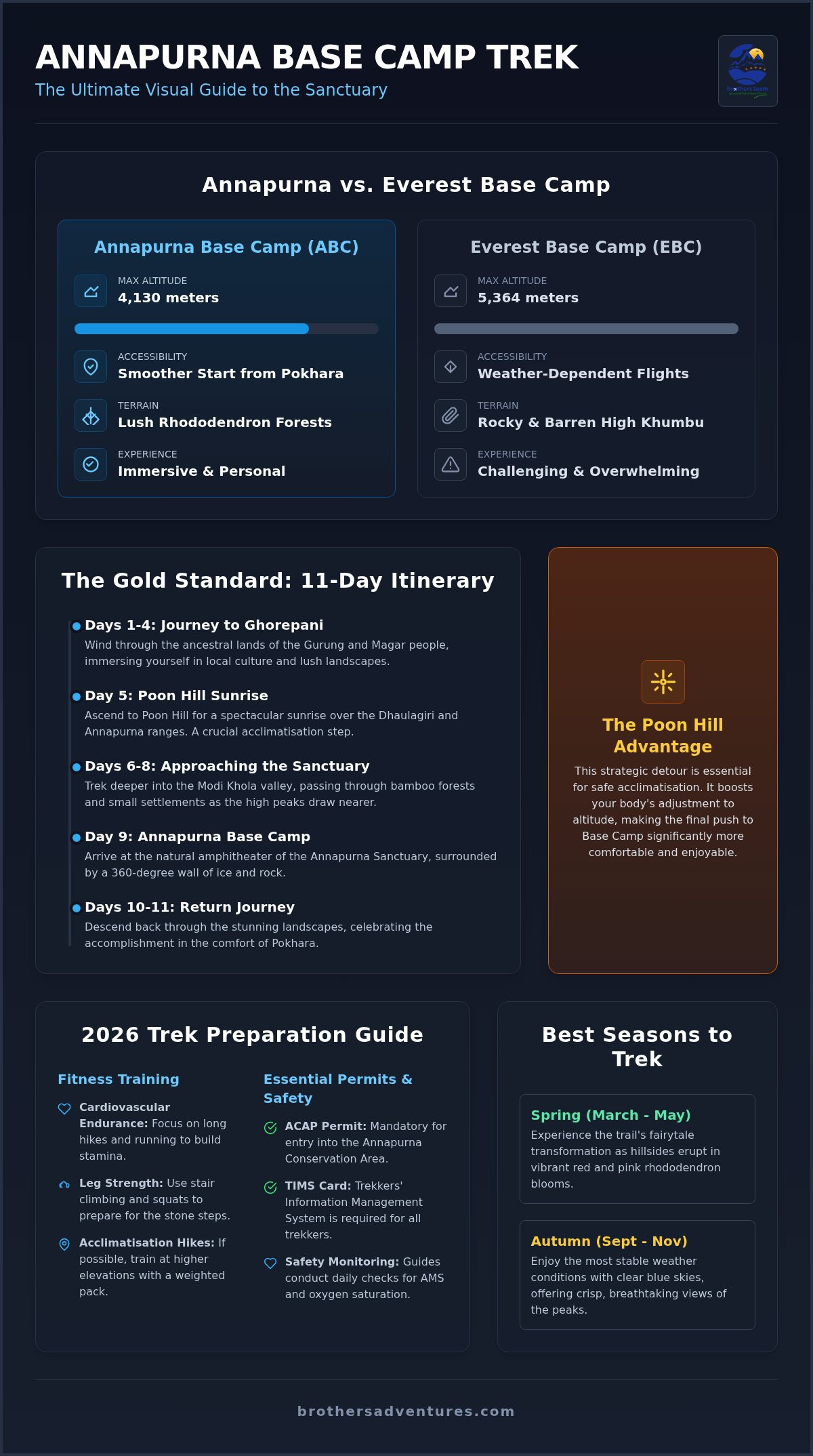
Choosing between Nepal’s two most famous treks often comes down to altitude and accessibility. While Everest Base Camp (EBC) sits at a dizzying 5,364 meters, the Annapurna Base Camp (ABC) reaches a more manageable 4,130 meters. This makes ABC an excellent choice for those concerned about extreme altitude but who still crave intimate mountain views. You won’t just see the peaks from a distance; you’ll feel like you can reach out and touch them. It’s an immersive experience that feels personal rather than overwhelming.
The terrain here is remarkably diverse. Unlike the rocky, barren landscapes of the high Khumbu, the Annapurna region is famous for its lush rhododendron forests. In the spring, these hillsides erupt in shades of crimson and pink, creating a fairytale backdrop for your ascent. Plus, reaching the trailhead is much simpler. You’ll start from the lakeside charm of Pokhara, avoiding the weather-dependent flights into Lukla that often complicate Everest itineraries. It’s a smoother start to a legendary journey.
The “Poon Hill” Advantage: Why a Detour is Essential
We always suggest the Annapurna Base Camp Trek via Poon Hill because it offers a strategic advantage for your body and your camera. By ascending to Ghorepani and Poon Hill first, you give your system a vital chance to adjust to higher elevations before pushing toward the sanctuary. It’s a natural acclimatisation boost that makes the rest of the journey significantly more comfortable. We’ve seen how this gradual approach builds confidence and strength in our trekkers.
The highlight of this detour is undoubtedly the sunrise. From the top of Poon Hill, you’ll watch the first light of day ignite the Dhaulagiri and Annapurna ranges in a golden glow. It’s a spectacular sight that transforms a standard Annapurna Base Camp trek itinerary into a scenic powerhouse. This route acts as a hybrid experience, capturing the best of the lower foothills and the high-altitude sanctuary in one seamless 11-day arc.
High Altitude Prep: Fitness, Permits & Packing for 2026
Success in the Himalayas starts months before you land in Kathmandu. While the Annapurna Base Camp trek itinerary is more accessible than Everest, your body needs to be ready for the relentless stone stairs of the sanctuary. Focus your training on cardiovascular endurance and leg strength; think long hikes with a weighted pack and frequent stair climbing. Our expert guides monitor for Acute Mountain Sickness (AMS) daily, but being physically fit is your best defense. It’s about arriving at the base camp feeling energized rather than exhausted.
Preparation isn’t just physical. It’s about having the right support system in place to manage the moving parts of a high-altitude expedition. We’ve been doing this since 1992, and we know that the difference between a good trek and a great one lies in the details. From checking your oxygen saturation levels to ensuring your pace is sustainable, professional guiding turns a challenging climb into a triumphant journey.
2026 Permit Requirements and Logistics
Permits are the gateway to your adventure. For 2026, you’ll need the Trekkers’ Information Management System (TIMS) card and the mandatory permit for the Annapurna Conservation Area Project (ACAP). Nepal has streamlined these processes with digital check-ins at key entry points like Birethanti, making the start of your trek much faster. As your tour operator, we handle all the tedious paperwork before you even arrive. Our dual offices in Singapore and Kathmandu ensure your permits are processed instantly, so you won’t face frustrating delays at the trailhead.
The Essential ABC Packing List
The weather in the Annapurna range is famously fickle. You might start your day in a t-shirt in the sub-tropical lower valleys and end it in a heavy down jacket as you reach the sanctuary. A smart layering system is non-negotiable. Temperatures can swing from a balmy +25°C at lower elevations to a crisp -10°C at the base camp. You need gear that works as hard as you do.
Pack these essentials for a safe journey:
- Well broken-in trekking boots: Don’t risk blisters with brand-new shoes; make sure they’ve seen some miles before the trek.
- A high-quality down jacket: It needs to be rated for sub-zero temperatures to keep you warm during chilly nights at the teahouses.
- Water purification: Use reliable tablets or a filtered bottle to stay hydrated without relying on single-use plastics.
We strongly advise against relying on standalone gear rental for critical safety items like boots or thermal layers. Your gear is your lifeline, and it’s always better to bring equipment you know and trust. If you’re feeling ready to start your preparation, explore our Annapurna Base Camp Trek via Poon Hill for a fully supported experience that covers every detail.
The Ultimate 11-Day Annapurna Base Camp via Poon Hill Itinerary
While some agencies push for rushed routes, we’ve found that an 11-day Annapurna Base Camp trek itinerary is the gold standard for safety and pure enjoyment. This pace allows your body to adapt naturally as you transition from lush, sub-tropical forests to the stark, beautiful alpine tundra. It’s a journey through the Annapurna Conservation Area Project that rewards patience with panoramic views. If you’re on a tighter schedule, you might consider our Nepal adventure tour 8 days, but for the full sanctuary experience, this 11-day path is unmatched.
Our approach focuses on a gradual elevation gain from Pokhara, ensuring you don’t just reach the base camp, but you arrive there feeling strong and capable. We’ve refined this route over decades to capture the most iconic landscapes while keeping your health a top priority. Every turn in the trail reveals a new perspective of the massif, building anticipation for the moment you finally step into the glacial basin.
Phase 1: The Ascent to Poon Hill (Days 1–4)
Your adventure begins with a drive from Pokhara to the trailhead. Days 1 and 2 test your resolve with the legendary 3,000 stone steps leading to Ulleri. It’s a steep climb, but the mountain air is refreshing and the local hospitality is even warmer. By Day 3, you’ll reach Ghorepani, walking through ancient rhododendron forests that feel like something out of a storybook. Day 4 is the crown jewel of this phase. You’ll wake before dawn for a hike to Poon Hill to witness a sunrise over the Dhaulagiri and Annapurna ranges before trekking onward to Tadapani.
Phase 2: Into the Sanctuary (Days 5–8)
The trail now dives deeper into the heart of the mountains. On Days 5 and 6, you’ll descend to the Modi Khola river before a steady climb to Chomrong, a village perched on a hillside with incredible views of Annapurna South. Day 7 takes you through the “gate” of the Sanctuary, passing through Bamboo and Deurali. The trees begin to thin, replaced by rugged cliffs and glacial debris. Day 8 is the final push. You’ll move from Machhapuchhre Base Camp (MBC) to Annapurna Base Camp (ABC), reaching the high glacial basin as the peaks close in around you.
Phase 3: The Descent and Return (Days 9–11)
After a final sunrise at ABC (4,130m), where the peaks turn a brilliant orange, the descent begins. Day 9 is a long but rewarding walk back down to Bamboo. On Day 10, your tired muscles get a treat at the natural hot springs of Jhinu Danda. It’s the perfect place to soak and reflect on your achievement. Finally, Day 11 involves a short trek to the road head and a scenic drive back to Pokhara. You’ll arrive back at the lakeside with a camera full of photos and a heart full of mountain memories.
Maximizing Your Experience: Teahouse Life and Best Trekking Seasons
The magic of the Himalayas isn’t found just on the mountain peaks; it’s woven into the fabric of the villages you’ll call home each night. Teahouse trekking is a uniquely Nepalese experience that combines rugged adventure with genuine local hospitality. As you follow your Annapurna Base Camp trek itinerary, these mountain lodges serve as your sanctuary, offering a warm place to rest, share stories with fellow travelers, and refuel for the next day’s climb. It’s a communal way of life that turns strangers into friends over a steaming plate of food.
By 2026, mountain connectivity has seen a significant boost. Many teahouses now offer satellite Wi-Fi and dedicated solar charging stations for your devices. While it’s tempting to stay plugged in, we encourage you to use these amenities sparingly. The true value of the Sanctuary lies in disconnecting from the digital world and reconnecting with nature. Remember that the Annapurna region is a fragile ecosystem. To protect this beauty, single-use plastic water bottles are strictly prohibited in the upper reaches of the Sanctuary, so ensure you have a reliable filtration system or purification tablets ready.
What to Expect in Himalayan Teahouses
Food is the fuel of the mountains, and “Dal Bhat Power, 24 Hour” is more than just a catchy slogan. This traditional meal of lentil soup, rice, and vegetable curry is the ultimate trekker’s fuel, providing the complex carbohydrates and protein you need for high-altitude endurance. Most teahouses offer communal dining areas centered around a “Bukhari,” a traditional wood or yak-dung heater. It’s the heart of the lodge where everyone gathers to dry socks and swap trail tips.
Sleeping arrangements are generally simple, consisting of twin beds in modest rooms. While blankets are often provided, we always insist that our guests bring a high-quality sleeping bag rated for at least -10°C. Mountain nights get crisp, and having your own familiar, warm cocoon ensures you get the deep rest required for the physical demands of the trail. This blend of simple comfort and social warmth is what makes the journey so memorable.
Choosing Your Window: Spring vs. Autumn 2026
Timing is everything when planning your journey. Spring, from March to May, is a sensory explosion. You’ll walk through vibrant rhododendron forests in full bloom while enjoying clearer mornings. However, be prepared for afternoon clouds that can occasionally obscure the highest peaks. It’s a season of renewal and lush greenery that many photographers find irresistible.
Autumn, spanning September to November, is widely considered the peak window. The post-monsoon air is incredibly crisp, offering the most stable weather and sharpest mountain views. If you’re looking for those iconic, deep blue sky backdrops for the Annapurna massif, this is your time. While winter and monsoon seasons offer a different kind of challenge, they are typically reserved for specialized Nepal Expeditions & Peak Climbing and seasoned professionals. For the classic ABC experience, stick to the spring and autumn windows for the best balance of safety and scenery. Ready to lock in your dates? Explore our Annapurna Base Camp Trek via Poon Hill to see our upcoming 2026 departures.
Why Trekking with a Specialist Agency Ensures a Seamless Journey
Choosing the right partner for your Himalayan journey is the single most important decision you’ll make after deciding to go. While many aggregator sites offer a generic Annapurna Base Camp trek itinerary, they often lack the boots-on-the-ground accountability that a specialist agency provides. We bridge the gap between your home and the high ridges of Nepal. Being a Singapore-registered agency with a dedicated Kathmandu operations team means you get the best of both worlds: professional, reliable planning and real-time, local support when it matters most. It’s about having a safety net that spans continents.
Our Annapurna Base Camp Trek via Poon Hill is more than just a walk in the woods; it’s a curated adventure designed by experts who live and breathe these mountains. We don’t just book teahouses; we build relationships with the families who run them. This ensures you get the best rooms and the warmest welcomes throughout the Sanctuary. When you trek with us, you’re benefiting from decades of logistical refinement that makes the difference between a stressful trip and a life-changing experience.
The Brothers Adventures Heritage: Since 1992
Our family-owned business has been operating since 1992, and we treat every trekker like an invited guest rather than just another customer. This heritage isn’t just a number; it’s a deep-rooted commitment to your safety and satisfaction. Our guides for Nepal expeditions & Peak Climbing come from a long line of Himalayan explorers. They don’t just know the trails; they understand the mountain’s subtle shifts and moods. We implement rigorous high-altitude safety and AMS monitoring protocols, ensuring your health is checked every morning and evening. You’re never alone on the trail when you’re with family.
From Planning to Summit: Our High-Touch Support
Preparation is where the summit is won. We provide high-touch support that starts long before you reach the trailhead in Nepal. This includes detailed pre-trip briefings and thorough gear checks to ensure you’re fully prepared for the variable 2026 mountain weather. We handle all the heavy lifting of logistics, from your Pokhara transfers to the complex permit handling. Our goal is to let you focus on the scenery while we manage the spreadsheets. If you’re looking for your next challenge after conquering the Sanctuary, explore our everest base camp trek from singapore for your next great Himalayan chapter.
Your Himalayan Journey Awaits
Standing in the heart of the Annapurna Sanctuary is a moment that redefines your perspective on the world. By following a carefully paced 11-day Annapurna Base Camp trek itinerary, you ensure that every step is taken with confidence and every sunrise is enjoyed in peak health. We’ve covered everything from the essential 2026 permit logistics to the vibrant teahouse culture that makes this region so iconic. Now, all that’s left is for you to lace up your boots and answer the mountain’s call.
At Brothers Adventures, we’ve been sharing the magic of Nepal since 1992. With our family-owned offices in both Singapore and Kathmandu, we provide a bridge of trust and expert-led safety protocols that larger agencies simply can’t match. We treat you as an invited guest, guiding you through the sub-tropical forests and up to the glacial basin with deep local heritage and professional care. It’s time to turn your mountain dreams into a reality. Book Your 2026 Annapurna Base Camp Adventure with Brothers Adventures today and join a legacy of explorers who have found their sanctuary in the peaks. We can’t wait to walk this path with you.
Frequently Asked Questions
How difficult is the Annapurna Base Camp trek compared to Everest Base Camp?
ABC is generally considered more accessible than EBC because the maximum altitude of 4,130 meters is significantly lower than Everest’s 5,364 meters. While EBC demands endurance against sustained high altitude and rocky paths, ABC is famous for its thousands of steep stone stairs. These steps require excellent leg strength and cardiovascular fitness. Both are rewarding, but ABC offers a more intimate mountain experience with less extreme oxygen depletion.
Do I need previous trekking experience for the 11-day ABC itinerary?
You don’t need previous high-altitude trekking experience to successfully complete our 11-day Annapurna Base Camp trek itinerary. It’s a fantastic entry-level trek for those with a good level of physical fitness. We recommend at least three months of training focused on stair climbing and long walks. Our expert guides manage the pace and monitoring, making this Sanctuary journey manageable for first-timers who are well-prepared and motivated.
What is the best month to trek to Annapurna Base Camp in 2026?
October and April are the premier months for trekking in 2026. October offers the crispest post-monsoon air and the most stable, crystal-clear mountain views across the massif. If you prefer seeing the hillsides draped in blooming red rhododendrons, April is your best choice. Both windows provide mild daytime temperatures and clear mornings, ensuring you capture those iconic golden sunrises over the peaks before any afternoon clouds roll in.
Is altitude sickness a major concern on the ABC trek?
Altitude sickness is a genuine risk as you ascend past 3,000 meters toward the base camp. While the ABC trek is lower than Everest, symptoms like headaches or nausea can still occur. This is why we prioritize a gradual ascent via Poon Hill to help your body adapt. Our guides perform daily health checks and monitor oxygen levels to ensure every guest stays safe while entering the high-altitude glacial basin.
Are there hot showers and Wi-Fi available at the teahouses?
Most teahouses along the route now provide hot showers and Wi-Fi, though these often come with a small additional fee of 200 to 500 NPR. Solar-powered showers are common, so they’re warmest in the afternoon. Connectivity has improved significantly by 2026, but speeds can be slow in the higher reaches of the Sanctuary. We suggest bringing a power bank for your devices, as charging in communal areas is also usually a paid service.
What kind of permits do I need for the Annapurna Sanctuary?
You must obtain two essential permits: the Annapurna Conservation Area Project (ACAP) permit and the Trekkers’ Information Management System (TIMS) card. For 2026, the ACAP fee for foreign nationals is NPR 3,000, while the TIMS card is NPR 2,000. As a specialist agency, we handle all this paperwork through our Kathmandu office before you arrive. This ensures you can pass through digital checkpoints at Birethanti without any logistical delays.
How much should I tip my guide and porter on a Nepal trek?
Tipping is a deeply appreciated tradition in Nepal and reflects the quality of service provided by your local team. A standard guideline is to budget approximately 10% to 15% of your total trek cost for tips. This amount is typically pooled and distributed among the guides and porters on the final evening of the trek. It’s a wonderful way to directly support the local families who make these Himalayan adventures possible.
Is it safe to trek to ABC solo, or should I hire a tour operator?
Hiring a registered tour operator is now a legal requirement, as solo trekking for foreigners was banned in the Annapurna region in April 2023. You must be accompanied by a licensed guide to ensure your safety and environmental protection. Our family-owned agency provides expert local guides who offer deep heritage knowledge and high-altitude monitoring. This professional support turns a complex Annapurna Base Camp trek itinerary into a seamless, safe, and enriching experience.



Comments are closed