


Nepal mountaineering expedition fees and what they cover
Permit changes can push Nepal mountaineering expedition fees higher, and the amount depends on the peak and climbing season. For 2026, Nepal’s listed climbing permit rates vary between spring, autumn, and winter or summer, so the season you choose can make a real difference to your budget.
It’s sensible to look beyond the permit itself: a full expedition budget can also reflect team size, travel, accommodation, meals, equipment, and the support needed on the mountain. Knowing what each cost covers helps you compare plans clearly and avoid surprises as you prepare for the climb.
This guide explains what can affect expedition fees, how permit costs vary by season and team size, and which travel and on-the-ground expenses may add to the total. Use these details to build a clearer budget, then focus on choosing an expedition that fits your goals and the mountain ahead.
Key Takeaways
- Identify the peak and permit category first, since Nepal’s issuing authority and permit requirements depend on the climb.
- Factor team size into planning: additional expedition members can affect permit costs, not just the number of people sharing trip expenses.
- Compare climbing seasons with the permit schedule to understand how timing may change the expedition budget.
- Build a fuller budget by accounting for travel, accommodation, food and equipment alongside climbing permits.
Are peak climbing costs expected to rise in 2025 and 2026?
Permit charges are one part of expedition costs, and Nepal’s 2026 rates vary by peak and season. The total also depends on required permits, team arrangements, staff support and the services included in an expedition.
Mountain Categories and Seasonal Rates
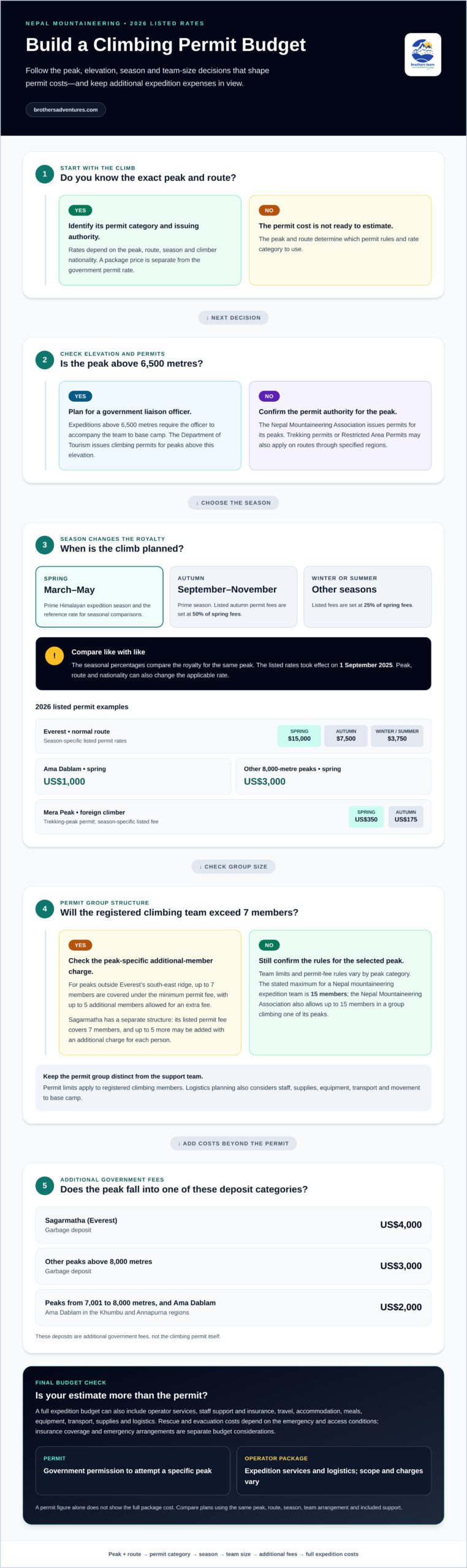
A climbing permit is official permission to attempt a specific Nepalese peak, with rates shaped by mountain category and season. For 2026, the normal-route Everest permit is listed at US$15,000 in spring, US$7,500 in autumn and US$3,750 in winter or summer. Ama Dablam’s spring permit is US$1,000, while spring permits for other 8,000-metre peaks are listed at US$3,000.
Trekking-peak permits also vary by season and climber nationality. The listed foreign-climber spring fee for Mera Peak is US$350; autumn is US$175. Do not treat an operator package price as a permit rate: those are separate costs.
Additional Government Fees
Additional government fees are charges beyond the climbing permit, including deposits and expedition oversight. A garbage deposit is listed at US$4,000 for Sagarmatha, or Everest, and US$3,000 for other peaks above 8,000 metres. For Nepalese peaks from 7,001 to 8,000 metres and Ama Dablam in the Khumbu and Annapurna regions, the listed deposit is US$2,000.
Expeditions above 6,500 metres require a government liaison officer to accompany the team to base camp. The Department of Tourism issues climbing permits for peaks above that elevation; the Nepal Mountaineering Association issues permits for its peaks. Trekking permits or Restricted Area Permits may also apply on routes through specified regions.
Operator Charges and Expedition Costs
Operator charges cover expedition services, not just government fees, and vary with the peak and package scope. The available figures do not support a like-for-like price comparison between Nepal, Tibet and Pakistan: permit rules, routes, seasons and included support all affect the total. Rates for Nepalese climbers can also differ from those for foreign climbers.
For Ama Dablam, Manaslu and Island Peak, an operator’s charge depends on the services and logistics included; a government permit figure alone cannot show the full package cost. Nepal expeditions also require attention to staff insurance. Rescue and evacuation costs depend on the emergency and access conditions, so insurance coverage and emergency arrangements are separate budget considerations.
Expedition team size and additional-member fees
An expedition team is the group registered to climb a particular peak under one permit arrangement. In Nepal, team limits and permit-fee rules vary by peak category, so the headcount can affect both the permit structure and expedition logistics.
The stated maximum for a Nepal mountaineering expedition team is 15 members. The Nepal Mountaineering Association also allows up to 15 members in a group climbing one of its peaks. These limits define the group size, not the number of people sharing every cost equally: climbers may have different support needs, and larger teams require more coordination at altitude.
For peaks outside Everest’s south-east ridge, a team can include up to 7 members under the minimum permit fee, with up to 5 additional members allowed for an extra fee. Sagarmatha has a separate structure: its listed permit fee covers a seven-member team, and the team may add up to 5 members by paying an additional charge for each person. These rules mean that a larger group should account for the permit structure before estimating shared expedition costs.
Group size also shapes the practical work around departures, transport, supplies and movement to base camp. More climbers may mean more equipment and provisions to coordinate, while the selected peak and route determine the expedition’s needs. The summit goal matters too: a high-altitude climb and an Annapurna-region expedition may require different arrangements, even with similar headcounts.
Keep the permit group distinct from the wider support team when planning an expedition. Permit limits apply to registered climbing members, while logistics planning also considers the people and supplies needed to support the journey. A clear headcount helps the operator organise the permit application and plan for the group’s route and altitude demands.
For a professionally organised climb, explore Nepal Expeditions & Peak Climbing, where the expedition plan can be shaped around the peak and team.
Expedition seasons
An expedition season is the period when climbers plan a permitted ascent, and the timing affects Nepal’s climbing royalty. Spring runs from March through May, while autumn runs from September through November. These are Nepal’s prime Himalayan expedition seasons. Winter and summer also appear in the seasonal fee schedule, so the departure period affects the permit budget.
A climbing royalty is the government fee for permission to attempt a peak. Foreign climbers’ rates vary by mountain category, route and season. For example, Nepal’s schedule distinguishes Everest’s normal route from its other routes, and separates other peaks above 8,000 metres from lower altitude categories. Manaslu also has separate seasonal rates, with its listed autumn royalty higher than its spring royalty.
Seasonal fee differences compare the royalty payable for the same peak across climbing periods. Under Nepal’s restructured schedule, autumn permit fees were set at 50% of spring fees, while winter and summer fees were set at 25% of spring fees. The listed rates took effect on 1 September 2025. A comparison of Nepal mountaineering expedition fees should therefore use the rate for the intended season.
Nationality matters too: foreign climbers and Nepalese climbers can face different royalty schedules for the same mountain. The 2026 listing gives foreign climbers a distinct spring category for other 8,000-metre peaks, separate from Everest. Nepalese climbers have their own rates, including for Everest’s normal route. Compare the peak, route, season and climber category before estimating permit expenses.
Match the climbing season to the mountain and its applicable royalty rather than treating spring as the only option. When estimating Nepal mountaineering expedition fees, separate permit charges from travel and expedition services. The Nepal government’s restructured royalty schedule sets autumn fees at 50% of spring fees, while winter and summer fees are set at 25%. These distinctions make the season an important part of the climbing budget.
Travel, accommodation, food and equipment costs
Travel costs cover the journey from Singapore to Nepal and onward to the expedition’s starting point. The route, destination and transport needed to reach the mountain shape this part of the budget, so an Everest approach and a Manaslu approach may involve different arrangements.
Accommodation costs cover overnight stays before and during the expedition. Kathmandu lodging, nights along a trekking route and stays at mountain camps are separate planning considerations. On popular trekking routes, teahouse stays commonly include meals, while remote expedition sections require provisions planned around the route and duration.
Food costs cover meals and expedition provisions, which can differ between Kathmandu, trekking stops and higher camps. The season matters: an autumn itinerary and a spring itinerary may follow different schedules and logistical plans. The team’s route and length of time away from established lodges also affect how food is organised.
Equipment costs cover the climbing and camping gear needed for the chosen peak and conditions. A professional expedition plan accounts for technical equipment, personal kit and group supplies rather than treating gear as interchangeable. Equipment needs can vary by altitude, route and season.
Hidden costs are expenses beyond transport, lodging, food and equipment. Nepal’s government garbage deposit is a separate expedition expense, and a refundable deposit may depend on meeting the applicable waste-dispatch requirements. Staff insurance, emergency arrangements and rescue or evacuation needs can also affect the overall budget; costs depend on the circumstances and support required.
For foreign climbers, the peak and season can also affect government charges. Manaslu’s listed mountaineering royalty differs between spring and autumn, while the garbage deposit is separate from the royalty. Keep these items distinct in your budget so permit charges, deposits and expedition logistics aren’t mistaken for one bundled cost.
Planning a climb involves matching the route, season, accommodation and equipment to your expedition goals. Explore Nepal expedition planning for support shaping the journey around those practical needs.
Brothers International Tours & Trading Pte Ltd: Nepal Expeditions & Peak Climbing
Brothers International Tours & Trading Pte Ltd offers Nepal Expeditions & Peak Climbing for travellers planning a mountain-climbing trip in Nepal. It is a natural next step when you are weighing the peak, season, team size and logistics, and want professional support shaping the journey around your plans.
For a different pace, the 8Days Nepal Adventure Tour, 8Days Scenic Nepal Mini Trek and 5Day Nepal Luxury Tour offer other ways to experience Nepal. These options suit broader adventure, trekking or leisure travel rather than a peak-climbing objective.
Contact Brothers International Tours & Trading Pte Ltd to discuss your Nepal travel plans.
Turn your mountain plans into a clear next step
Choosing a Nepal climb involves more than setting a summit goal. Shape the journey around the experience you want, the support you need and the practical details that matter to you. A clear conversation about Nepal mountaineering expedition fees can help connect those priorities to a workable plan.
If you’re drawn to a broader journey, Brothers International Tours & Trading Pte Ltd also offers the 8Days Nepal Adventure Tour, 8Days Scenic Nepal Mini Trek and 5Day Nepal Luxury Tour. Each offers a different way to discover Nepal beyond a mountaineering objective.
Bring your travel goals and questions together, then take the next step at your own pace. Discuss your Nepal plans with Brothers International Tours & Trading Pte Ltd and start shaping an adventure that feels like yours.
Frequently Asked Questions
How much does it cost to climb Mount Everest?
The total depends on the expedition plan, not just the climbing permit. Route, season, team size, guiding and support arrangements all shape the budget. A package quote is provided after a request, with costs based on the services and itinerary involved. Compare what each plan covers, including transport, accommodation and permit processing, rather than judging by a headline figure alone.
Is hiring a guide mandatory, and how much does a climbing guide cost in Nepal?
Nepal requires a government-appointed liaison officer to accompany expeditions on peaks above 6,500 metres to base camp. This officer is distinct from a commercial climbing guide, so the requirement should not be treated as a blanket guide rule for every climb. Guide costs depend on the role and duration of support; build them into the expedition plan alongside the route’s staffing needs.
How much does a Mount Everest expedition permit cost in Nepal?
For 2026, the permit fee for Everest’s normal route varies by season. The listed schedule sets different rates for spring, autumn, and winter or summer; the exact applicable amount depends on the climber category and route. Treat this as a permit charge, separate from expedition services and other government costs. A package quote can help distinguish those budget components.
What are Nepal climbing permit fees for 7,000-meter and 8,000-meter peaks?
Nepal’s permit schedule separates peaks by altitude category, so a 7,000-metre climb and an 8,000-metre climb may fall under different rates. It also distinguishes seasons and, for some peaks, climber nationality. For an accurate budget, identify the precise mountain, route, season and climber category first. Remember that a permit is only one part of the expedition’s overall costs.
Are Nepal mountaineering permit fees different by season or route?
Yes. Nepal’s schedule varies by season, and Everest’s normal route has a different fee category from its other routes. Autumn rates are set at half the spring rates, while winter and summer rates are set at a quarter of spring rates. These are permit-schedule differences, not a complete comparison of trip costs, which also depend on logistics and support.
What is included in a Nepal mountaineering expedition package, and what costs extra?
Multi-day travel packages can include professional guide services, local transport, accommodation and permit processing. The itinerary determines the package scope, so don’t assume every expedition includes the same services, meals or equipment. A helicopter return or overnight base-camp stay changes the itinerary and is not a standard inclusion. Package pricing is provided after a quote request, based on the planned trip.


Comments are closed