


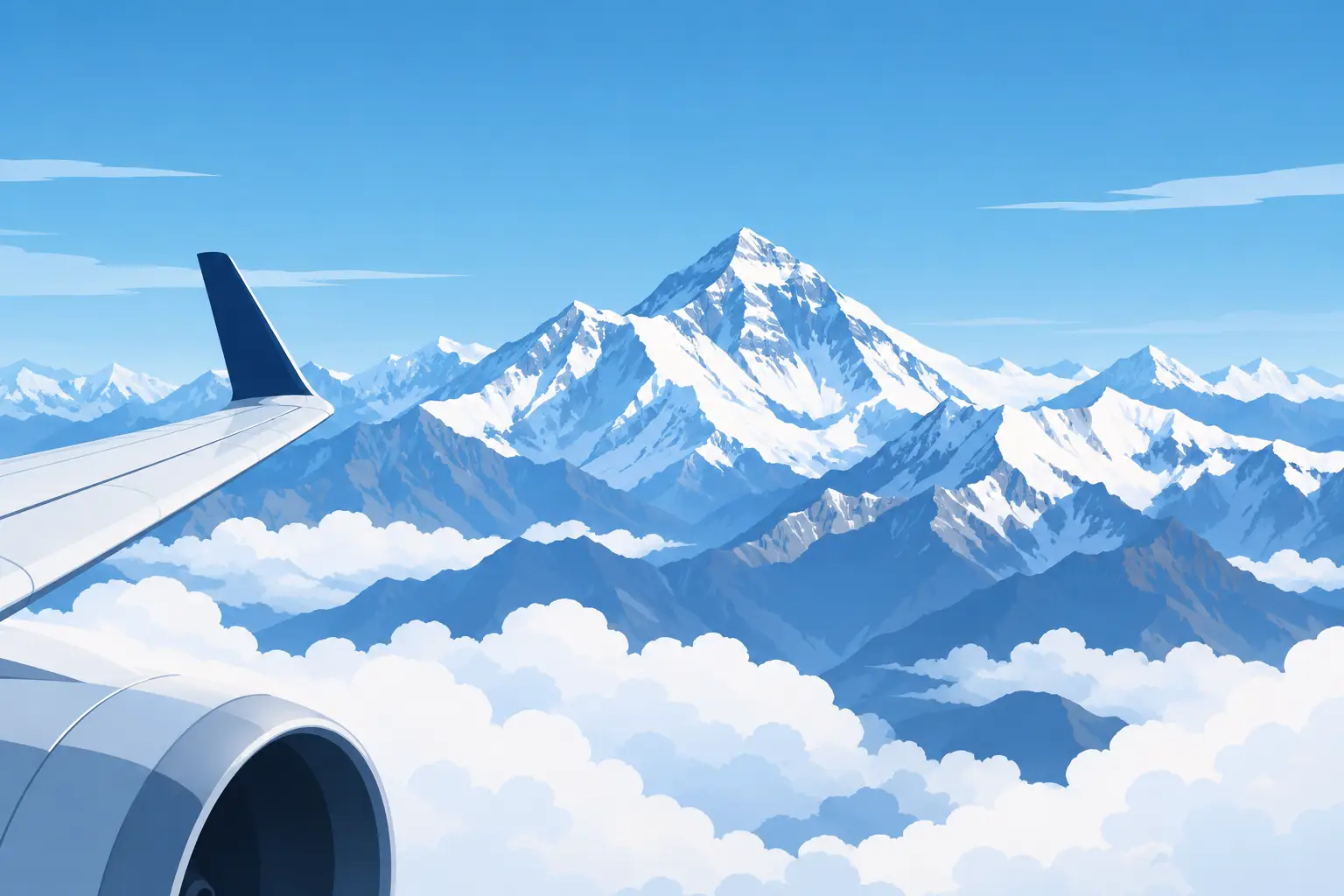
Mountain Flights: See Everest Without Trekking
At first light in Kathmandu, the city can still feel quiet beneath the valley haze. Then, less than an hour after take-off, the horizon changes completely: a wall of snow peaks rises beyond the aircraft window, with Everest standing above the surrounding Himalayan giants. Mountain flights offer one of Nepal’s most memorable experiences for travellers who want an intimate view of the high Himalaya but do not have the time, fitness or desire to trek for days.
They are not a replacement for walking through Sherpa villages, crossing suspension bridges or reaching a high mountain lodge under your own steam. They are something different: a short, powerful encounter with one of the world’s greatest landscapes. For many visitors, a mountain flight is the highlight that turns a Kathmandu stay into a Himalayan journey.
What are mountain flights in Nepal?
A mountain flight is a scenic fixed-wing flight from Kathmandu that follows the Himalayan range eastwards, usually in the early morning. The route is designed to give passengers clear views of a long procession of peaks, including Langtang, Dorje Lakpa, Gauri Shankar, Cho Oyu, Lhotse, Makalu and Mount Everest.
Most flights take around one hour. Passengers are generally seated by the window in small aircraft, and the crew may point out major mountains along the route. Depending on the airline and operating conditions, guests may also be invited towards the cockpit area in turn for a forward-facing view. This is never guaranteed, but it can be a special moment when permitted by the crew.
The experience is particularly well suited to families, older travellers, school groups, photography enthusiasts and anyone building a shorter Nepal itinerary. It also works beautifully as an opening or closing experience around a cultural tour, wildlife journey or trekking holiday.
Why Everest looks different from the air
Everest is not always the broadest or most immediately obvious summit in the Himalayan skyline. From the air, its height becomes meaningful because of its setting. You see the summit rising behind neighbouring peaks, with the immense ice and rock country of the Mahalangur Himal spread beneath it.
Aerial viewing also reveals the scale that is difficult to grasp from photographs. Deep valleys cut into the foothills. Ridges disappear into cloud. Glaciers sit high above settlements that look impossibly small from the aircraft. On a clear morning, the mountains do not appear as isolated postcard peaks but as part of a vast, continuous range.
For travellers planning the Everest Base Camp trek, mountain flights can provide helpful perspective before heading into the Khumbu. For those who will not trek, they offer a meaningful way to witness the region with comfort and limited time. Neither experience is better than the other – they simply answer different travel ambitions.
Mountain flight or helicopter flight?
These two experiences are often grouped together, but they have different strengths. A scheduled mountain flight uses a small fixed-wing aircraft and gives wide-ranging views across the Himalayan chain. It is usually the more straightforward choice for travellers who want a scenic morning excursion from Kathmandu at a comparatively accessible cost.
A helicopter experience can be more flexible and may land at selected high-altitude locations, subject to weather, route permissions and operational planning. It can be ideal for private groups, travellers with very limited time or those looking for a more exclusive high-mountain outing. However, helicopter trips are more expensive and can be affected by the same changeable Himalayan weather.
The right choice depends on your budget, group size, available time and whether you value a broad panoramic route or the possibility of landing in the mountains. A specialist operator can help you decide which experience fits naturally into the rest of your Nepal plans.
The best time for mountain flights
The clearest conditions are commonly found during Nepal’s main autumn season, from October to November, and spring season, from March to April. These months often bring good visibility, pleasant temperatures in Kathmandu and excellent conditions for combining a flight with sightseeing or trekking.
Winter can also offer superbly crisp views, especially on clear mornings from December to February. The trade-off is colder weather and the possibility of fog in the Kathmandu Valley, which can delay departures. During the monsoon period, broadly from June to August, cloud cover and rain make clear mountain views less reliable. Flights may still operate on suitable mornings, but flexibility is essential.
Early departures are standard for good reason. Clouds often build later in the day, while morning light can bring sharper visibility across the range. Even then, the mountains set the schedule. Safety and visibility always take priority over a fixed timetable.
What to expect on the day
Your morning begins early, usually with hotel collection and transfer to Kathmandu’s domestic terminal. Carry your passport, booking details and any items you may need during a short wait. Airport procedures and departure timings can change, so it is wise to keep the rest of your day open rather than booking an inflexible activity immediately afterwards.
Dress in comfortable layers. You will not be exposed to high-altitude cold in the aircraft, but Kathmandu mornings can be cool, particularly between autumn and spring. Sunglasses are useful, as sunlight reflecting from snow and cloud can be strong. Keep cameras and mobile phones ready, but take a few moments simply to look as well. Reflections on aircraft windows can make photography challenging, and the best view is not always the best photograph.
If you are travelling with young children or have concerns about mobility, let your travel adviser know in advance. The flight itself does not involve trekking or altitude exposure in the way a mountain journey on foot does, but airport access, boarding steps and seating arrangements are worth discussing. For groups, a coordinated transfer and clear pre-flight briefing make the early start far easier.
Weather, delays and the value of flexibility
Himalayan weather can change quickly. A clear Kathmandu morning does not automatically mean a clear route towards Everest, and a forecast is only one guide. Flights may be delayed, rescheduled or cancelled when conditions do not meet operational requirements.
This can be disappointing, especially when the flight is a key part of a once-in-a-lifetime holiday. Yet a cancellation for poor visibility is the correct decision. A mountain flight is worthwhile because the views are extraordinary, not because an aircraft must depart at all costs.
Build flexibility into your itinerary by planning the flight early in your Nepal stay. If weather prevents operation, you have time for a second attempt. Ask when booking about the operator’s current rescheduling and refund arrangements, as policies can vary. Avoid placing an international departure, a long overland transfer or an important event immediately after your scheduled flight.
At Brothers Team, we plan mountain experiences with this same practical approach: exciting enough to look forward to, but organised with weather contingencies and clear local support in mind.
Making the experience part of a bigger Nepal journey
A mountain flight pairs naturally with Kathmandu Valley sightseeing, where ancient temples, courtyards and Buddhist stupas offer a powerful cultural contrast to the high peaks. It can also be included before a trek to Poon Hill, Annapurna, Gokyo Lakes or Everest Base Camp, giving you a first glimpse of the terrain you will later explore on foot.
For school and college groups, the flight can become a valuable geography and environmental learning moment when supported by thoughtful preparation. Looking at glaciers, river valleys and densely layered ridges from above prompts questions that a classroom map cannot easily answer. For leisure travellers, it is simply an occasion to slow down, share a window view and appreciate the scale of Nepal beyond Kathmandu.
A small morning with a lasting memory
No one can promise a cloudless Everest view, and that uncertainty is part of travelling in the Himalaya. Choose a sensible season, allow time for weather, and go with realistic expectations. When the skies clear, mountain flights can leave you with something rare: not just a photograph of Everest, but a true sense of how immense the Himalaya really is.


Comments are closed