


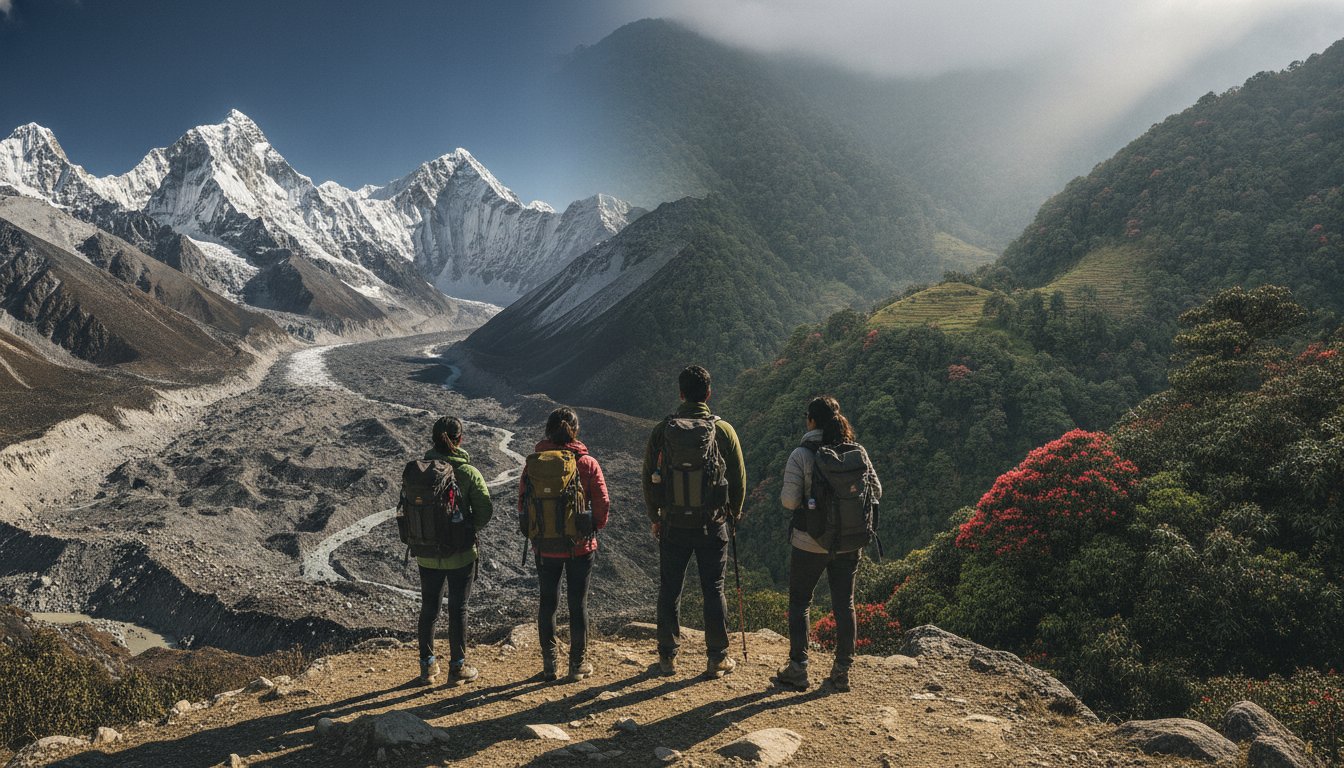
Everest Base Camp vs Annapurna Base Camp: Which Nepal Trek is Best for You in 2026?
The legendary status of Everest might make it the obvious choice for your 2026 adventure, but the hidden sanctuary of Annapurna is often the more rewarding experience for those seeking intimacy with the mountains. You’ve likely spent hours staring at photos of fluttering prayer flags, feeling a mix of excitement and anxiety about the Everest Base Camp vs Annapurna Base Camp debate. It’s natural to worry about altitude sickness or fear that choosing one means missing out on the “true” Himalayan experience. We understand that pressure because our family has lived and breathed these trails since 1992.
We promise to give you the definitive comparison you need to choose a journey that aligns with your fitness level and sense of wonder. Whether you crave the high-altitude prestige of the Khumbu or the lush, rhododendron-filled paths leading through Poon Hill, you’ll find total clarity here. We’ll preview the daily reality of both treks, including the latest 2026 permit updates and essential safety tips for high-altitude trekking. By the end of this guide, you won’t just have a plan; you’ll have the expert validation to step onto the trail that’s right for you.
Key Takeaways
- Evaluate the physical challenge by comparing the oxygen-thin altitudes of the Khumbu region against the more manageable heights of the Annapurna sanctuary.
- Navigate the Everest Base Camp vs Annapurna Base Camp debate with a clear look at the contrasting scenery, from stark glacial giants to verdant forests.
- Discover which itinerary fits your 2026 timeframe, ensuring you don’t miss out on the specific cultural experiences or mountain views you crave.
- Master the logistics of permits and high-altitude safety with expert validation from a team that has guided these trails since 1992.
- Use our “Choose Your Trek” framework to align your sense of adventure with the unique rhythms and daily experiences of each iconic trail.
The Great Himalayan Debate: Everest vs Annapurna in 2026
Choosing between the world’s two most famous trails is the ultimate dilemma for any mountain lover. On one side, you have the legendary Everest Base Camp Trek, the ultimate trophy for adventurers. On the other, the Annapurna Base Camp Trek via Poon Hill offers a sensory explosion that many seasoned hikers prefer. This Everest Base Camp vs Annapurna Base Camp choice will define your entire experience in Nepal, from the people you meet to the physical limits you’ll test.
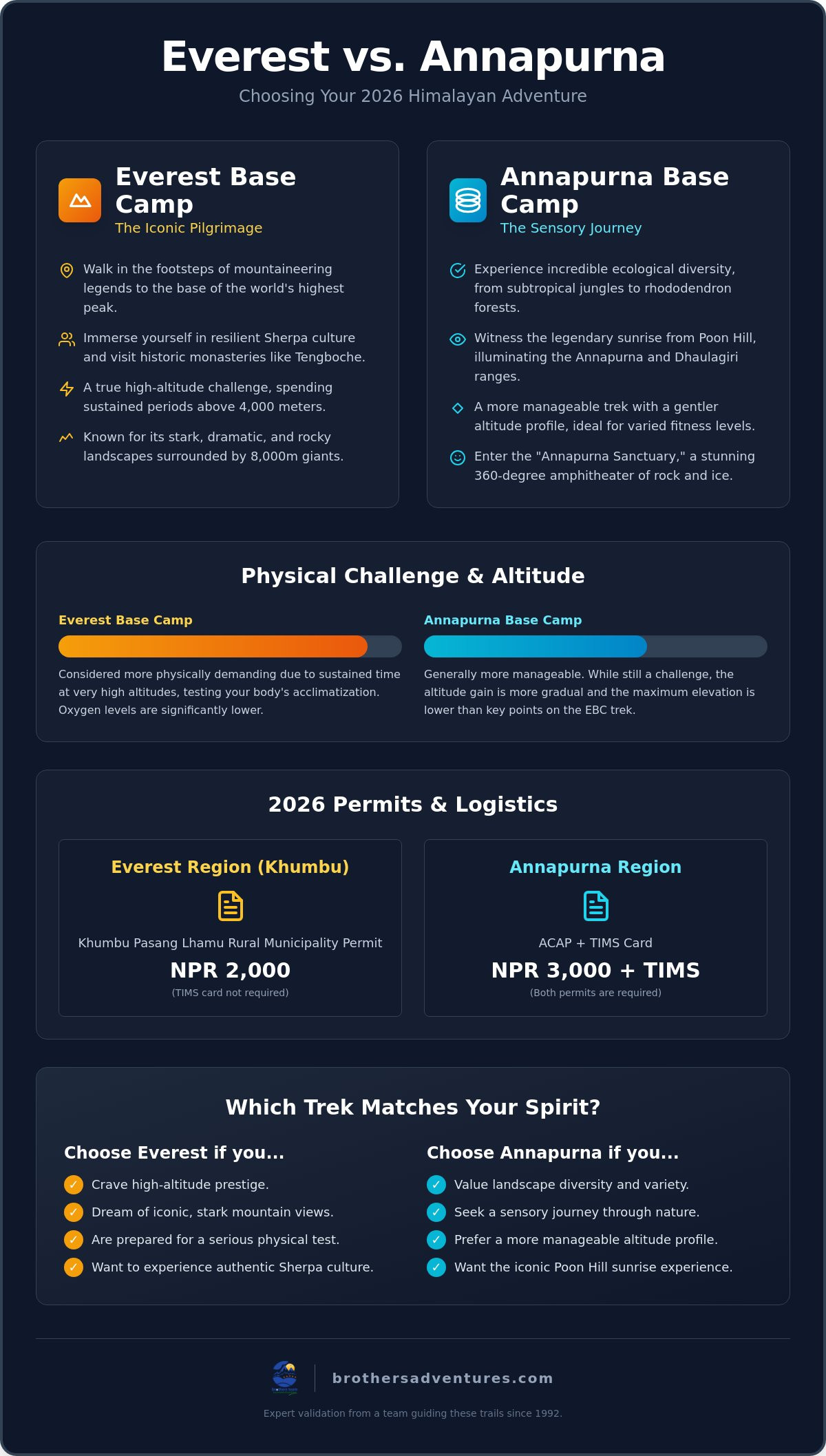
As we look toward 2026, Trekking in Nepal has become more structured yet remains deeply wild. Infrastructure in both regions has improved, with more reliable teahouse amenities and refined safety protocols. For your 2026 journey, it’s vital to note that permit systems have shifted toward local municipality control. In the Everest region, the Khumbu Pasang Lhamu Rural Municipality permit (NPR 2,000) is now the standard, while the Annapurna region still requires the ACAP (NPR 3,000) and a TIMS card. Our goal is to help you match your personal adventure style to the trail that will move you most.
The Everest Appeal: Walking with Giants
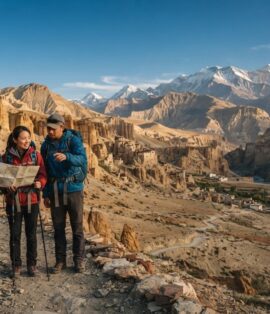
Stepping onto the trail in the Khumbu region feels like entering a living museum of mountaineering history. It’s a cultural pilgrimage through Sherpa heartlands where every mani stone and prayer wheel tells a story. Standing at the base of the world’s highest peak is an emotional milestone that stays with you forever. The landscape is stark, rocky, and dramatic. You’re surrounded by 8,000m giants like Lhotse and Makalu. It’s a high-altitude challenge that tests your grit while rewarding you with the most iconic views on the planet. For many, this isn’t just a hike; it’s a life goal realized.
The Annapurna Allure: A Journey Through Diversity
If Everest is a drama, Annapurna is a symphony. This trek is famous for its incredible ecological variety. You start in subtropical jungles before climbing through ancient rhododendron forests that bloom with vibrant color. The “sanctuary” itself is a natural amphitheatre, a 360-degree wall of rock and ice that feels like a secret hidden world. A major highlight is the legendary sunrise from Poon Hill. Seeing the first light hit the Dhaulagiri and Annapurna massifs is a sensory experience that rivals the destination itself. It’s the preferred choice for those who value landscape variety and cultural immersion over sheer altitude prestige.
Everest Base Camp: The Iconic Pilgrimage to the Top of the World
The journey begins with an adrenaline-fueled flight to Lukla, a tiny airstrip carved into the mountainside that serves as the gateway to the giants. From the moment you land, you’ll notice the landscape is strikingly different from the lower valleys. In the Everest Base Camp vs Annapurna Base Camp comparison, the Everest route is defined by its stark, high-alpine desert beauty. You’re walking through a world of rock and ice, surrounded by 8,000 meter peaks that dominate every horizon. This is the heart of Sherpa country, where the culture is as resilient as the mountains. You’ll visit the Tengboche Monastery, the largest in the Khumbu, where the rhythmic chants of monks and the scent of juniper incense provide a spiritual backdrop to your physical effort.
Prepare for a raw and authentic experience. Conditions here are more demanding than in the Annapurna region. Temperatures drop significantly once you climb past 4,000 meters, and the teahouses become more basic. While they offer a warm fire and a hearty meal, the focus is on functional comfort rather than luxury. It’s a small price to pay for the privilege of waking up in the shadow of the world’s highest peaks. If you’re looking for a seasoned partner to handle these logistics, our family-owned agency has been navigating these trails since 1992.
The Challenge of Altitude and Terrain
Success on the Everest trail requires a patient approach to the thinning air. We prioritize essential acclimatization days in Namche Bazaar to help your body adapt before pushing higher. EBC is generally considered more physically demanding than ABC because you spend significantly more time at sustained high elevations. Every step feels heavier when oxygen levels are low. This is why choosing a specialist tour operator is a vital safety decision. Our guides are experts in monitoring for altitude sickness, ensuring you have the support needed to reach your goal safely.
Key Highlights of the Everest Trail
The rewards for your grit are nothing short of legendary. You’ll explore the following highlights:
- Kala Patthar: This 5,545 meter viewpoint offers the most iconic, unobstructed gaze at Everest’s summit.
- The Khumbu Glacier: Walk alongside the world’s highest icefall, a shifting river of ice that groans beneath the peaks.
- Namche Bazaar: Experience the vibrant energy of the “Sherpa Capital,” a bustling hub filled with bakeries, gear shops, and trekkers from every corner of the globe.
Annapurna Base Camp: A Sensory Journey Through Nepal’s Diversity
While Everest offers a stark pilgrimage to the sky, the Annapurna Base Camp Trek via Poon Hill provides a vibrant explosion of life. It’s a journey that feels like walking through a living kaleidoscope. You’ll start in lush, subtropical valleys where waterfalls tumble over mossy cliffs, eventually climbing into the heart of the Annapurna Sanctuary. This isn’t just a destination; it’s a 360-degree amphitheatre where towering walls of rock and ice rise vertically from the basin. When deciding between Everest Base Camp vs Annapurna Base Camp, the sensory variety of the Annapurna region often wins over those who love deep green forests and warmer trails.
The transition on this route is staggering. One day you’re trekking through ancient rhododendron forests that glow with crimson blooms; the next, you’re standing at the base of the “Fish Tail” peak, Machhapuchhre, surrounded by a crown of 7,000 and 8,000 meter giants. Because the elevation is generally lower than the Everest region, the air is thicker and the climate is noticeably milder. It’s an inviting environment that allows you to focus on the landscape rather than just catching your breath.
The Poon Hill Sunrise Experience
Adding the Poon Hill detour to your trek is a non-negotiable for anyone who loves a good view. Watching the first rays of light hit the Dhaulagiri and Annapurna massifs is a spiritual experience. It’s a photographer’s dream, offering a panoramic perspective that you simply don’t get from the base camp itself. Beyond the peaks, this route weaves through Gurung villages like Ghandruk. Here, you’ll experience a different side of Himalayan culture, characterized by warm hospitality and stone-built houses that have stood for generations. It adds a rich cultural layer that perfectly complements the mountain scenery.
Terrain and Accessibility
The physical challenge of the Annapurna region is unique. Instead of the steady, rocky inclines of the Khumbu, you’ll face the legendary “stone stairs” of Nepal. These thousands of hand-cut steps test your quad strength and rhythm, making it a different kind of workout. However, because the base camp sits at 4,130 meters, it’s far more accessible for those worried about extreme altitude sickness. You get the high-mountain drama without the high-altitude risk associated with the 5,364 meter mark of Everest. If you’re looking for a slightly more compressed timeframe, our Nepal adventure tour 8 days is an excellent way to taste this diversity without the full commitment of a two-week trek.
The Comparison Framework: Difficulty, Scenery, and Logistics
Deciding between Everest Base Camp vs Annapurna Base Camp often comes down to a choice between technical altitude and ecological variety. At 5,364 meters, Everest Base Camp sits over 1,200 meters higher than the Annapurna Sanctuary, which tops out at 4,130 meters. This elevation gap is the single most important factor for your 2026 planning. While the Everest route offers a stark, monochromatic world of massive glaciers and high-alpine desert, the Annapurna trail is a sensory journey from subtropical heat to alpine ice. Logistics also differ significantly. EBC typically starts with the iconic, weather-dependent flight to Lukla, while ABC begins near Pokhara, a relaxed lakeside city that serves as a perfect staging ground for your trek.
Crowd dynamics are another key differentiator. Everest is the “superhighway” of the Himalayas, drawing thousands of dreamers to its historic path. You’ll find a vibrant, international energy in the teahouses there. Annapurna feels slightly more dispersed. Because the region has multiple entry and exit points through the foothills, the foot traffic feels less concentrated until you reach the final “bottleneck” leading into the sanctuary itself. Both offer incredible community, but the vibe in the Khumbu is one of high-stakes achievement, while Annapurna feels more like a deep immersion into the landscape.
Physical Preparation and Altitude Sickness
Success on the Everest trail requires superior cardiovascular endurance. You’ll be spending multiple days above 4,000 meters, where the air is significantly thinner. This is where the expertise of professional guides becomes non-negotiable. Our team monitors oxygen saturation and Acute Mountain Sickness (AMS) symptoms daily to ensure you’re adapting safely. If you’re concerned about high-altitude strain, you might consider a Nepal cultural tour package as a beautiful, lower-elevation alternative that still captures the magic of the mountains.
Accommodation and Daily Life
The teahouse experience has evolved rapidly. In the Khumbu region, you’ll find a surprising range of options, including some lodges that offer “luxury” touches like heated blankets and attached bathrooms. The Annapurna Base Camp trail tends to be more traditional and uniform. Teahouses here are cozy but simpler, focusing on the essentials of warmth and community. Regardless of the route, your diet will center on “Dal Bhat Power,” though menus now include everything from pasta to apple pie. Staying hydrated is your full-time job, and our guides ensure you have access to safe, treated water throughout the journey. If you’re ready to test your limits, check out our guided trekking itineraries to see which challenge fits your spirit.
Making Your Choice: Which Trek Matches Your Spirit?
The Everest Base Camp vs Annapurna Base Camp decision ultimately rests on what kind of story you want to tell. Are you looking for the prestige of the world’s highest peak, or does a journey through shifting ecosystems and cultural tapestries call to you? There is no wrong choice here. Both trails offer a profound connection to the Himalayas that will change your perspective on adventure. We’ve seen thousands of trekkers find their rhythm on these paths since 1992, and the “best” trek is simply the one that aligns with your current physical readiness and sense of wonder.
Choose the Everest Base Camp Trek if:
- You want to tick the ultimate “bucket list” item off your map.
- The history of mountaineering and Sherpa culture fascinates you.
- You’re prepared for a high-altitude challenge and the stark beauty of a glacial landscape.
- Standing at the foot of the world’s highest mountain is a non-negotiable dream.
Choose the Annapurna Base Camp Trek via Poon Hill if:
- You value landscape diversity, from subtropical jungles to alpine amphitheatres.
- You prefer a slightly shorter timeframe with more manageable altitude gains.
- Sunrise views and cultural immersion in Gurung villages are high priorities.
- You want a trek that feels like a sensory journey through every climate zone.
The 2026 Trekking Outlook
As we move into 2026, we’re seeing a shift toward more personalized, smaller group experiences. Climate considerations remain vital, with the spring and autumn windows staying the gold standard for clear skies. For those planning an Everest journey, we recommend booking at least six to eight months in advance. Permit caps and the limited availability of Lukla flights mean the early bird truly gets the mountain. If you find yourself completely torn, ask us about the “Double Base Camp” possibility. It’s a grand Himalayan odyssey for those who have the time and the stamina to experience the best of both worlds in a single trip.
Next Steps: Planning Your Journey with Brothers Adventures
Preparation is the difference between a difficult slog and a life-changing adventure. Our dual offices in Singapore and Kathmandu act as a bridge, providing you with seamless logistics from the moment you start training to the final celebration dinner. We believe in transparency, which is why our fixed-price packages cover your permits, expert guides, and local transport without hidden surprises. You’re not just a client to us; you’re an invited guest in our home mountains. Explore our Everest Base Camp Trek and Annapurna Base Camp Trek itineraries today to see which path speaks to your spirit. Let’s make 2026 the year you finally stand among the giants.
Begin Your Himalayan Adventure in 2026
Your journey to the roof of the world is more than just a hike; it’s a transformation. Whether you choose the stark, legendary heights of the Khumbu or the lush, sensory sanctuary of the Annapurna region, your 2026 trek will be a defining moment. We’ve explored the Everest Base Camp vs Annapurna Base Camp debate through the lenses of difficulty, scenery, and logistics to help you find your perfect match. Remember that Everest offers the ultimate high-altitude prestige, while Annapurna provides a diverse landscape that captures the heart of Nepal’s natural beauty.
Since 1992, our family-owned business has guided explorers through these sacred spaces with a deep commitment to safety. With offices in both Singapore and Kathmandu, we handle the complex logistics so you can focus on the wonder of the trail. Our professional high-altitude safety protocols ensure that your health is always the priority. Don’t let another year pass by just dreaming of the mountains. Plan your Himalayan trek with Brothers Adventures and step into the adventure you were meant for. The peaks are waiting for you.
Frequently Asked Questions
Which trek is harder, Everest Base Camp or Annapurna Base Camp?
Everest Base Camp is generally considered the more difficult trek because of the sustained high altitude and thinner air. While the Annapurna route features thousands of challenging stone stairs, the Everest trail requires you to spend several days above 4,000 meters, which puts a significantly higher strain on your cardiovascular system and increases the risk of altitude fatigue.
Do I need previous trekking experience for EBC or ABC?
What is the best month to trek in Nepal in 2026?
The best months for trekking are March through May and late September through November. These windows provide the most stable weather and clearest mountain views. Spring offers the beauty of blooming rhododendron forests, while the autumn months typically deliver the crispest air and most reliable flight schedules for the journey into the mountains.
Can I see Mount Everest on the Annapurna Base Camp trek?
You cannot see Mount Everest from the Annapurna region because these two massifs are located in entirely different parts of Nepal. If your heart is set on seeing the world’s highest peak, the Everest trail is your best choice. However, the Annapurna region offers its own spectacular giants, including the iconic “Fish Tail” peak of Machhapuchhre.
How much does an Everest Base Camp trek package typically cost?
The total investment for your journey depends on several factors, including the length of the itinerary, the quality of teahouses, and whether you include domestic flights or porters. When weighing Everest Base Camp vs Annapurna Base Camp, keep in mind that Everest is usually the more expensive option due to the necessary flights to and from Lukla. We provide fixed-price packages that cover all essential permits and logistics for peace of mind.
What are the symptoms of altitude sickness I should watch for?
Early symptoms of Acute Mountain Sickness (AMS) include persistent headaches, nausea, dizziness, and a significant loss of appetite. You might also experience trouble sleeping or unusual fatigue. It’s vital to communicate any of these signs to your guide immediately. Our professional team monitors your health daily to ensure you’re adapting safely to the elevation changes.
Is it safe to trek to Everest Base Camp without a guide?
While independent trekking is currently permitted in the Khumbu region, hiring a professional guide is much safer and more rewarding. A guide manages all the complex logistics, monitors your physical health, and acts as a cultural bridge to the local Sherpa communities. Having an expert by your side is especially important if weather conditions change rapidly or if you experience health issues.
How many days do I need for the Annapurna Base Camp trek via Poon Hill?
You’ll typically need 10 to 12 days to complete the full circuit that includes the Poon Hill sunrise experience. This timeframe allows for a steady pace that aids acclimatization and gives you enough time to enjoy the cultural immersion in villages like Ghandruk. Rushing the journey can increase the risk of exhaustion and prevents you from fully absorbing the mountain sanctuary experience.


Comments are closed