


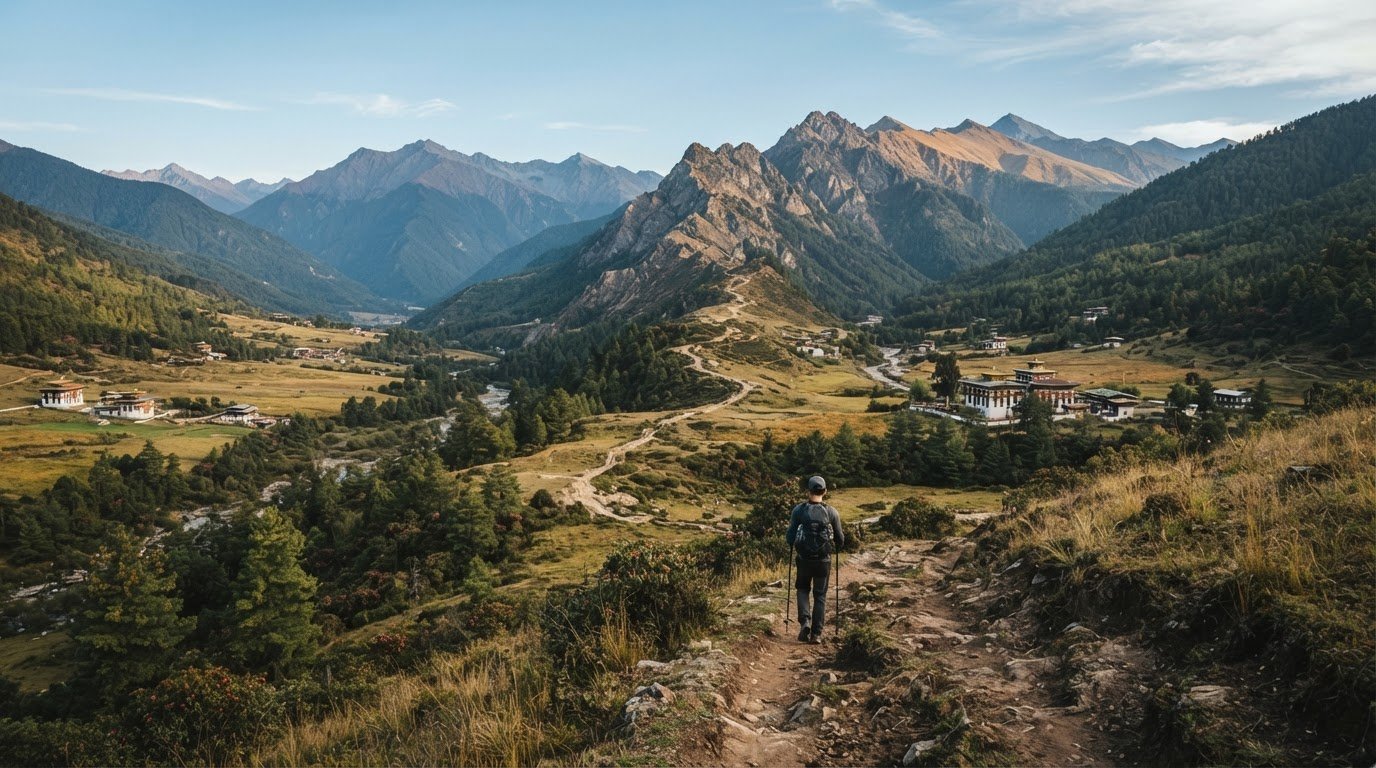
Bumthang Cultural Trek Bhutan: Distance, Route and Altitude
Three days on foot can reveal a whole valley of Bhutanese culture. The Bumthang cultural trek in Bhutan covers around 44 kilometres, averaging about 15 kilometres of walking per day, and reaches Phephe La Pass at 3,360 metres. It’s a rewarding route, but its long walking days and high pass make the effort part of the adventure.
If you’re considering the Bumthang Cultural Trek in Bhutan, the distance, your fitness and the altitude are all worth weighing up. The trek is rated easy to medium, but the terrain, daily climbs and time on your feet shape how challenging it feels.
This guide outlines the route and daily distances, the temples and monasteries along the way, the altitude profile and what to expect at Phephe Pass. It also explains the trek’s overall difficulty, helping you picture the journey through Bumthang’s quiet valleys and prepare for the days ahead.
Key Takeaways
- Plan your trek around the recommended seasons and learn how monsoon and winter conditions affect the journey.
- Follow the route stage by stage to understand where each walking day begins, ends and demands the most effort.
- Discover the temples and monasteries that bring Bumthang’s cultural landscape to life along the trail.
- Use the altitude profile and Phephe Pass ascent to judge how the terrain may shape your pace and preparation.
- Compare the trek’s overall difficulty with your walking experience to decide what preparation will help you enjoy it.
What is the Bumthang cultural trek length or distance?
The Bumthang Cultural Trek covers around 44 kilometres over three days, averaging about 15 kilometres of trekking daily. Expect a real walking journey, not a short stroll between valley viewpoints. Daily distances vary, and the route’s climbs and descents can make some stages feel longer than others. In Chamkhar Valley, the landscape shifts between villages, forest paths and cultural sites.
April to May and September to November are the recommended trekking seasons. These months may offer more suitable conditions for following the trail than periods of heavier seasonal rain. Although winter trekking season runs from December to February, this trek is not recommended from December through March because of extreme cold. Plan around the recommended months and match your itinerary to the season.
In spring, rhododendrons may add colour to the hillsides, standing out against Bumthang’s green valleys. April and May are identified as the best season for the trek, making them a good fit for travellers who want to combine walking with spring scenery. Flowering varies with local conditions, but forest sections can be especially striking. September to November offers another recommended window, with a different feel across the valley.
Compared with Bhutan’s popular Druk Path and Jomolhari treks, the Bumthang route puts more emphasis on valley scenery and cultural stops, including temples and monasteries. Druk Path is also available as a named trekking itinerary, while Jomolhari is a separate route. Compare the route profiles and daily walking demands when deciding which trek suits you.
Pack layered clothing, a waterproof outer layer, broken-in hiking boots, warm layers for the night and sun protection. To manage altitude, walk steadily, drink regularly and tell your guide promptly if you feel unwell. The pass and changing elevation make pacing important. Keep essentials dry and within easy reach, especially in changeable weather.
The main safety challenges are uneven paths, steep sections, changing weather and exertion during long walking days. Stay with your group, follow local guidance and carry basic first-aid supplies. Because emergency help depends on communication and access along the route, agree on an emergency plan with your trekking team before setting out.
Treat the stated distance as a whole-route estimate rather than a promise that every day will match the average. The route totals around 44 kilometres, but daily distances vary, and the climbs and descents affect how demanding the walking feels. When shaping an itinerary, consider daily effort as well as kilometres: an average of about 15 kilometres does not mean each stage will feel alike. This distinction is useful when comparing the trek with a shorter valley outing or deciding how much time to leave for cultural stops along the way.
The Bumthang Cultural Trek is listed as best undertaken from March to May and September to November. The spring window is broader than the April and May period highlighted for rhododendrons, while autumn offers another recommended time to walk. Match the route’s total distance and changing daily demands to your chosen season, rather than assuming the same pace will suit every stage. Keeping the three-day structure in mind can help you set realistic expectations for the walks and cultural visits.
Bumthang trek route and itinerary
The route runs from Toktu Zampa to Mesithang, followed by the overland journey into Bumthang. A complete itinerary also needs to account for the trek’s stages, travel days and required permit.
Route and Day-by-Day Plan
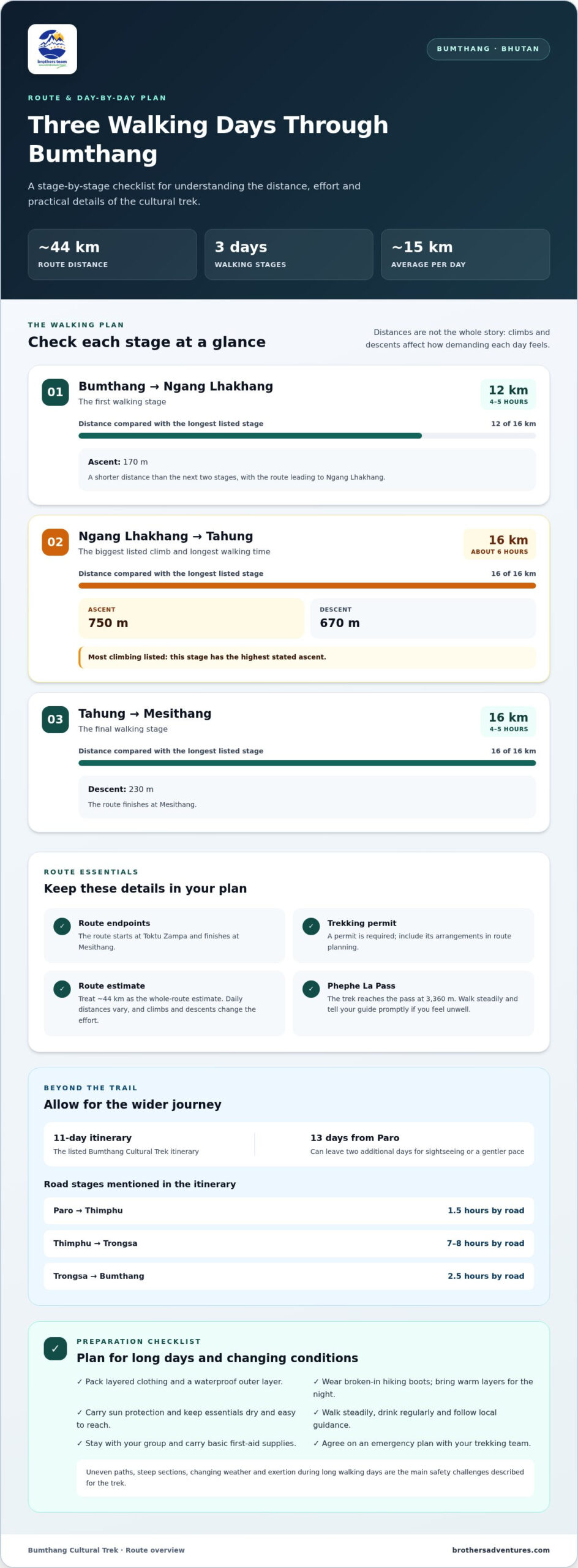
The three walking stages pass through villages and cultural landmarks, with Ngang Lhakhang and Tahung marking key points. Check the daily distances and walking times to see where the longest effort falls, rather than judging the trek by its total distance alone.
- Day one: Walk 12 km from Bumthang to Ngang Lhakhang, taking 4-5 hours with 170 m of ascent.
- Day two: Cover 16 km from Ngang Lhakhang to Tahung in about 6 hours, with 750 m of ascent and 670 m of descent.
- Day three: Trek 16 km from Tahung to Mesithang, usually taking 4-5 hours with 230 m of descent.
The route starts at Toktu Zampa and finishes at Mesithang. A trekking permit is required, so include permit arrangements in your route planning.
Tour Duration and Starting Point
The Bumthang Cultural Trek itinerary lasts 11 days, while a 13-day itinerary from Paro can leave two additional days for sightseeing or a gentler travel pace. Treat the trek as one part of the wider journey, not as the entire itinerary. Check how the plan connects Paro, Thimphu, Trongsa and Bumthang, and where overnight stays fall.
A Western Bhutan itinerary can start in Paro and travel onward through Thimphu before continuing east. Paro to Thimphu takes 1.5 hours by road. Plan visa paperwork and guide arrangements alongside the trek’s permit, as these are separate elements of the wider travel plan.
Travel to Bumthang
From Thimphu, the drive to Trongsa takes 7-8 hours; the onward drive from Trongsa to Bumthang takes 2.5 hours. Allow for these substantial road stages when arranging arrival and overnight stops. A filled river, forested slopes and high mountain scenery make the journey part of the experience, but travel time still shapes the day’s schedule.
Before setting out, compare the route’s highest point and overnight stops with your planned travel pace. Add cultural visits where they fit naturally, such as time at a lhakhang, and leave room for the guide’s explanations of local traditions, including teachings associated with a Rimpoche. For broader Bhutan itinerary ideas, explore Bhutan travel planning.
Bumthang temples, monasteries and sacred sites
Bumthang’s sacred places bring history and living Buddhist practice into the journey. Notice how temples, monasteries and dzongs shape the valley’s cultural landscape.
Buddhist Temples and Monasteries
Thangbi Lhakhang and Ngang Lhakhang are both associated with the 15th century. Tang Rimochen Lhakhang was built in the 14th century by Pema Lingpa. These dates offer useful context, but each site deserves attention beyond its age. Look at how its setting, purpose and continuing religious role distinguish one monastery or temple from another.
At each stop, take time to understand what you’re seeing instead of treating the visit as a quick photo break. A local guide can explain Buddhism, temple traditions and the significance of dzongs. Listen for how each site connects to Bumthang’s wider spiritual history. This turns separate visits into a cultural journey rather than a checklist of names.
- Thangbi Lhakhang: a 15th-century temple.
- Ngang Lhakhang: built in the 15th century.
- Tang Rimochen Lhakhang: built in the 14th century by Pema Lingpa.
- Ogyencholing: founded in the 14th century.
These sites also help visitors understand the difference between a lhakhang, a monastery and a dzong. Their names may appear close together on an itinerary, but each refers to a different kind of place. Ask your guide how a site serves its community and what its history means locally. The conversation can bring Buddhist practice into focus without reducing it to dates alone.
Dzongs and Sacred Sites
Jakar Dzong gives the valley a landmark dzong to include alongside Bumthang’s temples and monasteries. Ogyencholing adds another layer of history, with its 14th-century foundation. Look at how these places fit into the cultural landscape, then give each visit time for explanation and quiet observation.
A thoughtful visit follows a simple rhythm: learn the site’s name, hear its story, then take in the surroundings. At Ngang Lhakhang, for example, the 15th-century date provides a historical anchor; at Tang Rimochen Lhakhang, Pema Lingpa’s connection adds a specific story. These details help make Bumthang’s sacred places distinct and memorable.
Temples and monasteries are meaningful religious places, not simply historic buildings to view. Dress respectfully, keep your voice low and follow local guidance during visits. If your itinerary includes Jakar Dzong or Ogyencholing, ask how each site relates to the surrounding community. Understanding the context makes your journey through Bumthang richer and more respectful.
Trek altitude and Phephe Pass
The trek is rated easy to medium, with walking days of 12 km, 16 km and 16 km; Phephe La Pass reaches 3,360 m. Overnight camps feature along the route, so review the itinerary for sleeping and food arrangements at each stage.
Camp Locations and Altitudes
Camp elevations give a clearer picture of the route than distance alone. The first-day camp is listed at 2,800 m, while the second-day camp is at 2,720 m. The first trekking day reaches 2,900 m, so the walking elevation and overnight altitude aren’t necessarily the same.
Phephe La is the high point to keep in mind: the pass reaches 3,360 m, with an ascent of around 500 m. The route’s overnight camps sit below the pass, and the second day includes both a substantial climb and descent. Check each stage’s overnight stop when comparing itineraries, since camp elevation affects how the day’s effort is experienced.
Camping on the trek differs from staying in a town guesthouse. Plan around the overnight locations shown in the itinerary, and understand which meals and sleeping arrangements apply at each stop. This is especially useful if you’re travelling from Singapore, where warm evenings at home offer little preparation for cooler mountain nights.
Walking Difficulty and Elevation Changes
Easy to medium is the trek’s overall difficulty rating, but the daily profile explains the work involved. Day one covers 12 km in 4-5 hours, with 170 m of ascent. Day two covers 16 km in about 6 hours, climbing 750 m and descending 670 m. Day three adds 16 km and 230 m of descent.
The second day is the most demanding in terms of elevation change. The climb leads towards Phephe La, followed by a long descent, so set a steady pace instead of starting too fast. Walking poles can help on uneven ground, while well-fitted boots support comfort over extended walks. Prepare with steady walking practice, including uphill sections and controlled downhill steps.
Most of the trek is described as lying between 1,200 m and 2,500 m above sea level, but Phephe La rises higher. September falls within one of the recommended trekking windows, alongside October and November. Whatever month you choose, bring layers for changing conditions and keep water accessible during climbs. Buddhist sites and valley scenery reward a measured pace, so pause when needed without losing sight of the day’s route.
Altitude affects how strenuous a climb feels, while distance, gradient and descent contribute to fatigue in different ways. Consider all three when judging your readiness: even a shorter uphill section can feel demanding, and a long descent can tire your legs. Use the daily elevation figures to set a realistic rhythm and prepare for the high crossing at Phephe La.
Bumthang Cultural Trek overview and difficulty
The Bumthang Cultural Trek is rated easy to medium, but that label doesn’t tell the whole story. Its three walking days combine sustained distance, changing elevation and uneven terrain. To judge the challenge, look beyond the rating and consider your walking experience, comfort on climbs and descents, and ability to stay active for several hours.
The route is as much a cultural journey as a physical one. In Bumthang Valley, trails connect villages, Buddhist sites and open landscapes, with rivers running through the scenery. This isn’t a technical mountaineering expedition, but the daily walks still require steady effort. Cultural stops enrich the journey, but they don’t remove the physical demands between them.
Consider distance and elevation together. A long day can feel harder when it includes a major climb, and a descent can tire your legs after hours on foot. Phephe La is the trek’s high pass, so the approach and elevation changes matter as much as the total distance. Review the stage-by-stage itinerary and note where the biggest ascent and descent occur.
Prepare for the route’s demands. Before departure, practise walking for several hours on varied ground, including uphill and downhill sections. Choose well-fitted footwear and carry layers for changing mountain conditions. If you’re used to short, flat walks in Singapore, build up gradually rather than relying on one long training walk to prepare you for every trekking day.
The season also shapes the experience. September to November is a recommended trekking window, and November falls within it. Weather and ground conditions can change how the trail feels, so pack for varied conditions and follow your guide’s advice on pace. Leave enough time for breaks, photographs and cultural visits instead of measuring a successful day by speed.
Before choosing this route, ask yourself: can you walk for several hours, manage uneven paths and keep a steady pace on climbs? If so, the easy-to-medium rating is a useful starting point, not a promise that every stage will feel easy. If you have limited walking experience, prepare with regular walks and discuss the demanding stages with your trekking guide.
November’s cooler-season setting, Bumthang’s rivers and the cultural stops create a rewarding balance of effort and discovery. Choose the trek for its combination of walking and heritage, not simply because its rating sounds manageable. For another journey beyond Bhutan, explore travel planning for your next adventure.
Brothers International Tours & Trading Pte Ltd: 8Days Nepal Adventure Tour
Brothers International Tours & Trading Pte Ltd offers the 8Days Nepal Adventure Tour for travellers who want to continue exploring the Himalayas beyond Bhutan. If you’re drawn more to walking, the 8Days Scenic Nepal Mini Trek offers a trekking-focused alternative. These are Nepal journeys, not extensions of the Bumthang route, so consider them when planning a separate adventure.
Choose the experience that matches your travel style: a broader adventure tour or a mini trek centred on scenic walking. The 5Day Nepal Luxury Tour and 10Days Wonder Of Pakistan are other options for travellers comparing different kinds of regional journeys.
To explore the Nepal options, visit Brothers International Tours & Trading Pte Ltd.
Let Your Next Journey Take Shape
Let the experience you want shape your next travel decision. If the cultural encounters drew you in, look for journeys that bring local heritage and landscapes into focus. If walking was the highlight, choose a trip where time on the trail is central. The right next adventure is one that matches your curiosity, pace and idea of discovery.
Brothers International Tours & Trading Pte Ltd offers the 8Days Nepal Adventure Tour, the 8Days Scenic Nepal Mini Trek and the 5Day Nepal Luxury Tour. These distinct options give you different ways to explore beyond Bhutan, from scenic trekking to a broader Nepal journey or a luxury-focused itinerary.
Use what you’ve learned about the Bumthang cultural trek in Bhutan to plan with intention, then take the next step toward a journey that feels right for you. Contact Brothers International Tours & Trading Pte Ltd to explore your travel plans. The next memorable landscape is waiting to be discovered.
Frequently Asked Questions
What is the Bumthang Cultural Trek route and how many days does it take?
The Bumthang cultural trek in Bhutan follows a route from Toktu Zampa to Mesithang, with three walking days within an 11-day itinerary. It passes through Ngang Lhakhang and Tahung, with the second stage crossing Phephe La. Before settling on travel dates, distinguish the trek’s walking days from the full itinerary, which also includes road travel and time for other stops in Bhutan.
What are the main villages, monasteries, and cultural sites on the Bumthang Cultural Trek?
The route connects Bumthang settlements and cultural landmarks, including Ngang Lhakhang and Tahung. Nearby sites include Thangbi Lhakhang, Tang Rimochen Lhakhang, Ogyencholing and Jakar Dzong. Use an itinerary to identify which places are on the walking stages and which need a separate visit. This helps you plan cultural stops without assuming every landmark lies directly on the trail.
When is the best season to do the Bumthang Cultural Trek, and what is the weather like?
April to May and September to November are recommended seasons for the Bumthang Cultural Trek in Bhutan, with April and May identified as the best season. Bhutan’s summer monsoon normally runs from June to August, while the trek isn’t recommended from December through March because of extreme cold. Pack adaptable layers for changing conditions, and consider spring for a chance to see rhododendrons along the route.
What permits, visa requirements, and guided-tour rules apply to trekking in Bhutan?
A trekking permit is required. Include visa paperwork and guide arrangements in your wider travel plan, as these are separate from the permit.


Comments are closed