


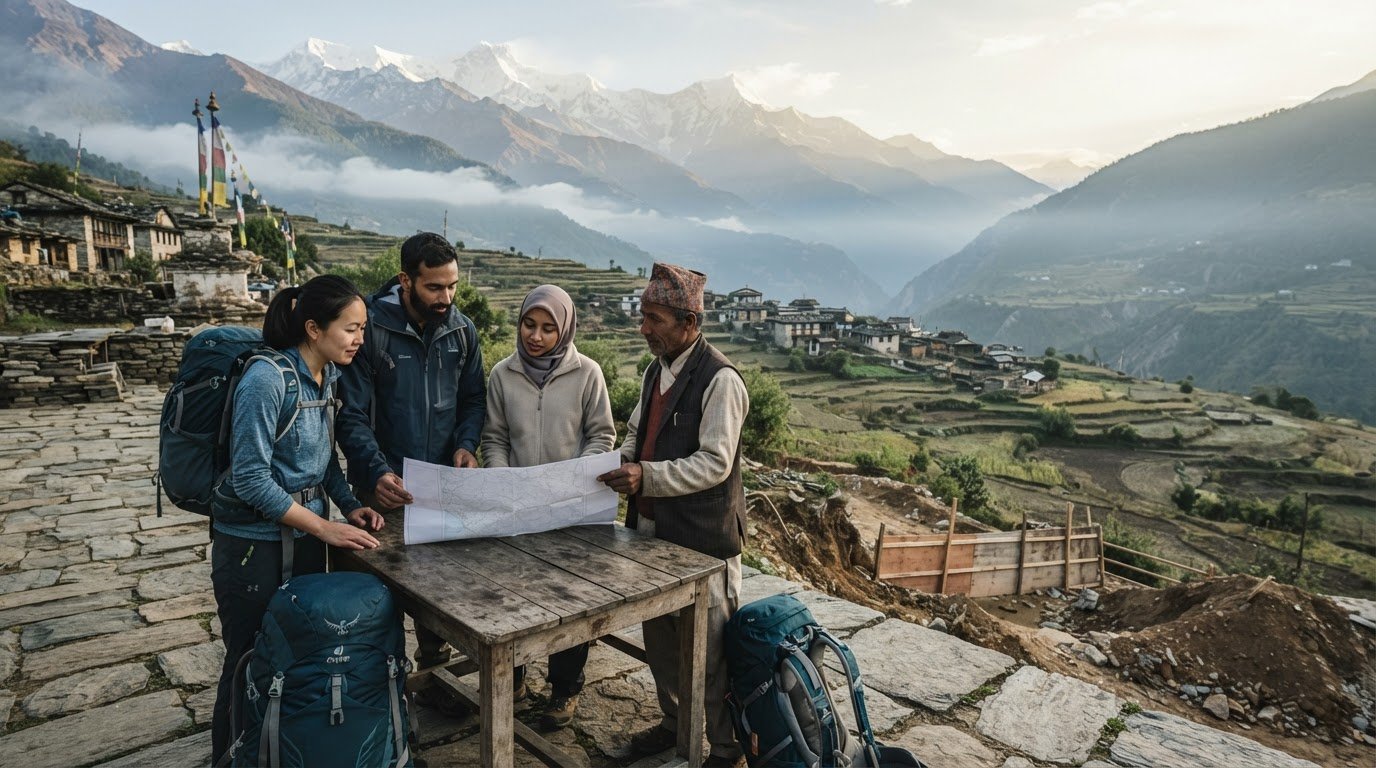
Tamang Heritage Trail Trek Package: What to Expect in 2026
What should you compare when choosing a Tamang Heritage Trail trek package? Look beyond the number of days: the walking pace, cultural experiences and practical support behind the itinerary can make a bigger difference to your trip. Packages can be difficult to compare when their lengths vary and inclusions are not clearly explained.
There is an important 2026 access update to consider before planning. Flash floods in August severely damaged access to the trail, and trekking trips were reported suspended as of October 2026. Treat this journey as a future possibility rather than a currently accessible trek.
This guide explains the trail’s cultural appeal and typical trip structure, then shows you how to compare itineraries, inclusions and walking demands. It also covers practical considerations around altitude, pace and comfort when planning a guided Nepal journey. With thoughtful preparation and flexible support, you can make informed choices when conditions allow the trail to welcome trekkers again.
Key Takeaways
- As of October 2026, flood damage has disrupted access to the Tamang Heritage Trail. Treat this trek as a future possibility rather than a currently accessible journey.
- Compare a Tamang Heritage Trail trek package by its stated itinerary, guiding, transport, accommodation, meals and exclusions, not by trip length alone.
- Published itineraries range from 10 to 12 days. Travel time, acclimatisation and route variations can all affect the schedule.
- Before planning, consider your fitness, preferred pace and comfort needs. Look for current, route-specific details on walking distances, hours and altitude.
- Brothers International Tours & Trading Pte Ltd is a family-owned travel agency established in 1992, with a flexible approach to food preferences and pace.
Why choose a Tamang Heritage Trail trek package for culture and mountain scenery?
A Tamang Heritage Trail trek package is a guided, multi-day journey that combines walking through Himalayan landscapes with opportunities to encounter local culture and village life. It is more than a route measured in distance. The experience can also include time to notice how people live, learn about local traditions and enjoy changing mountain views along the way.
This combination appeals to travellers who want more than a scenic backdrop. A quiet stretch of trail can be memorable, as can the human details: how a settlement is laid out, the design of its homes or a conversation that offers a glimpse of everyday life. Approach these encounters with respect. Communities are not attractions, and each visit depends on the people, place and circumstances of the day.
Keep the 2026 access situation in view. Following severe flood damage in August, the trail was reported inaccessible and trips suspended. As of October 2026, treat it as a future journey, not an available trek for the current season. Check current access and safety updates before making plans.
What makes the trail a cultural trekking experience?
The route is associated with the Tamang people, an ethnic group with distinct cultural, historical and linguistic traditions. For an introduction to Tamang people and their rich cultural heritage, explore how the community’s identity connects with the wider region. Cultural interest along the trail may come through village settings, local architecture and customs, but no single village visit represents every Tamang community or guarantees a particular interaction.
Let curiosity guide you, and be considerate. Follow your guide’s advice on local etiquette, ask before photographing people and give residents space to go about their day. A respectful visit is more meaningful than treating daily life as a performance arranged for visitors.
Who may enjoy this style of Nepal trek?
This style of trek may suit travellers who enjoy walking outdoors and want cultural context alongside mountain scenery. It has a different emphasis from a summit-focused expedition, where reaching a high point is the central goal. Here, the journey itself matters: landscapes and settlements can be as important as the day’s destination.
Published itineraries vary. Some describe journeys of 10 days, while others list 12. Neither duration is a universal standard. Travel time, route choices and additional sections can change the shape of a trip, so compare the day-by-day plan rather than relying on the headline length. Later sections of this guide explain how to assess those differences.
Before choosing a package, consider how comfortable you are with consecutive walking days, what pace feels manageable and which comforts matter most to you. A cultural trek can still be physically demanding. Current route-specific details on altitude, distances and walking hours are essential for judging whether the journey fits your abilities and preferences.
How the Tamang Heritage Trail itinerary works, and why package lengths differ
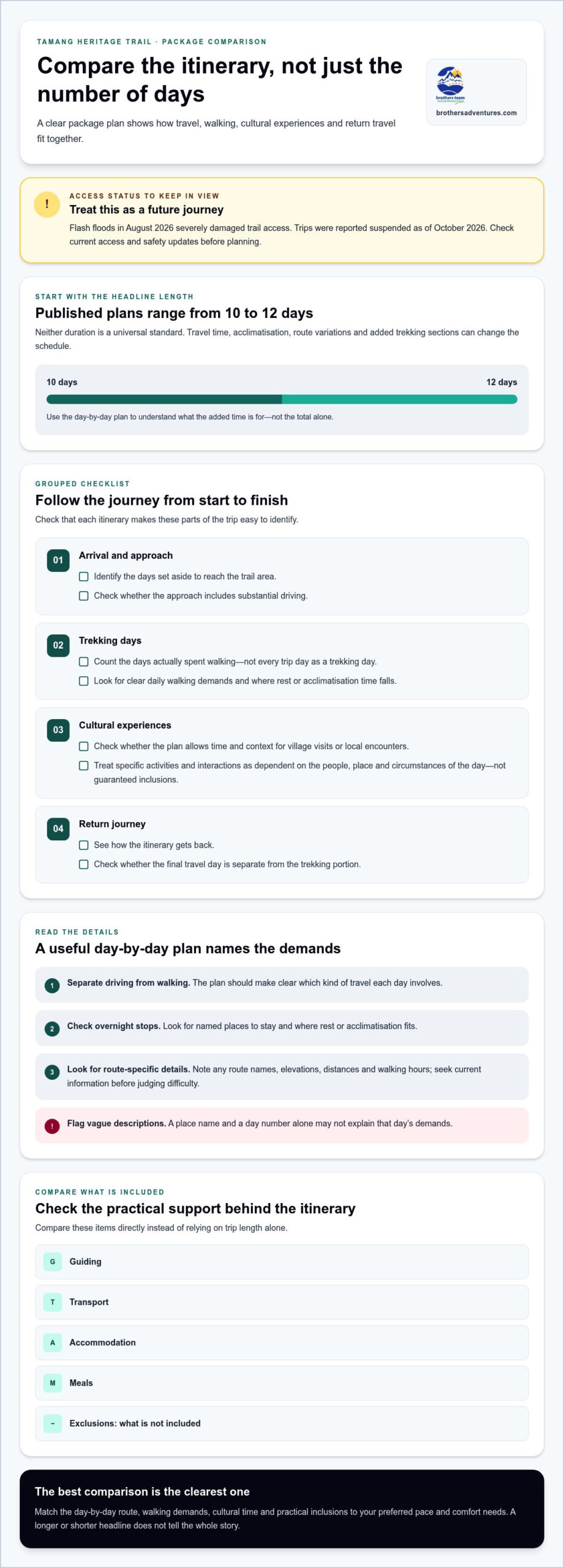
A package itinerary is more than a list of places. It shows how the approach journey, walking days, cultural experiences and return travel fit together, and whether the pace leaves room for rest. Published itineraries range from 10 to 12 days. Travel time, acclimatisation, route variations and added trekking sections can affect the total, so neither duration is a universal standard.
Think of the journey as a sequence rather than assuming every itinerary follows the same schedule:
- Arrival and approach: Identify the days set aside for reaching the trail area and whether they include substantial driving.
- Trekking days: Check how many days are actually spent walking, rather than counting every trip day as a trekking day.
- Cultural experiences: Look for time and context for village visits or local encounters, without assuming a specific activity is guaranteed.
- Return journey: See how the itinerary gets back and whether the final travel day is separate from the trekking portion.
This breakdown makes packages with different headline lengths easier to compare. One may allocate more time to the approach or rest, while another may add a trekking section. Those differences change the journey’s scope, not just its duration.
What to look for in a day-by-day itinerary
Read each day closely. Does the plan distinguish driving from walking and show where rest or acclimatisation time falls? Are overnight stops named, and are daily walking demands described clearly? Note any route names, elevations and distances, then seek current, route-specific information before using them to judge difficulty. If an itinerary gives only a place name and a day number, it may not tell you enough about the day’s demands.
For context on official tourism updates, consult Nepal’s Ministry of Culture, Tourism and Civil Aviation. Published itineraries can help explain a proposed plan, but they should not replace current information about access and conditions.
Heritage trail only or a combined trekking route?
Some itineraries add another trekking section, which can add walking days and change the route’s focus. A combined trip may offer a broader journey, but it is not directly comparable with an itinerary centred on the heritage trail alone. Compare the named route and daily plan, not just the package title or total days. Check that the places and route sections described match the journey you want.
For 2026 planning, treat published schedules as examples rather than proof that a route is operating. Access conditions have been disrupted, so current safety and route information should come before decisions about dates or day-by-day plans.
Once you have identified the kind of Nepal journey you want, explore the agency’s Nepal travel and trekking experience as a planning starting point. Brothers International Tours & Trading is family-owned and established in 1992.
Compare Tamang Heritage Trail trek packages by inclusions and traveler support
A package can sound appealing while leaving important practical details unclear. Compare the written descriptions side by side, and count a feature as included only when the package explicitly says so. This helps separate a clear plan from broad promises such as “all-inclusive” or “best experience.”
Use this checklist to organise your comparison. Record the exact details stated in each package description, or mark them “not specified” rather than guessing.
| Detail | What to compare | Your notes |
|---|---|---|
| Itinerary | Route scope, day-by-day activities, walking and rest time, overnight stops | Record named route sections and what happens each day |
| Guiding | Whether guiding is explicitly described and what the description says | Separate stated arrangements from general claims |
| Transport | Which journeys are described, and whether transport is identified for each leg | Note the stated transport and any unspecified legs |
| Accommodation | Whether overnight arrangements or accommodation types are specified | Write down the actual description, not an assumption |
| Meals | Which meals are stated as included and whether food preferences are addressed | List only meals and provisions explicitly mentioned |
| Exclusions | Any stated exclusions, plus details the description leaves open | Keep exclusions distinct from missing information |
Which package details deserve a close comparison?
Start with route scope. A package title may sound similar to another, yet one itinerary may describe a different route or an added trekking section. Then trace each day: does it distinguish walking from driving, identify overnight arrangements and describe the day’s activities? Compare meals and exclusions with the same care. “Meals provided” is less precise than a description naming which meals are covered. Vague wording is not proof of an inclusion.
For a fair comparison, use the itinerary and stated package details, not promotional adjectives. If a route name, elevation or distance is given, treat it as a detail to verify against current, route-specific information before relying on it for planning.
How support and flexibility affect the experience
Support can shape how manageable a journey feels, especially when travellers have different walking paces, food preferences or mobility needs. Brothers describes flexibility around pace and food preferences, as well as separate-van support to reduce walking for travellers with limited mobility. These reflect the agency’s broader approach, not a promise of a particular arrangement on this trail or itinerary.
Think about what would help you feel comfortable, then distinguish personal preferences from package inclusions. Brothers International Tours & Trading is family-owned and established in 1992. For a wider look at cultural travel planning, explore this Nepal cultural tour package guide.
Prepare for the trek: assess walking demands, comfort, and timing
A useful preparation plan starts with your needs, not a broad difficulty label. Before choosing a Tamang Heritage Trail trek package, compare the day-by-day walking demands with your current activity level. Think through what would help you feel comfortable over consecutive days outdoors.
There is also a major access consideration for 2026. Following the August flash floods, reports in September described damage and disruption to access, and the trail was reported inaccessible, with trips suspended. Treat the trail as a future possibility. Do not settle on dates until current information from local authorities indicates that access and conditions are safe.
How to judge whether the walking is right for you
Ask for current, route-specific details before assessing fitness: daily walking hours, distances, elevation changes and where rest time falls. Compare those demands with the walking you comfortably manage now, not an idealised version of your fitness. A label such as “moderate” is a general description, not a personal assessment or a substitute for the details of each day.
Use this checklist to make the comparison practical:
- Walking capacity: Can you manage the stated hours on consecutive days?
- Recovery: Does the schedule make room for rest that suits your needs?
- Mobility and comfort: Consider terrain, pace and any support that would help you take part.
- Health: Discuss personal health concerns, including questions about altitude or exertion, with a qualified clinician before committing.
What to plan before departure
Timing and preparation depend on current conditions, not just a calendar or a packing list copied from another itinerary. Check reliable weather and seasonal guidance for the route before choosing dates. Since access has been disrupted, verify trail status as well as transport access, and use current official sources to establish which entry and permit requirements apply to your particular journey.
Keep packing decisions grounded in up-to-date information. Seek route-specific guidance on clothing and equipment once the route and conditions are clear; avoid assuming a generic list fits every season or itinerary. Also raise food preferences, pace and mobility needs during planning, so they can be considered alongside the walking schedule. Brothers describes flexibility around food preferences and pace, as well as separate-van support to reduce walking for travellers with limited mobility. That support does not establish a particular arrangement on this trail.
For a broader framework on planning specialist-led adventure travel, read this specialist tour operator guide. To explore Nepal travel planning with a team established in 1992, discuss your preferences with Brothers.
Plan your Nepal trekking journey with Brothers Team
Once you know what matters in an itinerary, plan around the people taking the journey: their interests, walking pace and comfort needs. Brothers International Tours & Trading is a family-owned travel agency established in 1992. Its Nepal travel and trekking experience offers a grounded starting point for exploring a guided journey that fits your priorities.
Keep current access in mind as you plan. Flood damage disrupted access to the Tamang Heritage Trail, and trekking trips were reported suspended in 2026. Treat a Tamang Heritage Trail trek package as a future possibility until reliable, current updates indicate that the route is accessible and safe. You can still use the comparison framework in this guide to clarify what you value in a Nepal trekking experience.
A warm, personal approach to planning
Comfort is not one-size-fits-all. Brothers describes flexibility around food preferences and pace, which can help make planning more personal for travellers with different needs. For travellers with limited mobility, the agency also describes separate-van support to reduce walking. This is a support approach, not a promise of a particular arrangement on a specific route or itinerary.
Reviews from 2026 include feedback from groups of 29 pax. Reviewers praised care for travellers, guide and driver professionalism, food variety and accommodation. These comments offer a glimpse of past travellers’ experiences, rather than a guarantee that every journey will be identical.
Bring your preferences into the planning conversation early. For example, explain whether you prefer a gentler walking pace, have food preferences to discuss or need reduced-walking support. Clear information about your needs helps shape a useful discussion about Nepal trekking options and the practical details that matter to your group.
Take the next step toward a guided Nepal journey
As you plan, share the kind of experience you are looking for, how much walking feels comfortable, and any food or mobility considerations. You can also outline what you hope to prioritise, such as cultural experiences, mountain scenery or a particular style of trekking. With those preferences in view, the conversation can focus on options that match your travel goals, rather than starting with a package title alone.
Brothers’ family-owned approach keeps planning personal, with flexibility around pace and food preferences. If you are ready to explore Nepal trekking options and discuss the journey that suits your interests and comfort needs, Explore Nepal trekking tours with Brothers Team.
Keep your Himalayan plans flexible
A meaningful trek begins with a plan that respects both your comfort and the conditions on the ground. For now, treat the Tamang Heritage Trail trek package as a future possibility: the 2026 floods disrupted access, so make current route status and safety guidance your first planning priorities. If your travel window is approaching, consider whether another Nepal trekking experience could suit your interests while you wait for reliable updates.
Use what you have learned to shape your next conversation. Be clear about the scenery and cultural experiences you hope to enjoy, the pace that feels manageable and the support that would make the journey more comfortable. A good plan should fit the traveller, not just the itinerary.
Brothers brings a personal approach to Nepal travel planning, with flexibility around pace and food preferences. Share what matters to you, then explore the possibilities for a guided journey when the timing and route conditions are right.
Explore Nepal trekking tours with Brothers Team, and keep your next Himalayan adventure in view.
Frequently Asked Questions
How many days does the Tamang Heritage Trail trek take?
Published itineraries range from 10 to 12 days, but neither length is a universal standard. The total can include travel to and from the trail, rest or acclimatisation time, trekking days and additional route sections. Compare the daily schedule to see how much time is actually spent walking. As of October 2026, access disruption had led to trekking trips being suspended, so verify current status before planning.
Is the Tamang Heritage Trail trek suitable for beginners?
It may suit a beginner who is comfortable preparing for consecutive days of walking, but suitability depends on the individual and the actual itinerary. Review daily walking hours, elevation changes, terrain and rest opportunities rather than relying on a broad difficulty label. Build up your walking beforehand, and discuss personal health concerns or questions about altitude and exertion with a qualified clinician before committing.
When is the best time to trek the Tamang Heritage Trail?
The best dates depend on current weather, seasonal conditions and whether the route is accessible. For 2026, flood damage disrupted access, so usual seasonal preferences should not be treated as confirmation that the trail is open. Before choosing dates, check current guidance from local authorities and route-specific weather information. Recheck close to departure, since conditions and access can change.
What cultural experiences can travelers expect on the Tamang Heritage Trail?
The route offers opportunities to encounter Tamang village life, local architecture and customs, alongside mountain scenery. These are everyday community settings, not a set performance, so experiences can vary and should not be assumed for every visit. Be considerate: follow local guidance, ask permission before taking photographs and respect people’s privacy. A little curiosity and patience can make an encounter more meaningful than trying to fit it into a checklist.
What should I check before choosing a Tamang Heritage Trail trek package?
For a Tamang Heritage Trail trek package, compare the stated route and day-by-day plan, guiding, transport, overnight arrangements, meals, inclusions and exclusions. Check whether walking and driving are distinguished, and whether daily demands and rest time are described. Treat phrases such as “all-inclusive” as too broad to settle practical questions on their own. Also verify current route access, distances, elevations and permit requirements before relying on an itinerary.
Do I need a guide for the Tamang Heritage Trail?
Yes. As of October 2026, foreign trekkers in Nepal’s national parks are required to trek with a licensed guide through a registered agency. This requirement has applied since April 1, 2023, and TIMS cards are issued through an agency. Confirm current guidance before travel, particularly while access to the trail area remains disrupted.
What permits are required for the Tamang Heritage Trail trek?
The listed permits are a national park entry permit and a Trekkers’ Information Management System (TIMS) card. Parts of the route may also require a restricted-area permit. Requirements depend on the route taken, so verify the applicable permits with current official sources before travel. Access disruption may also affect route plans.




Comments are closed