


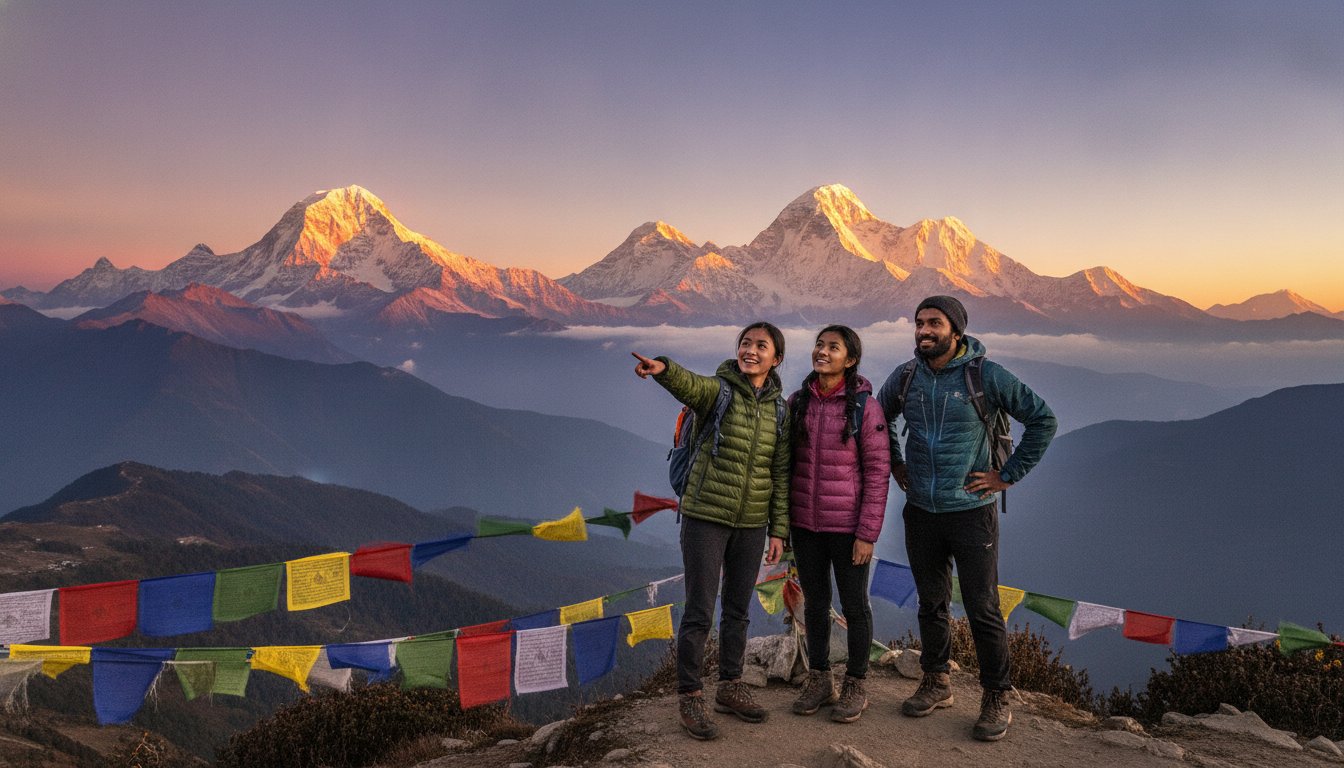
Nepal Trekking for Beginners: 2026 Guide to Mini Treks
What if you could stand amidst the world’s highest peaks without spending months in a gym? Many Singaporeans dream of the Himalayas but feel held back by worries about physical fitness or the complexity of local permits. It’s completely natural to feel anxious about altitude sickness or the logistics of navigating a foreign mountain range. This guide shows you that Nepal trekking for beginners is not only possible but incredibly rewarding when you choose the right path. You’ll discover how to experience a golden sunrise over the Annapurna range without elite-level fitness through our expert-led beginner trekking guide.
Since 1992, our family-owned team has helped travelers bridge the gap between their daily lives in Singapore and the crisp mountain air of Kathmandu. We understand the need for clarity regarding gear and the 2026 digital e-TIMS requirements. This article provides a clear list of easy-to-moderate routes, including the gold-standard 8-day scenic mini trek. We’ll walk you through what a typical day on the trail looks like, from the warmth of a mountain teahouse to the stunning vistas of Ghorepani Poon Hill. Get ready to swap the city skyline for the jagged peaks of the Himalayas with total confidence.
Key Takeaways
- Discover how to master Nepal trekking for beginners by choosing routes with lower maximum altitudes and shorter daily walking times that don’t require elite fitness.
- Identify the top three scenic mini treks, including the gold-standard 8-day itinerary that offers breathtaking Himalayan views with significantly less physical strain.
- Learn the essential three-month training timeline and gear requirements to ensure you arrive in Kathmandu feeling prepared and confident for your first trail.
- Understand why mini treks are the safest entry point for first-timers, featuring easier descent routes and expert-led monitoring for altitude sickness.
- Gain the peace of mind that comes from booking with a family-owned specialist operating since 1992 with dedicated support in both Singapore and Kathmandu.
What is Beginner Trekking in Nepal?
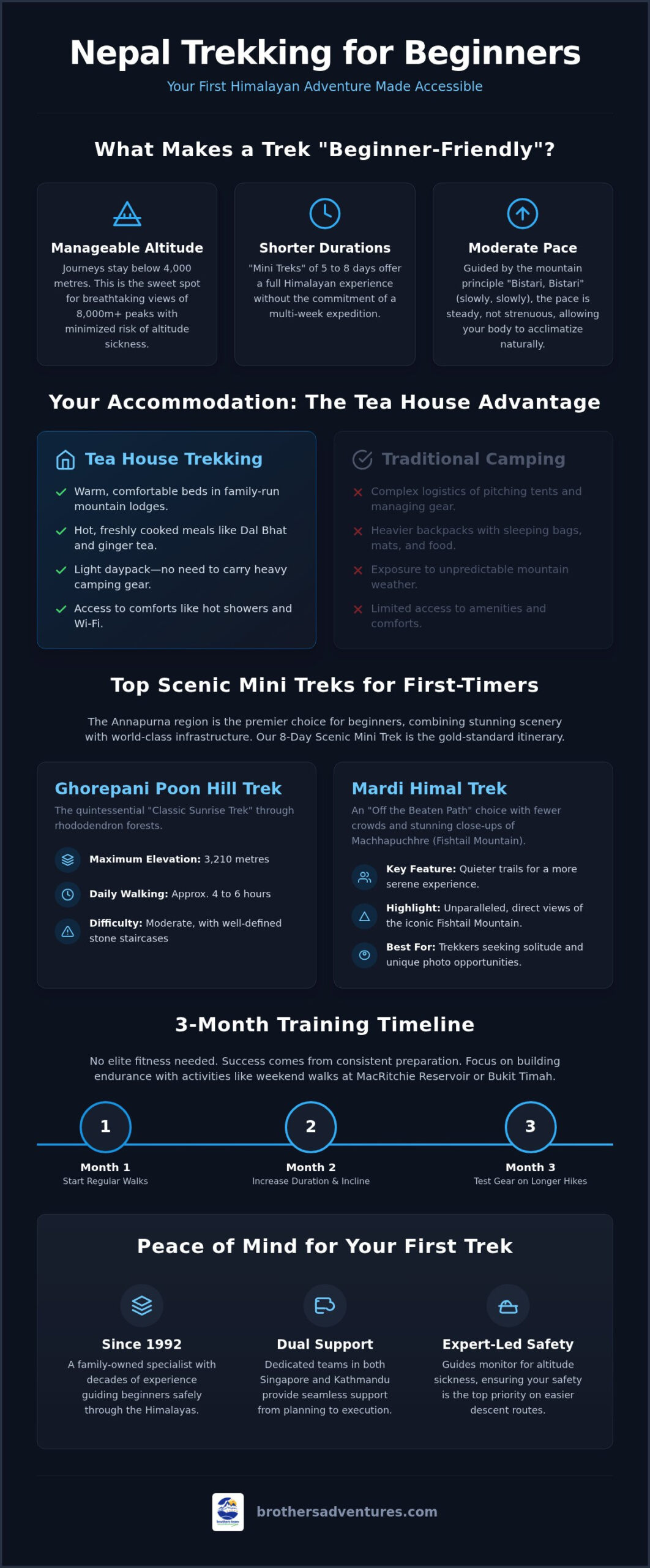
Nepal trekking for beginners is often misunderstood as a grueling ordeal reserved for the ultra-fit. In reality, it’s a spectrum of experiences that allows anyone with a sense of adventure to witness the world’s most iconic peaks. Beginner trekking is a journey staying below 4,000 metres with moderate daily inclines. This specific altitude range is the sweet spot; it’s high enough to offer jaw-dropping views of 8,000-metre giants like Annapurna and Dhaulagiri, yet low enough to minimize the physical strain associated with extreme elevations.
Nepal is uniquely suited for first-timers because of its centuries-old mountain infrastructure. While the Great Himalaya Trail spans the entire length of the country through rugged and remote terrain, beginner routes focus on well-maintained paths that connect vibrant local villages. We often recommend the “Mini Trek” concept for those visiting from Singapore. These itineraries, typically lasting between 5 to 8 days, prioritize maximum scenery without the exhaustion of a multi-week expedition. When you choose Nepal trekking for beginners, you aren’t just walking; you’re entering a living museum of culture and nature at a pace that feels like a holiday rather than a boot camp.
The Myth of the “Elite Athlete” Requirement
You don’t need to be a marathon runner to enjoy the Himalayas. Many of our guests arrive with moderate fitness levels, having spent their weekends walking at MacRitchie Reservoir or Bukit Timah. The secret to success isn’t raw power; it’s the golden rule of the mountains: “Bistari, Bistari,” which means slowly, slowly. Our expert guides manage the group’s energy levels with precision, ensuring the rhythm of the walk matches your breath. We focus on steady progress rather than speed. This approach allows your body to adjust naturally to the changing environment while you focus on the rhythmic crunch of your boots and the crisp mountain air.
Tea House Trekking vs. Camping
For a beginner, tea house trekking is a total game-changer. Forget the complexities of pitching tents in the rain or managing heavy camping gear. Tea houses are charming, family-run mountain lodges that provide a warm bed, hot meals, and a cozy social atmosphere. Imagine finishing a day of walking and stepping into a dining room filled with the scent of fresh ginger tea and steaming dal bhat. These lodges simplify logistics significantly, allowing you to carry a much lighter daypack. Since we’ve been operating since 1992, we’ve hand-selected the best lodges that offer the perfect balance of local authenticity and essential comforts like hot showers and Wi-Fi, making your first mountain trip feel surprisingly civilized.
Top 3 Scenic Mini Treks for Your First Himalayan Journey
Choosing the right trail is the most critical step when planning Nepal trekking for beginners. You want a route that challenges your legs without overwhelming your spirit. The Annapurna region is our premier recommendation for 2026 because it combines world-class mountain infrastructure with scenery that looks like a high-definition postcard. Consider our 8-Day Scenic Nepal Mini Trek as your starting point; it’s designed to give you the full Himalayan experience in a condensed, manageable timeframe.
Ghorepani Poon Hill: The Classic Sunrise Trek
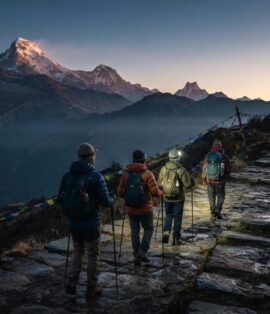
This is the quintessential choice for anyone starting their journey in the mountains. You’ll hike through ancient, moss-covered rhododendron forests to reach the famous Poon Hill viewpoint. The payoff is a 360-degree panorama of the Dhaulagiri and Annapurna ranges bathed in golden morning light. Here is what to expect on this classic route:
- Maximum Elevation: 3,210 metres at the Poon Hill summit
- Daily Walking: Approximately 4 to 6 hours
- Difficulty: Moderate, featuring well-defined stone staircases
While there are plenty of stone steps to navigate, the steady incline is manageable for most Singaporeans who enjoy regular weekend walks. It’s a vibrant, social trail where you’ll meet fellow adventurers from around the globe in cozy tea houses each evening.
Mardi Himal: The “Off the Beaten Path” Beginner Choice
If you prefer a quieter trail with fewer crowds, Mardi Himal is a brilliant alternative to the more famous routes. It offers a stunningly close-up look at Machhapuchhre, the iconic “Fishtail Mountain” that dominates the Pokhara skyline. The trail is narrower and slightly steeper in certain sections, requiring a bit more focus on your footing. However, the sense of solitude and the dramatic ridge-line walks make it a favorite for those seeking a more rugged feel. It’s a fantastic step up for those who want to push their boundaries slightly while still staying within a beginner-friendly framework.
The Royal Trek: Culture-First Exploration
Named after Prince Charles who explored this path in the 1980s, this route is the gentlest option available. It stays at a lower elevation throughout, making it ideal for families or those who prioritize cultural immersion over high peaks. You’ll wander through terraced hillsides, lush valleys, and traditional Gurung villages where life moves at a peaceful pace. Even on these lower-altitude routes, it’s wise to review CDC information on altitude illness to stay informed about how your body reacts to new environments. This trek proves that you don’t need to climb the highest summits to find the heart of Nepal.
Finding your perfect path depends on your personal comfort zone and what you hope to see. Whether you’re chasing that iconic sunrise or a quiet village encounter, our team is ready to guide you every step of the way. Explore the details of our 8-Day Scenic Nepal Mini Trek to see how we’ve curated the perfect introduction to these mountains.
Preparation: Training and Gear for Success
Success in the Himalayas starts long before you land in Kathmandu. It begins with a shift in mindset and a steady commitment to your physical well-being. Preparing for Nepal trekking for beginners isn’t about becoming a world-class athlete; it’s about conditioning your body to enjoy the journey rather than just enduring it. By following a structured approach, you’ll arrive at the trailhead with the stamina to appreciate every mountain vista.
A Realistic 12-Week Training Plan
Give yourself three months to prepare. During the first month, focus on building a consistent base. Aim for three 30-minute walks each week at a brisk pace. In the second month, start introducing inclines. If you’re training in Singapore, head to Bukit Timah Hill or increase the gradient on your treadmill. This is also the time to start wearing your trekking boots during every workout. You want to break them in thoroughly to avoid painful blisters on the trail.
The final month is about specificity. Singapore’s high-rise HDB blocks are perfect training grounds. Spend two sessions a week climbing 20 to 30 flights of stairs while wearing a weighted daypack. This mimics the vertical gain you’ll experience on routes like Ghorepani Poon Hill. Combine this with back-to-back walking days on the weekend to get your legs used to consecutive days of movement. This physical readiness builds the mental grit needed for the mountains.
Essential Gear: The “Big Four” for Beginners
Having the right equipment can make or break your experience. Don’t feel pressured to buy the most expensive professional brands. Focus on fit and functionality instead. Your trekking boots are your most important investment. They should have a sturdy sole and provide excellent ankle support. Ensure there’s a thumb-width of space in the toe box, as your feet will naturally swell at higher altitudes.
Mastering the layering system is your secret weapon against changing mountain weather. Start with a moisture-wicking base layer to keep sweat away from your skin. Add an insulating mid-layer, such as a fleece or down jacket, and finish with a waterproof and windproof outer shell. Your daypack should be comfortable and lightweight, containing only the essentials like water, sunblock, and a camera. For a comprehensive list, see our guide on what to pack for an 8-day Himalayan adventure. We can also advise you on which bulky items are better to rent locally in Kathmandu to save on luggage weight.
Finally, prepare your mind for the simplicity of mountain life. You’ll be trading city noise for the sound of rushing rivers and wind through the pines. Embrace the chance to disconnect from your digital life and reconnect with the raw beauty of nature. This mental openness is what truly turns a trek into a life-changing adventure.
Safety and Altitude: Addressing Beginner Concerns
Anxiety about altitude is the most common hurdle for those exploring Nepal trekking for beginners. It’s a valid concern, yet it shouldn’t stop you from reaching the mountains. Beginner-focused mini treks are inherently safer because they prioritize lower maximum altitudes and offer multiple easy descent routes. Unlike high-altitude expeditions that push the limits of human physiology, these shorter journeys allow your body to adapt comfortably while staying well within safe boundaries.
Recognizing and Managing AMS Symptoms
Acute Mountain Sickness (AMS) can affect anyone, regardless of fitness level. It typically starts with mild symptoms like a slight headache, a bit of dizziness, or a reduced appetite. In our itineraries, we build in gradual elevation gains to give your system time to adjust. We follow the proven “climb high, sleep low” principle, ensuring your overnight stays are at a lower elevation than the highest point you reached that day. On a mini trek, you rarely exceed the “danger zone” for serious altitude issues. Staying hydrated is your best defense; aim for four to five litres of fluid daily to help your blood carry oxygen more efficiently.
The Value of a Professional Guide
A professional guide is far more than a navigator; they are your primary health monitor on the trail. Our team, with heritage dating back to 1992, is trained to spot the subtle signs of altitude distress before they become serious. We use pulse oximeters to check your blood oxygen saturation levels and heart rate every evening during dinner. This data-driven approach removes the guesswork and ensures every member of the group is trekking safely. If a person feels unwell, we have clear emergency protocols in place, ranging from local pony evacuations to coordinated helicopter logistics for immediate descent.
Trusting a specialist with high altitude trekking safety experience means you can focus on the scenery while we manage the risks. We prioritize your well-being above all else, ensuring that your first mountain experience is both breathtaking and secure. If you’re ready to start your journey with a team that puts your safety first, contact our Singapore office to plan your 2026 adventure.
Why Book Your First Trek with Brothers Adventures?
Choosing a partner for your first Himalayan journey is a decision built on trust. Since 1992, Brothers International Tours & Trading Pte Ltd has operated as a family-owned specialist, acting as a reliable bridge between the bustling streets of Singapore and the serene trails of the Himalayas. We don’t just sell tours; we invite you into a heritage of exploration that spans over three decades. For those exploring Nepal trekking for beginners, this depth of experience ensures that every logistical detail, from permit filings to tea house selections, is handled with professional precision and a personal touch.
From Singapore to the Summit: A Seamless Journey
Our unique structure, with dedicated offices in both Singapore and Kathmandu, provides a high-touch experience that large corporations simply can’t match. Before you even board your flight, Brothers International Tours & Trading Pte Ltd hosts personalized pre-trip briefings in Singapore to answer every question about gear, fitness, and local customs. This face-to-face support builds immediate confidence, transforming anxiety into infectious enthusiasm. Once you land, our Kathmandu team takes over, utilizing deep local knowledge to secure the most charming tea house placements with the best views.
Safety remains our absolute priority. By maintaining small group sizes, our guides can provide the personalized attention necessary for effective altitude monitoring. Every guide is part of our extended family, trained to uphold the high standards we’ve established since our founding. We also remain deeply committed to ethical trekking. This means ensuring fair wages for our porters and supporting the local communities that make these mountains so special. When you walk with us, your journey contributes directly to the preservation of Nepalese culture and mountain environments.
Tailored Itineraries for Every Beginner
We recognize that every traveler has a different comfort zone. Our specialized 8-Day Scenic Nepal Mini Trek is the gold standard for first-timers, curated to deliver maximum visual impact with manageable physical effort. If you’re traveling with younger explorers, we offer customized family trek Nepal options that adjust the pace and activities to suit all ages. We also facilitate specialized school and college trips, focusing on safety and educational immersion.
Your Himalayan story is waiting to be written. Don’t let the fear of the unknown hold you back from witnessing the world’s most magnificent landscapes. Whether you’re seeking a quiet cultural escape or a classic sunrise over the peaks, Brothers International Tours & Trading Pte Ltd provides the steady, thorough guidance you expect from an established specialist. Start your adventure today by reaching out to our team; let’s turn your dream of the mountains into a breathtaking reality.
Your Himalayan Story Starts Here
The majestic peaks of Nepal are no longer a distant dream reserved only for elite climbers. By focusing on well-planned mini treks and the right preparation, Nepal trekking for beginners becomes an achievable and life-changing reality. You’ve learned that success on the trail isn’t about speed; it’s about the steady rhythm of your breath and the expert guidance that keeps you safe. From the golden sunrises of Poon Hill to the cozy warmth of a mountain tea house, these experiences are now within your reach.
We invite you to join our family-owned institution, founded in 1992, for a journey defined by heritage and heart. Benefit from our 100% personalized pre-trip planning in Singapore and the security of expert guides trained in specialized AMS safety protocols. Every detail of your 2026 adventure is handled with the care only a seasoned specialist can provide. It’s time to trade the urban skyline for the jagged horizons of the Annapurna range. View our 2026 Beginner-Friendly Nepal Trekking Packages and take your first step toward the summit. The mountains are calling, and we’re ready to lead the way.
Frequently Asked Questions
Do I need prior trekking experience for a Nepal mini trek?
No prior trekking experience is necessary for a Nepal mini trek. These routes are specifically curated for first-time hikers with moderate fitness levels. Our itineraries focus on well-trodden paths and gradual inclines, making them the perfect introduction to the Himalayas. While you should be comfortable walking for several hours, you don’t need any technical climbing skills or previous mountain history to enjoy these breathtaking landscapes safely.
What is the best time of year for a beginner to trek in Nepal?
The best times for a beginner to trek are the spring months from March to May and the autumn window from September to November. During these periods, the weather is stable, the skies are clear, and the temperatures are mild. Spring brings blooming rhododendrons, while autumn offers the crispest mountain views. These windows provide the safest and most comfortable trail conditions for those new to the high-altitude environment.
How much does a beginner Nepal trekking package typically cost?
The cost of Nepal trekking for beginners depends on your chosen route and the level of support you require. For example, a shorter mini trek will have a different budget than a full base camp expedition. These packages typically cover your licensed guide, porters, and teahouse accommodation. We recommend reviewing the inclusions carefully to ensure your flights and permits are accounted for, allowing you to focus entirely on the trail.
Is it safe to trek in Nepal as a solo beginner?
Solo trekking is no longer permitted in major regions like Annapurna and Everest as of 2026. Foreign trekkers must hire a licensed guide for their safety and to comply with local regulations. This change ensures you have expert support for navigation and health monitoring. Booking through a registered agency provides a secure framework, allowing you to focus on the scenery while we manage all safety protocols and logistics.
Will I have access to Wi-Fi and electricity during the trek?
Yes, most teahouses along beginner routes offer Wi-Fi and electricity, though availability can be intermittent. You should expect to pay a small fee, typically around S$3 to S$7, for charging devices or accessing the internet. At higher altitudes, the connection speed may drop. Carrying a portable power bank is a smart strategy to ensure your camera and phone stay charged for those essential mountain photos without relying solely on lodge facilities.
What kind of food is served in the tea houses?
Tea houses serve a surprising variety of hearty meals, with the traditional “Dal Bhat” being the most popular choice. This nutritious platter of lentil soup, rice, and vegetable curry provides the perfect energy for a day of walking. You’ll also find international options like pasta, pancakes, eggs, and even pizza. The menus are designed to be calorie-dense and comforting, ensuring you’re well-fueled for your Himalayan journey every single day.
Do I need a special visa or permit for beginner treks?
You will need a standard tourist visa and specific trekking permits like the digital e-TIMS card and regional conservation area permits. As of 2026, the e-TIMS card costs approximately S$20, while the Annapurna Conservation Area Permit is roughly S$30. These must be obtained through a registered trekking agency. We manage the entire application process for our guests, so you don’t have to worry about navigating local government offices in Kathmandu.
How many hours of walking should I expect per day?
On a typical Nepal trekking for beginners itinerary, you should expect to walk between 4 and 6 hours per day. This pace is designed to be manageable, allowing for plenty of breaks to take photos and enjoy the local culture. We start our days early to take advantage of the clear morning weather, usually arriving at our next teahouse by mid-afternoon. This schedule leaves you with ample time to rest.


Comments are closed