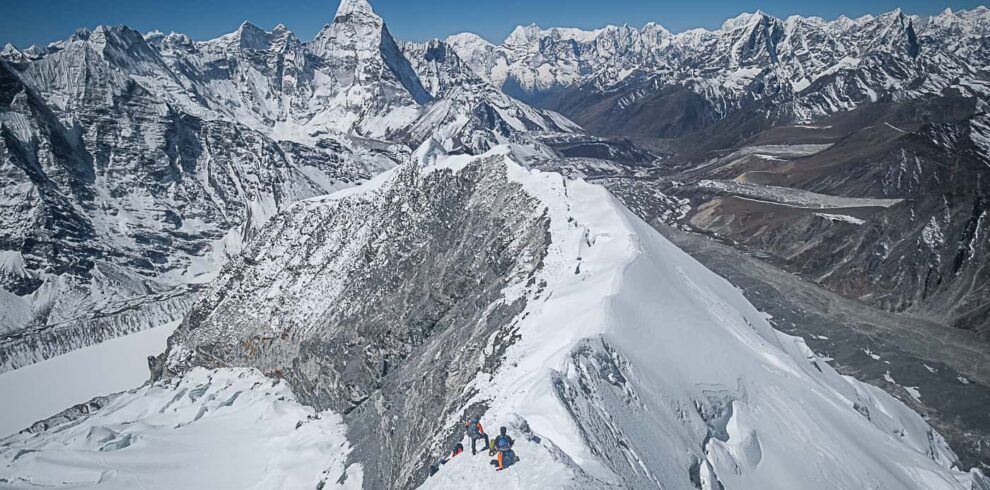
Pisang Peak (Jong Ri) is located in the northern part of Nepal in Manang district. It lies in between Annapurna I and Manaslu. Pisang Peak (6091m) is among the most popular climbing Peaks in Annapurna region as it is famously known as the easy climbing peak. Pisang Peak rises from yak pastures above the village of Pisang in a uniform slope to the final summit pyramid which is an undistinguished snow and ice slope. n 1955, a German expedition was made the first ascent of Pisang peak and since it has been going very popular nowadays.
Considered as an easy climbing peak, Pisang peak provides its climbers an interesting journey passing along varied ecosystems, diverse cultures, and amazing landscapes. Although this climb is considered to be among the easier ones of the Himalayan region, a reasonably high level of physical fitness and health is still strongly recommended. The view from the top – majestic views of the entire Annapurna range — makes it all worth it. Crossing Thorong La pass, the widest pass in the world, after the descent is another highlight of the this climbing trip.
Overview
The 21 Days Pisang Peak Climbing with Annapurna Circuit Trek is an exciting high-altitude adventure combining the legendary Annapurna Circuit with the ascent of Pisang Peak (6,091m). The journey passes through traditional Himalayan villages, lush valleys, pine forests and dramatic alpine landscapes, offering magnificent views of Annapurna II, Annapurna III, Annapurna IV, Gangapurna, Tilicho Peak and Manaslu.
After acclimatisation and climbing preparation in the Manang region, experienced climbing guides will lead you towards the summit of Pisang Peak. The adventure continues across the renowned Thorong La Pass (5,416m) before descending to sacred Muktinath and the beautiful Mustang region.
Designed for physically fit and adventurous travellers, this challenging Nepal climbing expedition offers an unforgettable combination of trekking, mountaineering, cultural discovery and spectacular Himalayan scenery. Previous high-altitude trekking experience and basic climbing skills are highly recommended.
Highlights: 21 Days Pisang Peak Climbing with Annapurna Circuit Trek
- Climb one of the most popular trekking peaks at 6091m/19983ft
- Cross a challenging Thorong La Pass 5416m/17764ft
- Explore the rich Buddhist culture, Himalayan villages with the breathtaking landscapes and stunning views of mountains on the Trans-Himalayan route.
- Enjoy a Scenic adventure flight: Jomsom-Pokhara
- Enjoy breathtaking views of Annapurna II, Annapurna III, Annapurna IV, Gangapurna, Tilicho Peak, Chulu East and Manaslu.
- Explore traditional Himalayan settlements, including Chame, Upper Pisang, Manang and Muktinath.
- Experience changing landscapes—from subtropical valleys and pine forests to high-altitude deserts and glaciers.
- Acclimatise in the beautiful mountain village of Manang.
- Receive essential climbing instruction and practise using ropes, crampons and ice axes.
- Visit the sacred Muktinath Temple, an important pilgrimage destination for Hindus and Buddhists.
- Receive essential climbing instruction and practise using ropes, crampons and ice axes.
Itinerary
21 Days Pisang Peak Climbing with Annapurna Circuit Trek, combining one of Nepal’s most scenic trekking routes with an exciting Himalayan climbing adventure. The journey follows the legendary Annapurna Circuit through lush valleys, traditional villages, alpine landscapes and dramatic mountain terrain.
Trek through Besisahar, Chame, Upper Pisang and Manang, enjoying spectacular views of Annapurna II, Annapurna III, Annapurna IV, Gangapurna, Tilicho Peak and Manaslu. After proper acclimatisation and climbing preparation, ascend Pisang Peak (6,091m) with the support of experienced climbing guides. The summit rewards climbers with breathtaking panoramic views across the Annapurna and Manaslu ranges.
Continue across the famous Thorong La Pass (5,416m), one of the world’s highest trekking passes, before descending to sacred Muktinath and beautiful Jomsom in the Mustang region.
Ideal for physically fit trekkers with an adventurous spirit, this Pisang Peak climbing package in Nepal offers the perfect combination of trekking, mountaineering, cultural discovery and magnificent Himalayan scenery. Previous high-altitude trekking experience and basic climbing knowledge are recommended for this challenging yet rewarding expedition.
Upon your arrival in Kathmandu, Brothers Team representative will be there at Tribhuvan International Airport, waiting for you to greet and meet. He will pick you up and drive you all the way to hotel where you will freshen up. After a short rest, trek/ climbing leader will brief you about the peak climbing and trekking. In the evening, a welcome dinner at nearby restaurant.
After early breakfast, we will head out a full day guided tour of Kathmandu Valley whereby we will visit the UNESCO enlisted cultural heritage sites of Boudhanath, Swayambhunath and Durbar Squares of Kathmandu, and Patan. Late afternoon is for final preparation, some shopping and rest before embarking on a long journey the next day.
After breakfast, we leave Kathmandu for our journey to Annapurna region. Drive by a jeep to Beshishahar through the beautiful Nepalese countryside. Beshishahar is a big town and district headquarters of Lamjung district, explore the surrounding area and overnight at the hotel.
After breakfast, we will begin our trek from Beshishahar with nice view of snowcapped mountain and peak 29 (Ngadi Chuli) and crossing some local wooden & bamboo bridges to reach Bhulbhule. It then continues to Ngadi village for lunch passing through waterfall along the river bank before reaching at Bahundanda for overnight. This is nice village on a top of hill and you may have chance to explore the evening time to local village and around the school areas.
After a breakfast the trek descends to Syange village crossing fields and local villages, a short downhill walk brings you to Syange village. Six-hours long walk through the Eden-like aura of inclined cliffs, mark woods, and few scattered settlements wind up at the bridge in Marshayngdi River crossing which we will pass through Jagat to Chamje. Overnight at local lodge.
From Chamje a short walk brings to a suspension bridge over the raging Marshyangdi river, after crossing the bridge it’s another steep climb for another 2-3 hours till Tal, the village is situated on the gorge-valley by the side of the river Marshyangdi and decorated with beautiful waterfall & sandy spread river. Further trek follows the upstream up to the Dharapani, which is through the rocky trails and crossing few suspension bridges and small teashops bring you at quite large village at Dharapani for the overnight at hotel.
We continue our trek further to Chame. From where changing the vegetation, people and the landscapes changes and the air will get cooler, the trail then climb through pine forests to Bagarchhap, the first village on the trek with typical Tibetan architecture. After a pleasant walk to Bagarchhap, the altitude slowly gains as we come at Danaque and to the alpine region passing through farm, orchards and beautiful pine forest with views of towering peaks of Lamjung and Annapurna II, the trail follows the river Marshyangdi upstream passing by the villages of Latamanang and Koto. After half an hour brings you at Chame, the headquarters of Manang district with grand view of Annapurna II. Overnight in a hotel.
The trails leads from the other side of the river on the northern bank passes through pine woods and small villages with few ups and downs till you reach the orchard village of Bhartang for apple garden. We continue on the gradual path up to a bridge, from the bridge a short steep climb through the pine forest brings you at the top of the ridge of Dhukur Pokhari for the lunch. After walking out of the tree line a great view of Pisang peak on the north and the Chulu peak can be seen with Pisang village below you, from this top a gentle descent for an hour brings you to windswept village of Pisang for overnight. Evening visit upper Pisang for the Tibetan style of houses and monastery with panoramic view of the Annapurna range and valley.
Acclimatization is a must to synchronize your body with the high altitude atmosphere. We will take a short tour around Upper Pisang.Great views of surrounding high peaks including Annapurna, Gangapurna and Tilicho can be seen from this point. Eating fruits, soup and drinking plenty of water is recommended.
Taking a casual stroll uphill through the sparse woods, we will be arriving at a meadow of the green lush vegetation of Kharka where Himalayan Yak and Thar can be spotted grazing which seamlessly fits as the Basecamp for Pisang Peak. Overnight at tented camp.
The next day, we will trek up to Pisang Peak High Camp located at 5400m altitude. Thorough study about the features is advisable prior to trekking towards Pisang Peak High Camp as it can be tricky at some parts especially due to being snowy and thus slimy. South Western ridge is considered best for mounting. After reaching there, we will quickly set up our camp and make necessary arrangements for climbing equipment and check if everyone is properly acclimatized for climbing the summit tomorrow.
Today we will start early, fully acclimatized and properly equipped we head out for climbing the summit of Pisang Peak. Leaving our high camp, we will climb a well-defined ridge and then head towards the final snow slope which is steep and more technical. Following the guidance of our best climbing experts and making proper use of ropes, ice axes and other climbing equipment we head towards the summit of Pisang Peak. Once at the top of the summit of Pisang Peak, we are rewarded with stunning views of Annapurna Himalayan Ranges including Tilicho Peak and Glacier Dome. After successfully achieving the summit, we head back to reach the Base Camp.
After successful ascent of Pisang Peak, we will follow the trail that heads towards and through Pisang village. From there we will continue our trekking across the riverside with magnificent views of surrounding high peaks to reach Manag Valley. Manang is well known for its rich customs and traditions. Here, we will have a chance to experience the traditional lifestyle of the local Manangi people.
Leaving Manang, we will follow the trail that turns north and then climb a stone wall with a gate that stops domesticated livestock from leaving the grazing grounds of high pastures. From there we will gradually descend towards a suspension bridge over the Ghyanchang Khola where we will find a couple of tea shops. From here an hour’s moderate walking will lead us towards Yak Kharka.
We start our trek with slow and own pace to get to Phedi. We still have same amazing view of mountains and landscapes. After an hour walk we'll reach at Ledar and continue to climb along the east bank of Jorsang Khola, then descend and cross the stream on a wooden bridge to get to a small tea shop. We stop for wonderful view and tea break, we follow a narrow path across a high, unstable slope before heading to Thorong Phedi for the overnight. Phedi, which means ‘foot of the hill’, is a common Nepali name for any settlement at the bottom of a long climb.
Today, we will start early for the crossing of the challenging Thorong La Pass, to avoid the strong winds at the pass after midday. We will climb steeply up towards a watercourse before climbing through another large gully formed by the melt of Thorong Peak. From there we will continue climbing across undulating moraine towards the top of the Thorong Pass. Once at the top we will have great views of Annapurna Mountain Ranges to the south and Mukut Himal bordering Dolpo to the west. From the top, we will descend steeply towards the grassy meadows and further to a very important pilgrimage site for Hindus and Buddhists – Muktinath.
From Muktinath, we will follow the trail that leads to Jharkot. From here we will avoid the motor road by following a small irrigation stream to reach Khingar, but from here onwards we will have to follow the road route that will lead us all the way to Jomsom. Jomsom is the main administrative centre and headquarters of Mustang. After arriving at Jomsom, we will celebrate the completion of our trek and climb of Pisang Peak. Overnight at hotel.
We take an early morning scenic flight from Jomsom to Pokhara. Pokhara is home to thick forest, emerald lakes and a place of remarkable natural beauty. The reflection of the Machhapuchre (Fish-Tail) Himal over the serene Fewa Lake makes this place truly magical. Besides, visiting sacred places and sightseeing around the city in Pokhara could be a good way to spend your day.
After breakfast, we start our drive back to Kathmandu. It takes approximately six to seven hours drive to reach Kathmandu from Pokhara. We drive over the Prithvi Highway which offers scenic hilly zigzag roads while driving along the banks of Trishuli River. The daily activities of the local people can be seen along the road when we pass through numerous villages and towns before finally arriving back to Kathmandu.
You would surely like to see as much of Kathmandu as possible. An early start is practical to visit the temples of Kathmandu. Also, walking around the shopping area of Thamel is worth spending quality time at Kathmandu. It is also good time for some shopping of souvenirs and gifts back home.
Brothers Team representative will help to transfer to the airport for your scheduled international flight.
Cost $3880
The Cost Includes
- Air port pick up and drop off
- Hotel accommodation in Kathmandu & Pokhara on BB plan
- All meals during trek & climbing
- Best available teahouse accommodation during trek
- All necessary ground transportation as per itinerary in Nepal.
- Trekking/ climbing peak permit/s & entrance fees
- Necessary climbing gear & equipment,
- Trekking/Climbing Guide (English speaking, First Aid trained) & Sherpa helpers
- Exclusive medical kit bag
- All government and local taxes
The Cost Excludes
- Air ticket SIN-KTM-SIN,Nepal visa fee,personal travel insurance
- Drinks (alcoholic and cold drinks),Personal expenses
- Lunch and dinner in Kathmandu and Pokhara
- Personal climbing equipment
- Tips for Guide, Sherpas & Porters
FAQs: 21 Days Pisang Peak Climbing with Annapurna Circuit Trek
Pisang Peak rises to 6,091 metres (19,984 feet) above sea level and offers outstanding views of the Annapurna, Manaslu and Chulu mountain ranges.
The climb is considered challenging and physically demanding. It involves high-altitude trekking, steep snow or ice sections and the use of climbing equipment. Excellent fitness, preparation and a positive attitude are essential.
Previous high-altitude trekking and basic mountaineering experience are strongly recommended. Your climbing guide will provide training in using crampons, ropes, harnesses, an ice axe and other essential equipment.
The highest point is the summit of Pisang Peak at 6,091 metres. The trek also crosses Thorong La Pass at 5,416 metres.
The best seasons are spring from March to May and autumn from September to November, when the weather is generally more stable and mountain visibility is clearer
You should have excellent cardiovascular fitness, strong endurance and the ability to walk for approximately six to eight hours daily over steep and uneven terrain. Summit day may be considerably longer.
The journey normally requires an Annapurna Conservation Area Permit, a TIMS card and a Pisang Peak climbing permit. Additional local or administrative documents may also be required. The trekking company usually arranges these permits.
Yes. The itinerary includes gradual altitude gain and acclimatisation time around Manang and the Pisang Peak area. However, travellers must still monitor themselves for symptoms of altitude sickness.
Accommodation is generally provided in hotels in Kathmandu and Pokhara, local teahouses during the Annapurna Circuit Trek and tented camps during the Pisang Peak climbing section.
Teahouses serve meals such as rice, noodles, pasta, soup, vegetables, eggs and local dishes. During the climbing section, the support team normally prepares nutritious high-altitude meals
Essential equipment includes mountaineering boots, crampons, a climbing harness, helmet, ice axe, ropes, carabiners, ascender, descender and suitable high-altitude clothing. A detailed packing list will be provided before departure.
Yes. Comprehensive travel insurance is essential and should cover trekking and mountaineering above 6,000 metres, emergency medical treatment, helicopter evacuation, trip cancellation and lost baggage.
The guide will assess the symptoms and may recommend rest, descent or evacuation. Travellers should never continue ascending with serious symptoms. Emergency helicopter evacuation may be arranged when required and subject to weather conditions.
Summit day can take approximately 10 to 14 hours, depending on the route, snow conditions, weather, group pace and location of the high camp.
Very fit beginners with strong trekking experience may attempt the climb after proper training and preparation. However, previous experience at altitude and familiarity with basic mountaineering techniques are strongly recommended.
Mobile coverage and Wi-Fi are available in some lower villages, but the connection becomes limited or unavailable at higher elevations and near Pisang Peak.
Charging facilities are available at many teahouses for an additional fee. Electricity may be limited at higher elevations, so carrying a power bank is recommended.
This combination provides gradual acclimatisation, diverse Himalayan landscapes, traditional mountain culture, the thrill of a 6,091-metre summit and the opportunity to cross the renowned Thorong La Pass in one remarkable expedition.